English translation
Simple implementation example of a Conditional VAE
AI Article Decision Snapshot
Turn the lesson into workflow, model, budget, and security checks before choosing tools.
Use this quick snapshot before leaving the article. It keeps the next search tied to practical AI software, model/API, cost, privacy, and implementation questions.
Workflow fit
Identify the real job behind the article: coding, research, document review, support, analytics, content, or internal automation.
Model or tool decision
Decide whether the next step is a software shortlist, an AI tool comparison, an API platform choice, or a model benchmark.
Budget and usage signal
Estimate seats, API calls, prompt volume, retries, review time, and fallback work before assuming the workflow is cheap.
Security and privacy review
Check whether source code, customer data, private documents, prompts, logs, or embeddings will enter the AI workflow.
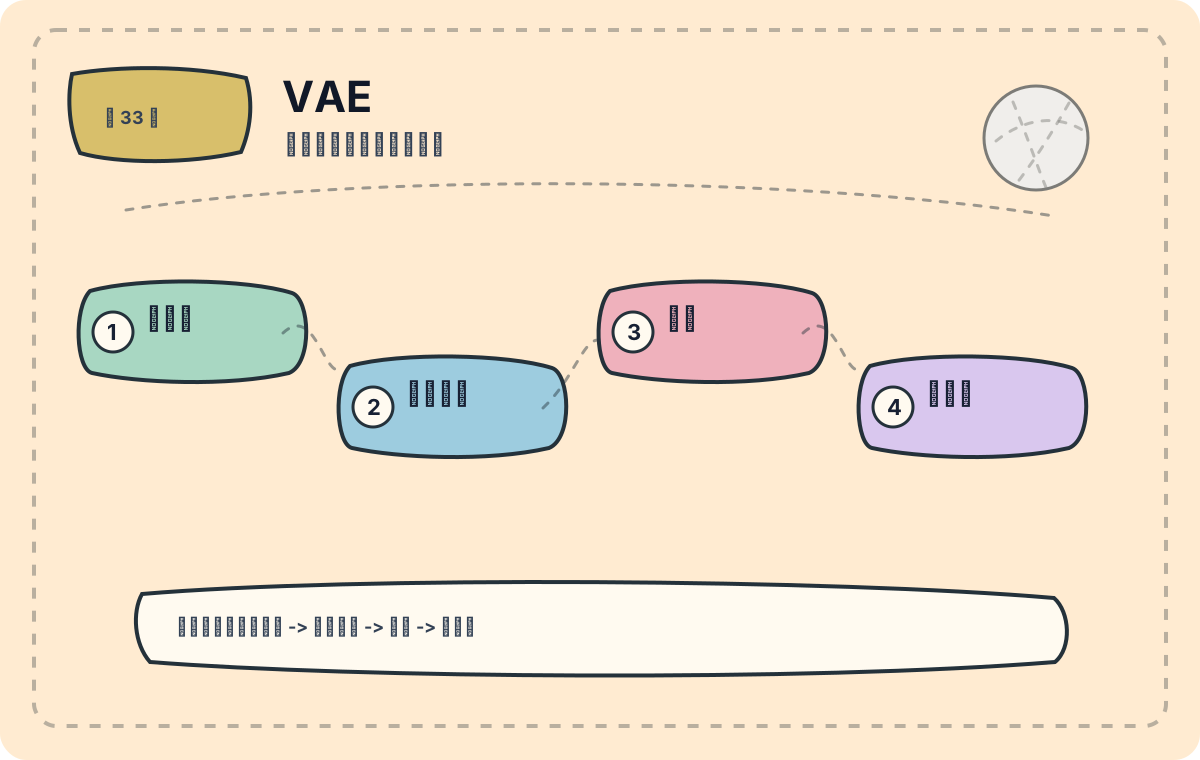
VAEs do not merely compress images—they learn a latent space that is amenable to sampling. Reconstruction quality and latent-space regularity must be evaluated jointly. This article focuses on architecture. First, clearly map out the data flow, key modules, and output layers; only then revisit the underlying formulas or implementation code.
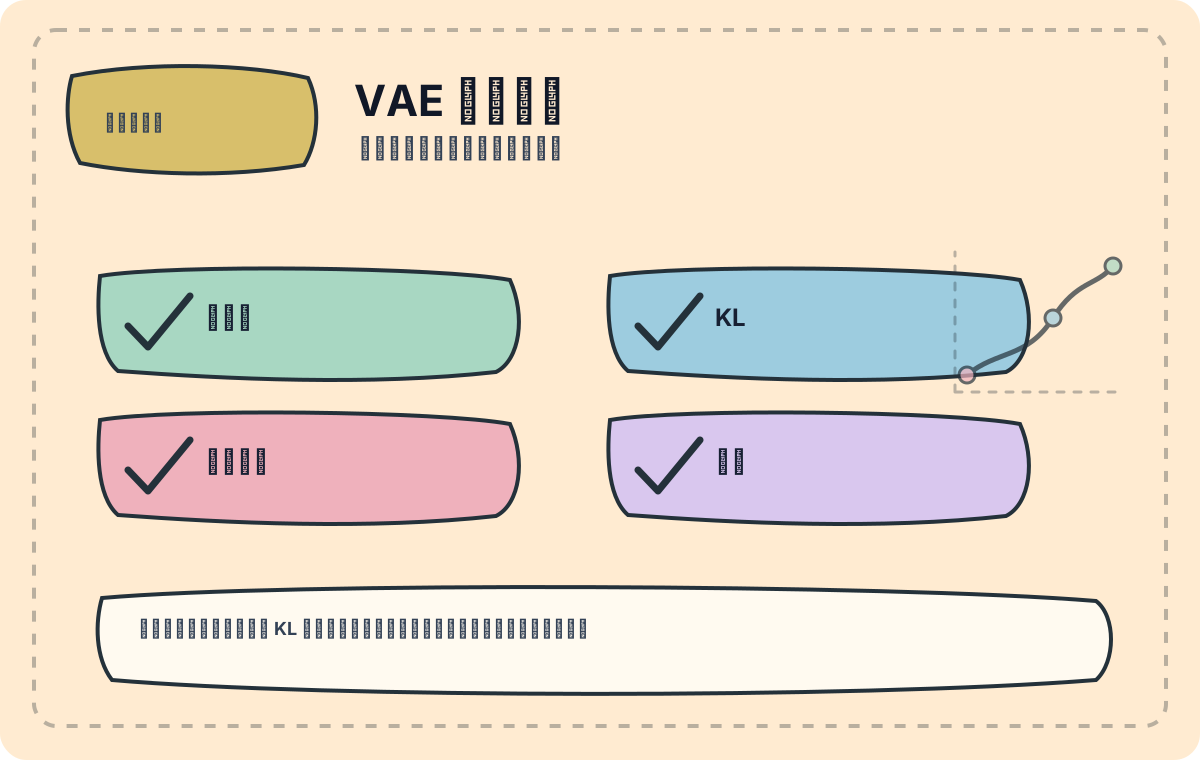
I will monitor both reconstruction error and the KL term simultaneously—to prevent the model from either simply copying inputs or generating completely divergent outputs.
In the previous article, we compared and discussed SegNet, analyzing its application and performance in image segmentation tasks. This article shifts focus to improved architectures of Variational Autoencoders (VAEs)—a class of generative models widely used in unsupervised learning, especially for synthesizing images and other complex data. We’ll introduce several state-of-the-art architectural enhancements and illustrate their practical applications.
1. Core Concepts of Variational Autoencoders
A Variational Autoencoder consists of an encoder, a decoder, and a regularization term derived from variational inference. Its central idea is to introduce latent variables so that generated samples better capture the underlying data distribution. Specifically, VAEs are trained by maximizing the Evidence Lower Bound (ELBO).
Given a set of observed data , the joint probability with latent variable is defined as:
Our goal is to learn the generative process by maximizing the log marginal likelihood.
2. Motivation and Objectives Behind Architectural Improvements
Traditional VAEs often face limitations in generation tasks due to strong assumptions about the latent space—e.g., insufficient sharpness, realism, or diversity in generated images. To address these issues, researchers have proposed various architectural improvements aimed at enhancing sample fidelity and generative capability.
2.1 Structural Transformations
In standard VAEs, the encoder outputs the mean and variance of the latent distribution, followed by sampling via the reparameterization trick. Some recent works incorporate more sophisticated manifold-learning techniques—adjusting how the latent space is constructed—to increase modeling flexibility. For instance, Normalizing Flows extend the expressiveness of the latent distribution, thereby improving image-generation quality.
2.2 Conditional Generation
The Conditional Variational Autoencoder (CVAE) is a widely adopted improvement: it augments the generation process with auxiliary conditional information (e.g., class labels). This enables precise control over outputs—crucial for tasks requiring label-specific synthesis, such as generating images of particular styles or categories.
# Simple implementation example of a Conditional VAE
import torch
import torch.nn as nn

class ConditionalVAE(nn.Module):
    def __init__(self, input_dim, latent_dim, num_classes):
        super(ConditionalVAE, self).__init__()
        self.encoder = nn.Sequential(
            nn.Linear(input_dim + num_classes, 128),
            nn.ReLU(),
            nn.Linear(128, 2 * latent_dim)  # Outputs mean and log-variance
        )
        self.decoder = nn.Sequential(
            nn.Linear(latent_dim + num_classes, 128),
            nn.ReLU(),
            nn.Linear(128, input_dim),
            nn.Sigmoid()
        )

    def encode(self, x, c):
        h = torch.cat((x, c), dim=1)
        z_params = self.encoder(h)
        mu, logvar = z_params.chunk(2, dim=1)  # Split into mean and log-variance
        return mu, logvar

    def reparameterize(self, mu, logvar):
        std = torch.exp(0.5 * logvar)
        eps = torch.randn_like(std)
        return mu + eps * std

    def decode(self, z, c):
        h = torch.cat((z, c), dim=1)
        return self.decoder(h)
3. Practical Case Study: Image Generation
To validate the effectiveness of these improved architectures, consider a concrete example: image generation using the CIFAR-10 dataset. With a Conditional VAE, we can synthesize images conditioned on specific class labels.
3.1 Data Preparation
We preprocess the CIFAR-10 dataset and feed class labels as conditional inputs:

While reading this article, treat the sequence “Core VAE Concepts → Motivation & Goals of Improvements → Structural Transformations → Conditional Generation” as a verification checklist: first align the object, steps, and evidence; then cross-check against case studies, code, or evaluation metrics.
from torchvision import datasets, transforms
from torch.utils.data import DataLoader

transform = transforms.Compose([
    transforms.ToTensor(),
    transforms.Normalize((0.5,), (0.5,))
])

cifar10_dataset = datasets.CIFAR10(root='./data', train=True, download=True, transform=transform)
data_loader = DataLoader(cifar10_dataset, batch_size=64, shuffle=True)
3.2 Training Procedure
During training, we jointly optimize the model using both KL divergence and reconstruction loss:
After reading “Improved Architectures of Variational Autoencoders”, don’t stop at “I understand.” Instead, pick one step and implement it yourself—then document where you get stuck. This hands-on reflection makes subsequent learning more robust.
import torch.optim as optim

def loss_function(recon_x, x, mu, logvar):
    BCE = nn.functional.binary_cross_entropy(recon_x, x, reduction='sum')
    KLD = -0.5 * torch.sum(1 + logvar - mu.pow(2) - logvar.exp())
    return BCE + KLD

# Initialize model and optimizer
model = ConditionalVAE(input_dim=3072, latent_dim=32, num_classes=10).to(device)
optimizer = optim.Adam(model.parameters(), lr=1e-3)

# Training loop
for epoch in range(num_epochs):
    model.train()
    for data, labels in data_loader:
        optimizer.zero_grad()
        mu, logvar = model.encode(data.view(-1, 3072).to(device), labels.to(device))
        z = model.reparameterize(mu, logvar)
        recon_batch = model.decode(z, labels.to(device))
        loss = loss_function(recon_batch, data.view(-1, 3072).to(device), mu, logvar)
        loss.backward()
        optimizer.step()
When reviewing “Improved Architectures of Variational Autoencoders”, place key concepts, procedural steps, and observable outcomes side-by-side on a single page for efficient recall.
When practicing “Improved Architectures of Variational Autoencoders”, explicitly write down the input conditions, processing actions, and observable results together—making future review faster and more actionable.
4. Summary
In this article, we thoroughly examined improved architectures of Variational Autoencoders—with special emphasis on Conditional VAEs (CVAEs) and their application in image generation. By incorporating conditional signals and richer latent-space representations, VAEs achieve substantial gains in both visual quality and diversity of generated outputs.
In the next article, we’ll delve into training techniques for Variational Autoencoders, exploring how refined training strategies—including advanced optimization, scheduling, and regularization—can further boost model performance. Stay tuned!
Apply This Lesson
Turn this article into AI software, model, API, and security decisions.
English Article FAQ
Use this article as evidence before choosing AI tools
How should I use this AI Tutorials article?
Use it as the implementation or learning layer, then connect the idea to AI software buyer guides, tool comparisons, benchmarks, API choices, and security checks before making a production decision.
Is this English article different from the Chinese original?
The English edition is localized for global AI readers while preserving the original diagrams, screenshots, prompts, code examples, and source context from the Chinese article.
What should I read after Simple implementation example of a Conditional VAE?
Continue with AI Software Buyer Guides, AI Tools Workbench, Best AI Coding Agents, AI Model Benchmarks, OpenAI vs Anthropic API, or LLM Security Tools depending on the decision you need to make.
Can this article alone choose an AI product or model?
No. Treat the article as evidence and context, then validate fit with pricing, privacy requirements, integration effort, benchmark results, workflow tests, and fallback planning.
Continue