English translation
Apply data augmentation
AI Article Decision Snapshot
Turn the lesson into workflow, model, budget, and security checks before choosing tools.
Use this quick snapshot before leaving the article. It keeps the next search tied to practical AI software, model/API, cost, privacy, and implementation questions.
Workflow fit
Identify the real job behind the article: coding, research, document review, support, analytics, content, or internal automation.
Model or tool decision
Decide whether the next step is a software shortlist, an AI tool comparison, an API platform choice, or a model benchmark.
Budget and usage signal
Estimate seats, API calls, prompt volume, retries, review time, and fallback work before assuming the workflow is cheap.
Security and privacy review
Check whether source code, customer data, private documents, prompts, logs, or embeddings will enter the AI workflow.
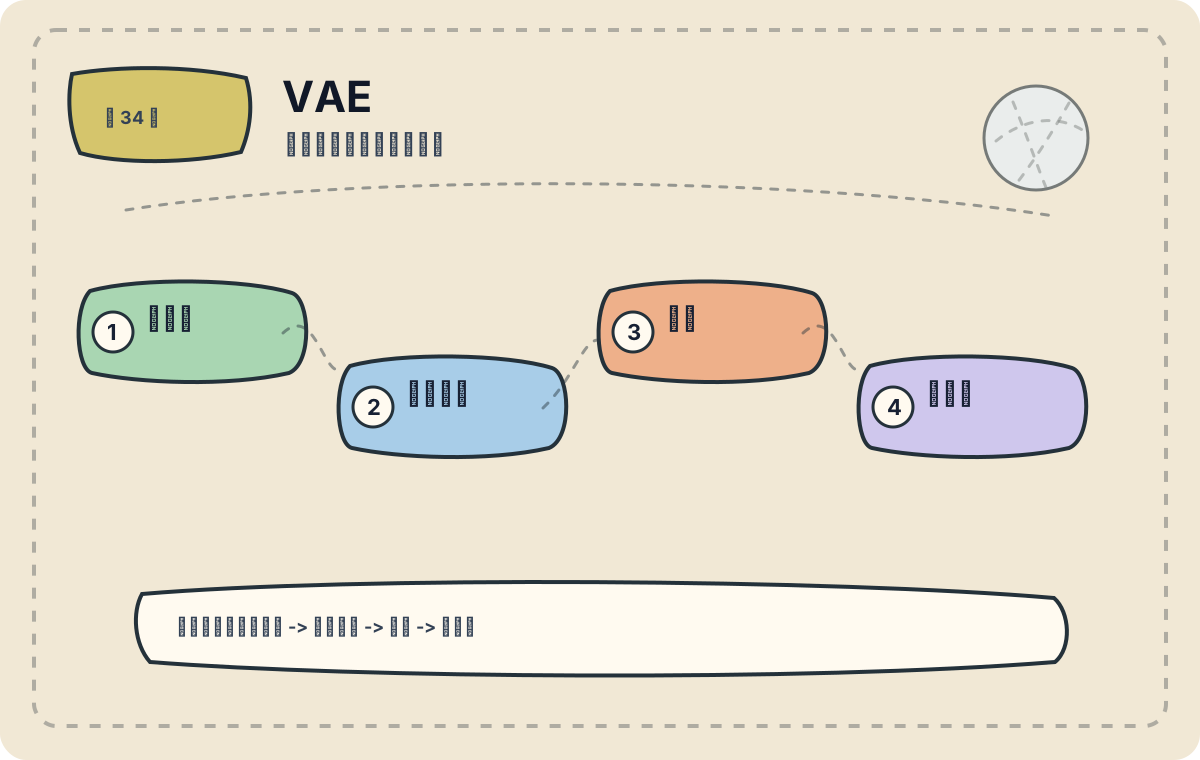
VAEs do not merely compress images—they learn a latent space that is both meaningful and sampleable. Reconstruction quality and latent-space regularity must be evaluated jointly. This article focuses on training: data preprocessing, loss design, optimizer selection, and logging must form a closed, traceable loop—only then can training outcomes be rigorously analyzed and reproduced.
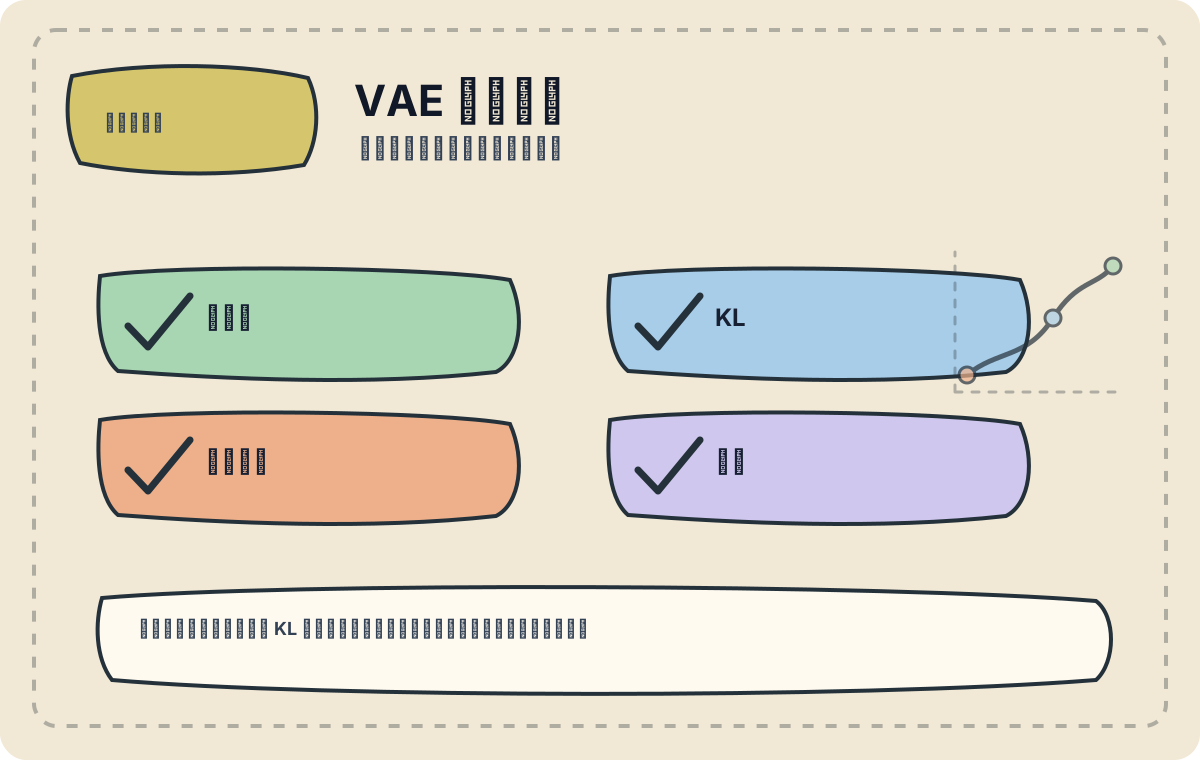
I always log both reconstruction error and the KL term to prevent the model from either simply copying inputs (mode collapse) or generating completely divergent, incoherent outputs.
In the previous article, we explored architectural improvements to Variational Autoencoders (VAEs), including their advantages in generative modeling and recent variants. In this article, we shift focus to practical training techniques, enabling robust, efficient VAE training and high-fidelity generation.
1. Data Preprocessing and Normalization
Preprocessing is critical before training a VAE. Below are key practices:
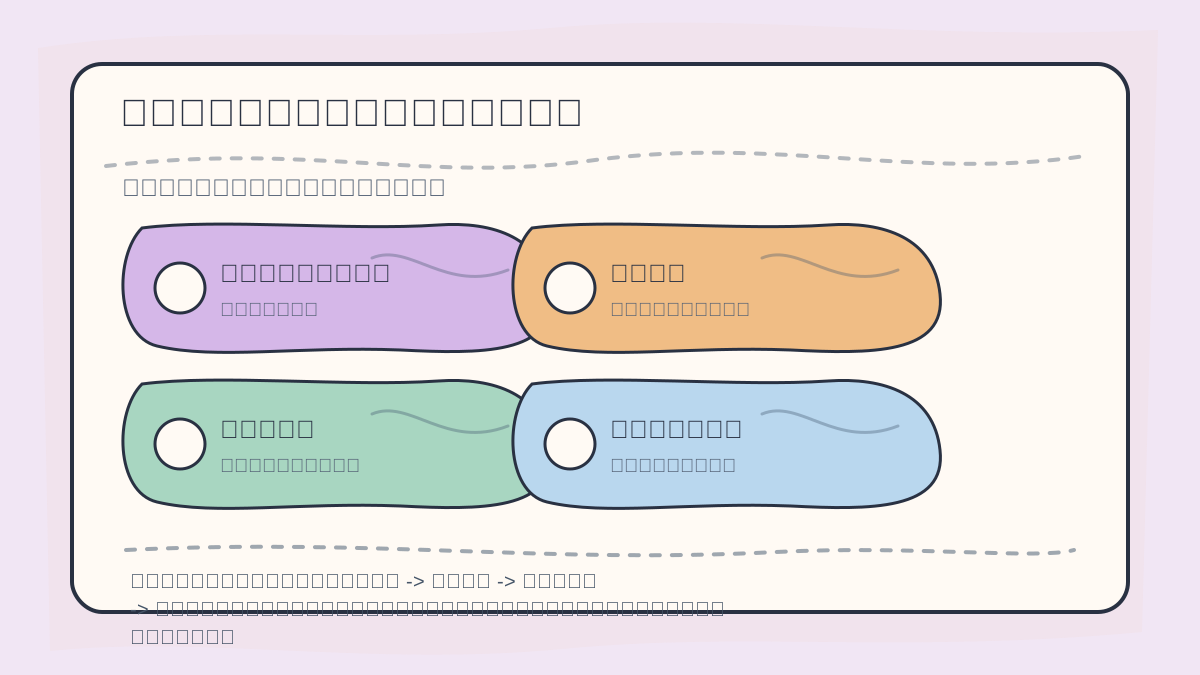
While reading this article, treat the sequence “Data Preprocessing & Normalization → Example Code → Learning Rate Scheduling → Loss Balancing” as an integrated verification checklist: first align the objects, steps, and evidence; then revisit concrete examples, code snippets, or metrics for validation.
- Normalization: Scale input data into the range or , which accelerates convergence.
- Data Augmentation: Increase dataset diversity via rotation, flipping, scaling, etc., to mitigate overfitting.
Example Code
import numpy as np
from keras.preprocessing.image import ImageDataGenerator

# Apply data augmentation
datagen = ImageDataGenerator(
    rotation_range=20,
    width_shift_range=0.2,
    height_shift_range=0.2,
    shear_range=0.2,
    zoom_range=0.2,
    horizontal_flip=True,
    fill_mode='nearest'
)

# Fit generator to training data
datagen.fit(train_images)
2. Learning Rate Scheduling
Learning rate choice profoundly impacts final model performance—especially in deep neural networks. Consider these strategies:
When reading “Training Techniques for Variational Autoencoders”, first examine the task, concepts, exercises, and decision points illustrated in the accompanying figures—then return to the main text to fill in technical details. This approach helps you quickly assess where and how this content applies to real-world scenarios.
- Learning Rate Decay: Gradually reduce the learning rate during training to enable finer-grained convergence near the optimum.
- Adaptive Optimizers: Use algorithms like
AdamorRMSprop, which automatically adjust per-parameter learning rates.
3. Balancing the Loss Function
A VAE’s total loss comprises two core components: reconstruction loss and KL divergence loss. Properly balancing their relative weights is essential:
Tune hyperparameters governing this trade-off to match your specific dataset and downstream goals.
Example Code
from keras.losses import MeanSquaredError
import keras.backend as K

def vae_loss(x, x_decoded_mean):
    recon_loss = MeanSquaredError()(x, x_decoded_mean)
    kl_loss = -0.5 * K.sum(1 + z_log_var - K.square(z_mean) - K.exp(z_log_var), axis=-1)
    return K.mean(recon_loss + kl_loss)
4. Momentum and Batch Normalization
Momentum improves training stability, while batch normalization stabilizes layer-wise input distributions—both accelerate convergence. Batch normalization is especially beneficial for deeper architectures.
Example Code
from keras.layers import BatchNormalization, Dense, Input
from keras.models import Model

inputs = Input(shape=(original_dim,))
x = Dense(intermediate_dim, activation='relu')(inputs)
x = BatchNormalization()(x)  # Apply batch normalization
z_mean = Dense(latent_dim)(x)
z_log_var = Dense(latent_dim)(x)
5. Early Stopping and Model Checkpointing
Apply early stopping to monitor validation loss and halt training before overfitting occurs. Simultaneously, save the best-performing model checkpoint for final evaluation.
Example Code
from keras.callbacks import EarlyStopping, ModelCheckpoint

early_stopping = EarlyStopping(monitor='val_loss', patience=5)
model_checkpoint = ModelCheckpoint('vae_best_model.h5', save_best_only=True)

model.fit(train_data,
          epochs=100,
          batch_size=32,
          validation_data=(val_data),
          callbacks=[early_stopping, model_checkpoint])
6. Empirical Insights and Case Study
Generating handwritten digits (e.g., MNIST) remains a canonical VAE benchmark. Applying all the above techniques consistently improves digit fidelity, training stability, and convergence speed.
To apply “Training Techniques for Variational Autoencoders” to your own task, start small—validate just one critical decision point in isolation.
After studying “Training Techniques for Variational Autoencoders”, try adapting it to one of your own projects—and specifically observe whether inputs, internal processing, and outputs remain meaningfully aligned.
Demonstrated Results
An optimized VAE produces high-quality reconstructions like those shown below:
# Generate and visualize results
import matplotlib.pyplot as plt

decoded_images = vae.predict(test_data)
n = 10  # Display 10 samples
plt.figure(figsize=(20, 4))
for i in range(n):
    # Original image
    ax = plt.subplot(2, n, i + 1)
    plt.imshow(test_data[i].reshape(28, 28))
    plt.gray()
    ax.axis('off')

    # Reconstructed image
    ax = plt.subplot(2, n, i + 1 + n)
    plt.imshow(decoded_images[i].reshape(28, 28))
    plt.gray()
    ax.axis('off')
plt.show()
By applying the training techniques outlined here, you can significantly enhance VAE performance and generate high-fidelity, diverse samples. Next, we’ll explore Xception: Efficient Convolutional Architectures—a pivotal direction in modern deep learning. Stay tuned!
Apply This Lesson
Turn this article into AI software, model, API, and security decisions.
English Article FAQ
Use this article as evidence before choosing AI tools
How should I use this AI Tutorials article?
Use it as the implementation or learning layer, then connect the idea to AI software buyer guides, tool comparisons, benchmarks, API choices, and security checks before making a production decision.
Is this English article different from the Chinese original?
The English edition is localized for global AI readers while preserving the original diagrams, screenshots, prompts, code examples, and source context from the Chinese article.
What should I read after Apply data augmentation?
Continue with AI Software Buyer Guides, AI Tools Workbench, Best AI Coding Agents, AI Model Benchmarks, OpenAI vs Anthropic API, or LLM Security Tools depending on the decision you need to make.
Can this article alone choose an AI product or model?
No. Treat the article as evidence and context, then validate fit with pricing, privacy requirements, integration effort, benchmark results, workflow tests, and fallback planning.
Continue