English translation
Load pre-trained Xception model (without top classification layer)
AI Article Decision Snapshot
Turn the lesson into workflow, model, budget, and security checks before choosing tools.
Use this quick snapshot before leaving the article. It keeps the next search tied to practical AI software, model/API, cost, privacy, and implementation questions.
Workflow fit
Identify the real job behind the article: coding, research, document review, support, analytics, content, or internal automation.
Model or tool decision
Decide whether the next step is a software shortlist, an AI tool comparison, an API platform choice, or a model benchmark.
Budget and usage signal
Estimate seats, API calls, prompt volume, retries, review time, and fallback work before assuming the workflow is cheap.
Security and privacy review
Check whether source code, customer data, private documents, prompts, logs, or embeddings will enter the AI workflow.
Xception pushes Inception’s multi-branch design philosophy to the extreme by adopting depthwise separable convolutions. When studying it, clearly distinguish between spatial convolution (which captures spatial patterns) and channel mixing (which integrates information across channels). This article first establishes a high-level conceptual map: what problem Xception solves, what its core module is, and in which types of tasks it fits best.
I will verify the number of channels in separable convolutions, the presence and structure of residual branches, and output dimensions—ensuring that “efficiency” is not achieved by discarding critical information.
In the previous article, we explored training techniques for Variational Autoencoders (VAEs) and learned how to optimize their training process. In this article, we delve into the Xception network—a highly efficient deep learning architecture primarily used for image classification, object detection, and related vision tasks. We’ll examine its architecture and the key innovations it introduces.
Overview of the Xception Network Architecture
Xception (Extreme Inception) was proposed by François Chollet in 2017 to enhance model performance through an “extreme” variant of the Inception module. Its central idea is to replace standard convolutions with depthwise separable convolutions, which decompose conventional convolution into two sequential, independent operations: depthwise convolution and pointwise convolution.
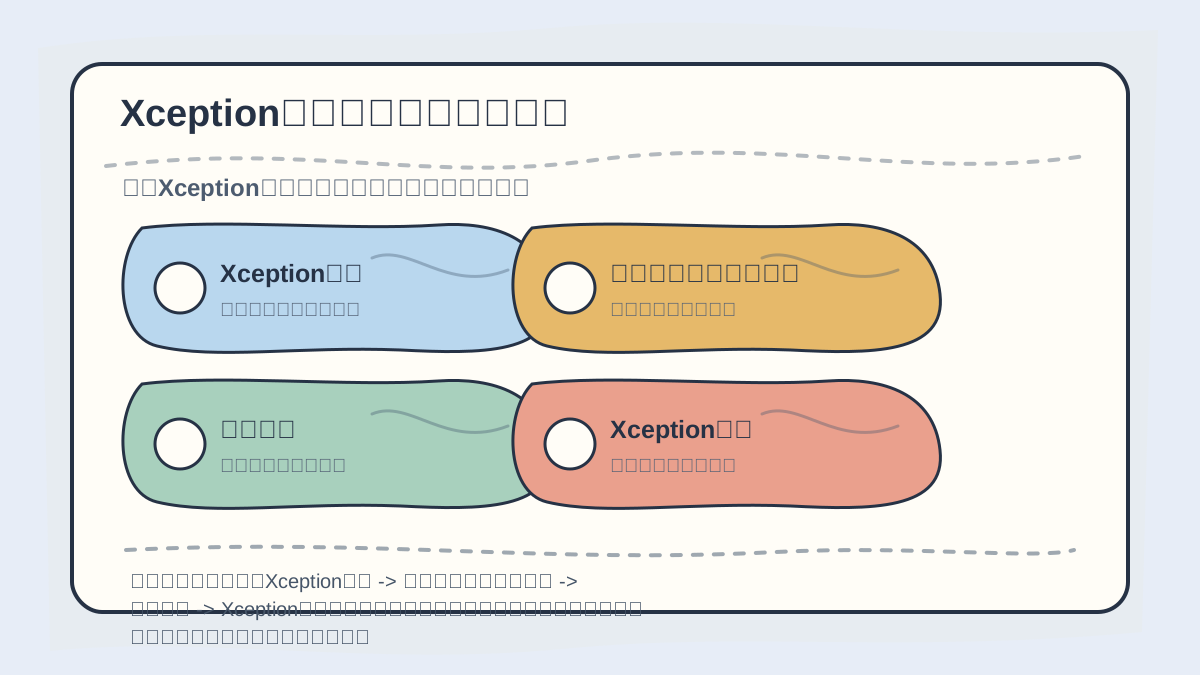
While reading this article, treat the progression “Xception network → principle of depthwise separable convolution → mathematical formulation → Xception network” as a verification chain: first grasp the object, the operation, and the criteria for evaluation, then revisit concrete examples, code snippets, or quantitative metrics to cross-check understanding.
Principle of Depthwise Separable Convolution
In traditional convolution, kernels operate simultaneously across both spatial and channel dimensions—resulting in high computational complexity. Depthwise separable convolution dramatically reduces computation via two distinct steps:
- Depthwise Convolution: Applies a separate convolutional kernel to each input channel. This extracts spatial features independently per channel.
- Pointwise Convolution: Uses kernels to linearly combine the outputs from the depthwise step across channels—effectively performing channel-wise feature integration.
This two-stage approach significantly reduces parameter count and computational cost while preserving expressive power.
Mathematical Formulation
Assume an input feature map of dimension . After applying depthwise convolution kernels, the output dimension becomes . A subsequent pointwise convolution maps this to an output of dimension . Formally:
Xception Network Structure
The Xception architecture consists of stacked depthwise separable convolution modules, each followed by Batch Normalization and a ReLU activation. Crucially, Xception also incorporates residual connections, enabling more effective information flow across deep layers.
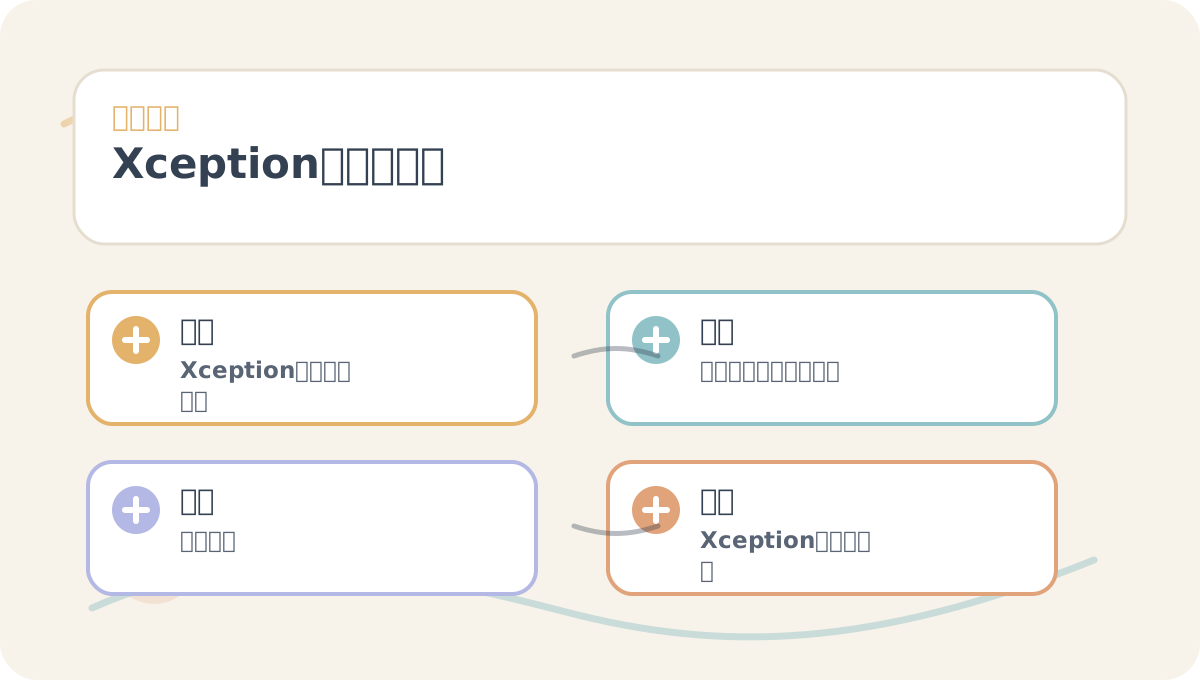
Before reading “Xception: Efficient Network”, use the accompanying diagram to confirm the main narrative thread; after reading, revisit it to identify which steps you can implement directly—and which require supplementary study.
Encoder–Decoder Structure
The Xception network can be broadly divided into two functional parts:
- Encoder: Progressively downsamples the input feature maps to extract increasingly abstract, high-level semantic features.
- Decoder: Upsamples features back toward the original resolution—enabling downstream tasks such as classification, segmentation, or detection.
Practical Applications
Image Classification Example
Suppose we want to apply Xception to an image classification task using the Keras framework:
import tensorflow as tf
from tensorflow.keras.applications import Xception
from tensorflow.keras.preprocessing.image import ImageDataGenerator

# Load pre-trained Xception model (without top classification layer)
model = Xception(weights='imagenet', include_top=False, input_shape=(299, 299, 3))

# Data preprocessing
datagen = ImageDataGenerator(rescale=1.0/255.0, validation_split=0.2)
train_generator = datagen.flow_from_directory('path_to_data', target_size=(299, 299), subset='training')
validation_generator = datagen.flow_from_directory('path_to_data', target_size=(299, 299), subset='validation')

# Add custom classification head
x = model.output
x = tf.keras.layers.GlobalAveragePooling2D()(x)
x = tf.keras.layers.Dense(256, activation='relu')(x)
predictions = tf.keras.layers.Dense(num_classes, activation='softmax')(x)

# Assemble full model
model = tf.keras.models.Model(inputs=model.input, outputs=predictions)
model.compile(optimizer='adam', loss='categorical_crossentropy', metrics=['accuracy'])

# Train the model
model.fit(train_generator, validation_data=validation_generator, epochs=10)
In this example, we load a pre-trained Xception backbone and attach a custom classification head tailored to our specific task. The GlobalAveragePooling2D layer replaces fully connected layers, reducing overfitting risk while retaining discriminative capacity.
Application Scenarios
Thanks to its efficiency and strong feature representation capability, Xception is widely adopted in:
- Image Classification: Scalable handling of large-scale image datasets.
- Object Detection: Often serves as a backbone within frameworks like Faster R-CNN or SSD.
- Semantic Segmentation: Frequently used as the encoder in U-Net–style architectures—especially in medical imaging segmentation.
If “Xception: Efficient Network” hasn’t yet been fully internalized, walk through the four actions on this card to reinforce understanding.
When revisiting “Xception: Efficient Network”, avoid launching a full-scale project upfront. Instead, start with one simple working example to verify whether the core logic is clear.
Conclusion
In this article, we introduced the core concepts and architecture of the Xception network, along with a practical implementation for image classification. Subsequent articles will explore real-world application cases in greater depth—demonstrating Xception’s performance advantages and versatility across diverse computer vision tasks. Through these discussions, we hope to deepen your understanding of this efficient architecture—and empower you to deploy it effectively in your own projects.
Apply This Lesson
Turn this article into AI software, model, API, and security decisions.
English Article FAQ
Use this article as evidence before choosing AI tools
How should I use this AI Tutorials article?
Use it as the implementation or learning layer, then connect the idea to AI software buyer guides, tool comparisons, benchmarks, API choices, and security checks before making a production decision.
Is this English article different from the Chinese original?
The English edition is localized for global AI readers while preserving the original diagrams, screenshots, prompts, code examples, and source context from the Chinese article.
What should I read after Load pre-trained Xception model (without top classification layer)?
Continue with AI Software Buyer Guides, AI Tools Workbench, Best AI Coding Agents, AI Model Benchmarks, OpenAI vs Anthropic API, or LLM Security Tools depending on the decision you need to make.
Can this article alone choose an AI product or model?
No. Treat the article as evidence and context, then validate fit with pricing, privacy requirements, integration effort, benchmark results, workflow tests, and fallback planning.
Continue