English translation
Load the dataset
AI Article Decision Snapshot
Turn the lesson into workflow, model, budget, and security checks before choosing tools.
Use this quick snapshot before leaving the article. It keeps the next search tied to practical AI software, model/API, cost, privacy, and implementation questions.
Workflow fit
Identify the real job behind the article: coding, research, document review, support, analytics, content, or internal automation.
Model or tool decision
Decide whether the next step is a software shortlist, an AI tool comparison, an API platform choice, or a model benchmark.
Budget and usage signal
Estimate seats, API calls, prompt volume, retries, review time, and fallback work before assuming the workflow is cheap.
Security and privacy review
Check whether source code, customer data, private documents, prompts, logs, or embeddings will enter the AI workflow.
Xception extends Inception’s multi-branch design philosophy into depthwise separable convolutions. When studying it, clearly distinguish the roles of spatial convolution (handling spatial structure) and channel mixing (handling cross-channel interactions). This article focuses on practical application scenarios. First, assess whether your task truly aligns with Xception’s strengths; then evaluate data scale, deployment cost, and performance boundaries.
I will verify the number of channels in separable convolutions, the design of residual branches, and output tensor dimensions—ensuring efficiency is not achieved by discarding critical information.
In the previous article, we deeply explored Xception’s highly efficient architecture and the underlying principles that make it work. As a deep convolutional neural network, Xception leverages depthwise separable convolutions to achieve outstanding performance across many image processing tasks. Next, we’ll focus on several key real-world applications of Xception—including image classification, object detection, and semantic segmentation.
Image Classification
Image classification is Xception’s most common application. Its depthwise separable convolutions not only accelerate training and inference but also improve classification accuracy.
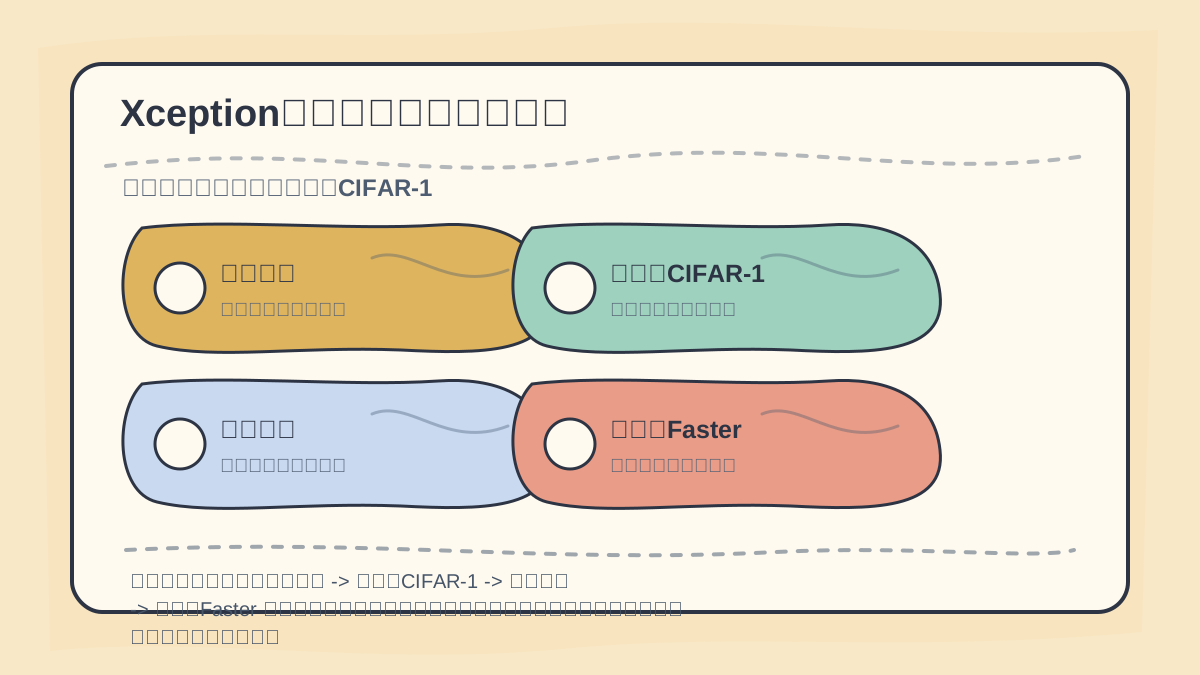
While reading this article, treat “image classification → case: CIFAR-10 → object detection → case: Faster R-CNN” as a verification thread: first clarify the topic, workflow path, and validation points; then revisit the case study, code, or metrics for cross-checking.
Case Study: CIFAR-10 Image Classification
In this example, we apply the Xception network to classify images from the CIFAR-10 dataset—a collection of 60,000 32×32 color images across 10 classes. Below is a Keras-based implementation for building and training an Xception model.
import tensorflow as tf
from tensorflow.keras import layers, models
from tensorflow.keras.datasets import cifar10

# Load the dataset
(x_train, y_train), (x_test, y_test) = cifar10.load_data()
x_train = x_train.astype('float32') / 255.0
x_test = x_test.astype('float32') / 255.0

# Build the Xception model
model = tf.keras.Sequential([
    tf.keras.applications.Xception(input_shape=(32, 32, 3), weights=None, classes=10)
])

# Compile the model
model.compile(optimizer='adam', loss='sparse_categorical_crossentropy', metrics=['accuracy'])

# Train the model
model.fit(x_train, y_train, epochs=10, batch_size=64, validation_data=(x_test, y_test))
In this minimal example, we construct an Xception model using Keras’ built-in tf.keras.applications.Xception. Since weights=None, all parameters are randomly initialized—suitable for small-scale or custom-domain fine-tuning.
Object Detection
Beyond classification, Xception can serve as a powerful backbone for more complex tasks like object detection. When integrated with Faster R-CNN, it delivers highly efficient feature extraction.
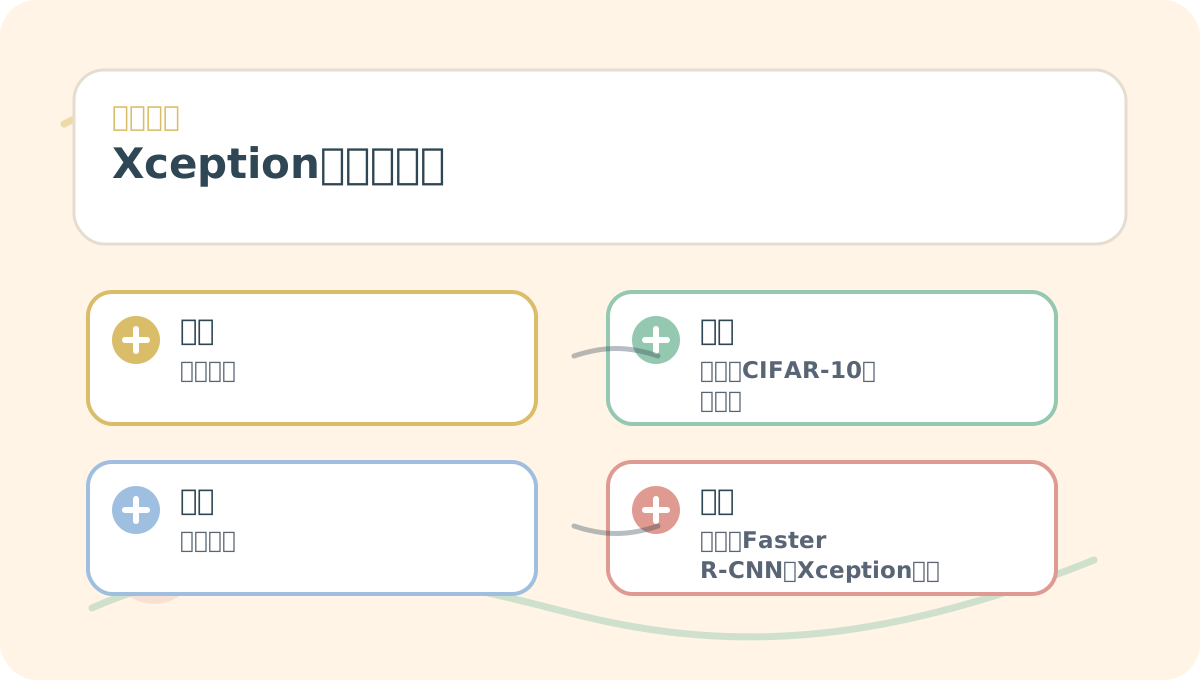
Read “Xception Application Cases” through the lens of Scenario → Concept → Action → Result. First align these four dimensions; then return to the text to examine parameters, code snippets, or pipeline steps.
Case Study: Faster R-CNN with Xception Backbone
We can adopt Xception as the feature extractor within Faster R-CNN to perform object detection. For instance, on the Pascal VOC dataset, replacing the default backbone with Xception significantly improves detection accuracy. Here's a brief illustration of how to implement this using TensorFlow:
import tensorflow_hub as hub

# Load a Faster R-CNN model with Xception backbone
detector = hub.load('https://tfhub.dev/google/faster_rcnn/openimages_v4/inference/1')

# Perform object detection
def detect_objects(image):
    result = detector(image)
    return result

# Load and preprocess image
import cv2
image = cv2.imread('image.jpg')
detections = detect_objects(image)
In this snippet, we load a pre-trained Faster R-CNN model from TensorFlow Hub—already configured with an Xception backbone. During inference, Xception’s computational efficiency directly translates into faster, more scalable detection.
Semantic Segmentation
Semantic segmentation—assigning a class label to every pixel—is another core computer vision task. By combining Xception with U-Net, we achieve both high efficiency and precise segmentation.
Case Study: Medical Image Segmentation with Xception-U-Net
In medical imaging, Xception serves effectively as the encoder within a U-Net architecture, enhancing segmentation fidelity. Below is a simplified implementation:
import tensorflow as tf
from tensorflow.keras import layers

def build_unet_with_xception(input_size):
    inputs = layers.Input(input_size)
    x = tf.keras.applications.Xception(input_shape=input_size, include_top=False)(inputs)
    # Additional decoder layers would be added here to complete the U-Net structure
    return tf.keras.Model(inputs, x)

# Instantiate the U-Net model
unet_model = build_unet_with_xception((128, 128, 3))
unet_model.summary()
Here, build_unet_with_xception defines a U-Net variant where Xception acts as the encoder. Leveraging Xception’s strong hierarchical feature representation enables robust performance on challenging medical segmentation tasks.
At this point, consolidate “Xception Application Cases” into a retrospective table: articulate the central narrative first, then validate it using a small end-to-end task.
After finishing “Xception Application Cases”, pick one small example and walk through its full pipeline end-to-end—then identify which steps you can now execute independently.
Summary
Through the above cases, we see Xception’s broad applicability across image classification, object detection, and semantic segmentation. Its efficiency and exceptional feature-extraction capability have made it a widely adopted choice in computer vision. In our next article, we’ll explore EfficientNet—focusing on its significance and practical use in node-level processing.
Apply This Lesson
Turn this article into AI software, model, API, and security decisions.
English Article FAQ
Use this article as evidence before choosing AI tools
How should I use this AI Tutorials article?
Use it as the implementation or learning layer, then connect the idea to AI software buyer guides, tool comparisons, benchmarks, API choices, and security checks before making a production decision.
Is this English article different from the Chinese original?
The English edition is localized for global AI readers while preserving the original diagrams, screenshots, prompts, code examples, and source context from the Chinese article.
What should I read after Load the dataset?
Continue with AI Software Buyer Guides, AI Tools Workbench, Best AI Coding Agents, AI Model Benchmarks, OpenAI vs Anthropic API, or LLM Security Tools depending on the decision you need to make.
Can this article alone choose an AI product or model?
No. Treat the article as evidence and context, then validate fit with pricing, privacy requirements, integration effort, benchmark results, workflow tests, and fallback planning.
Continue