English translation
EfficientNet Node Processing
AI Article Decision Snapshot
Turn the lesson into workflow, model, budget, and security checks before choosing tools.
Use this quick snapshot before leaving the article. It keeps the next search tied to practical AI software, model/API, cost, privacy, and implementation questions.
Workflow fit
Identify the real job behind the article: coding, research, document review, support, analytics, content, or internal automation.
Model or tool decision
Decide whether the next step is a software shortlist, an AI tool comparison, an API platform choice, or a model benchmark.
Budget and usage signal
Estimate seats, API calls, prompt volume, retries, review time, and fallback work before assuming the workflow is cheap.
Security and privacy review
Check whether source code, customer data, private documents, prompts, logs, or embeddings will enter the AI workflow.
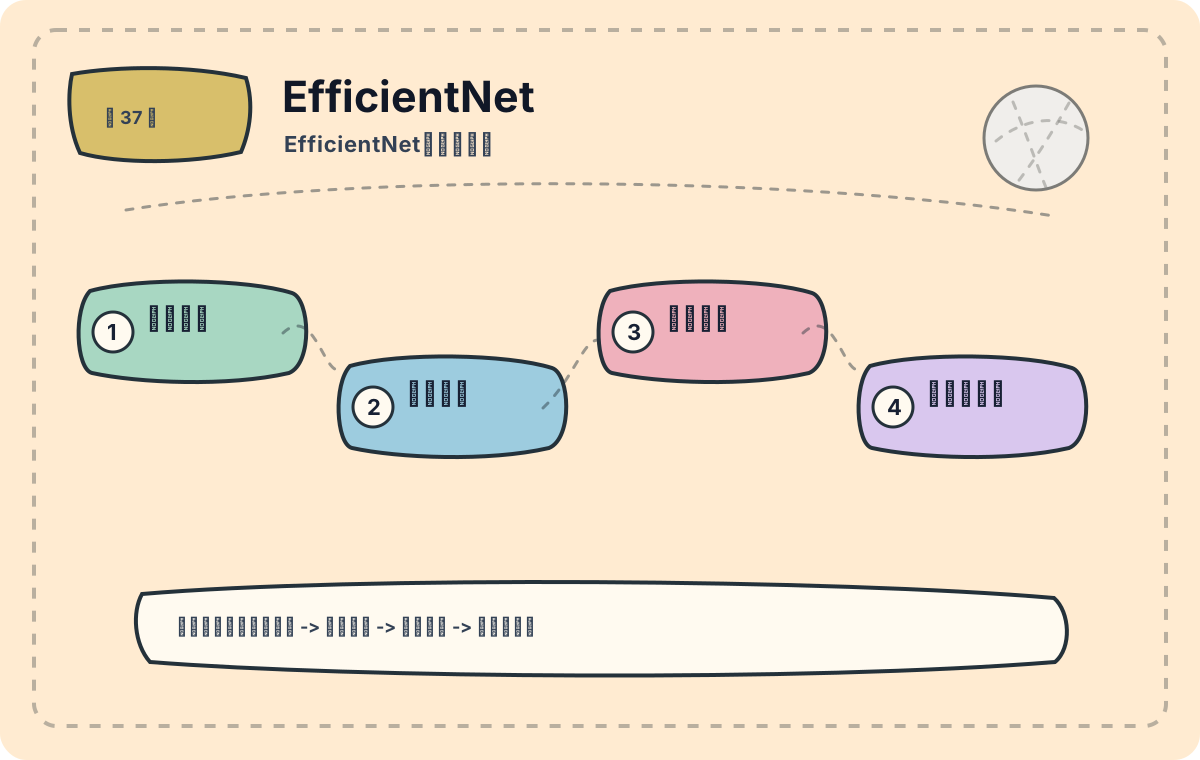
At its core, EfficientNet simultaneously scales depth, width, and resolution—rather than blindly increasing just one dimension. This article first establishes the big picture: what problem it solves, what its core modules are, and which types of tasks it best suits.
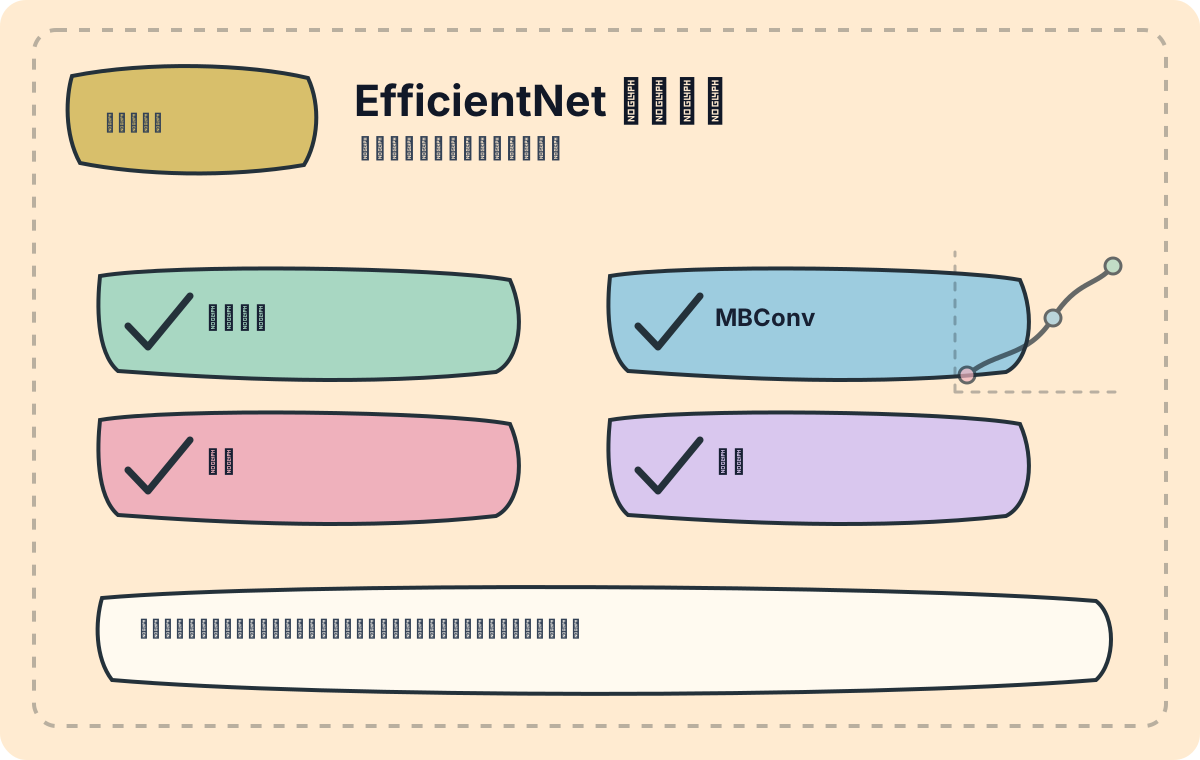
I’ll jointly evaluate input resolution, parameter count, inference latency, and accuracy. High-efficiency models require holistic accounting.
In the field of deep learning, EfficientNet is a state-of-the-art convolutional neural network (CNN) that achieves top-tier accuracy and exceptional resource efficiency. This tutorial focuses on EfficientNet’s node processing and key practical considerations in real-world deployment.
Overview of EfficientNet
EfficientNet’s core contribution lies in its compound scaling method—a systematic approach to jointly optimizing network width, depth, and input resolution. This strategy proves significantly more effective than traditional single-axis scaling (e.g., only increasing depth or width). The base architecture of EfficientNet consists of stacked Mobile Inverted Bottleneck Convolution blocks—layers specifically designed for high performance on mobile and edge devices.
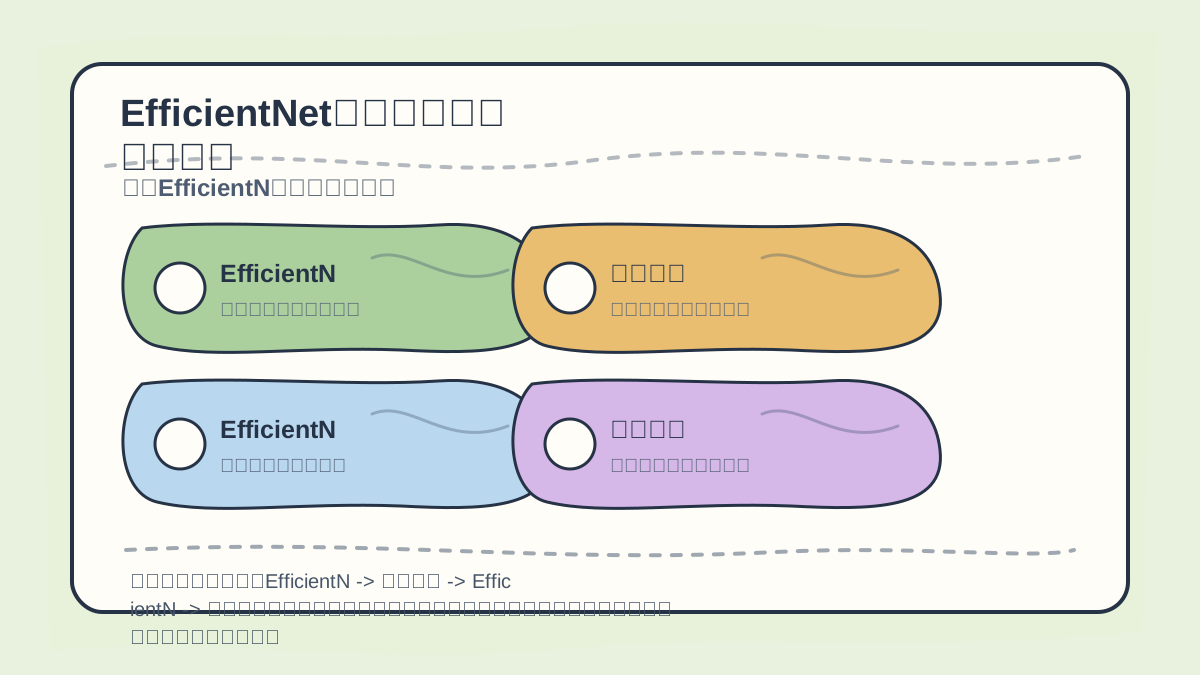
While reading this article, use the mental checklist: “EfficientNet → Compound Scaling → EfficientNet → Feature Propagation”. First identify the object, action, and decision criteria; then revisit concrete examples, code snippets, or evaluation metrics for verification.
Compound Scaling
To ensure robust performance across diverse tasks and hardware constraints, researchers introduced proportional scaling factors to jointly adjust depth, width, and resolution. Specifically, given a baseline network , different variants are generated using a compound scaling coefficient :
where denotes the scaling exponents for depth, width, and resolution respectively.
Node Processing in EfficientNet
Node processing refers to how individual layers (or “nodes”) interact within the model—and how those interactions are optimized to improve overall performance. A defining characteristic of node processing in EfficientNet is its highly efficient feature propagation mechanism.
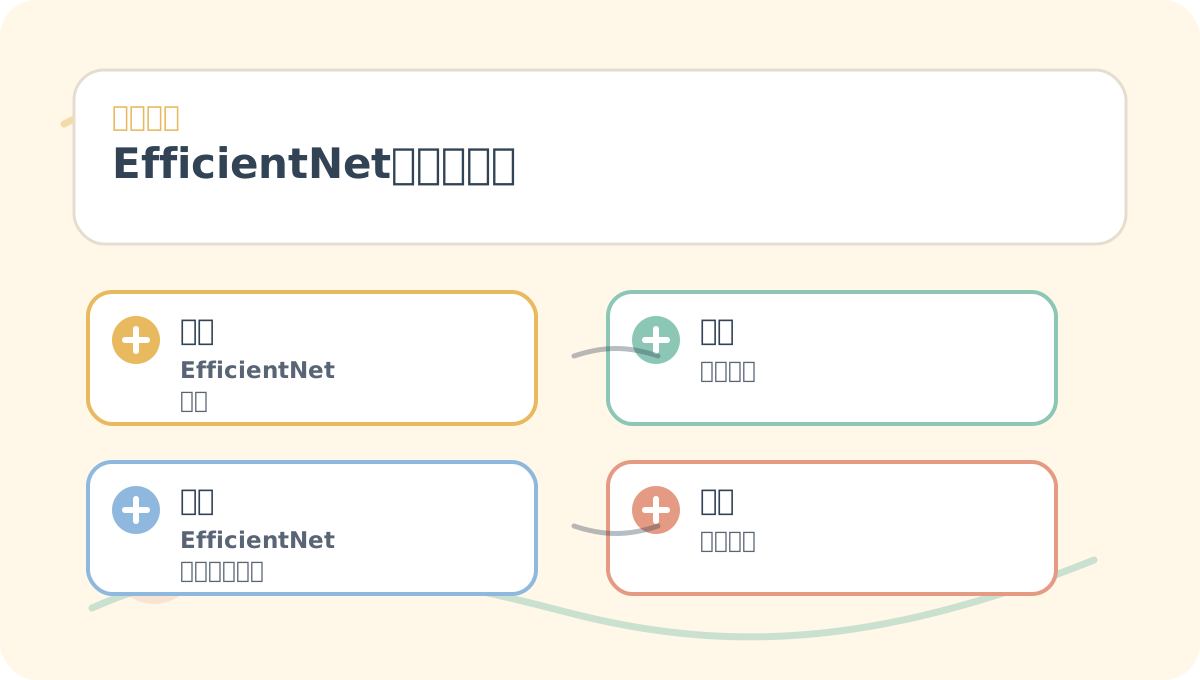
After finishing “EfficientNet Node Processing”, reflect on three questions:
- What problem does it solve?
- At which step is error most likely to occur?
- Can I run a small working example end-to-end?
Feature Propagation
EfficientNet incorporates Squeeze-and-Excitation (SE) blocks. This mechanism adaptively recalibrates channel-wise feature responses—enhancing the model’s focus on task-relevant information.
Squeeze-and-Excitation (SE) Block
The SE block enhances features through two sequential stages:
- Squeeze: Global average pooling compresses each 2D feature map into a single scalar value—yielding a channel-wise descriptor vector.
- Excitation: Two fully connected layers—with ReLU and sigmoid activations—generate a learned channel-weight vector.
Here, and are learnable weights, and denotes element-wise multiplication. This enables the network to selectively emphasize informative channels—boosting representational power and overall performance.
Python Code Example: EfficientNet Node Processing
Below is a practical Keras implementation demonstrating how to integrate an SE block and construct a minimal EfficientNet-inspired network.
import tensorflow as tf
from tensorflow.keras import layers, models

def squeeze_and_excitation(input, ratio=16):
    filters = input.shape[-1]
    se_shape = (1, 1, filters)

    se = layers.GlobalAveragePooling2D()(input)
    se = layers.Reshape(se_shape)(se)
    se = layers.Dense(filters // ratio, activation='relu')(se)
    se = layers.Dense(filters, activation='sigmoid')(se)

    return layers.multiply([input, se])

def efficientnet_node(input_shape=(224, 224, 3)):
    inputs = layers.Input(shape=input_shape)
    x = layers.Conv2D(32, (3, 3), strides=(2, 2), padding='same')(inputs)
    x = squeeze_and_excitation(x)  # Apply SE block
    # Continue building other EfficientNet layers...
    x = layers.GlobalAveragePooling2D()(x)
    x = layers.Dense(10, activation='softmax')(x)  # Assuming 10 output classes
    model = models.Model(inputs, x)
    return model

model = efficientnet_node()
model.summary()
This snippet defines a basic EfficientNet-style network with an embedded SE block. It serves as a foundation that can be extended with additional layers and advanced functionality.
When reviewing “EfficientNet Node Processing”, place key concepts, procedural steps, and observable outcomes side-by-side on a single page for rapid cross-reference.
When practicing “EfficientNet Node Processing”, explicitly write down the input conditions, processing actions, and expected observable outcomes together—making future review and debugging straightforward.
Summary
In this tutorial, we thoroughly examined node processing in EfficientNet—particularly its feature propagation strategy and the role of the Squeeze-and-Excitation block. By jointly optimizing architectural dimensions and enabling adaptive channel recalibration, EfficientNet delivers outstanding performance across multiple benchmark tasks.
In the next article, we’ll dive into concrete application case studies—demonstrating how theoretical principles translate into real-world results.
Stay tuned—we’ll continue exploring how to deploy EfficientNet effectively in practical deep learning scenarios!
Apply This Lesson
Turn this article into AI software, model, API, and security decisions.
English Article FAQ
Use this article as evidence before choosing AI tools
How should I use this AI Tutorials article?
Use it as the implementation or learning layer, then connect the idea to AI software buyer guides, tool comparisons, benchmarks, API choices, and security checks before making a production decision.
Is this English article different from the Chinese original?
The English edition is localized for global AI readers while preserving the original diagrams, screenshots, prompts, code examples, and source context from the Chinese article.
What should I read after EfficientNet Node Processing?
Continue with AI Software Buyer Guides, AI Tools Workbench, Best AI Coding Agents, AI Model Benchmarks, OpenAI vs Anthropic API, or LLM Security Tools depending on the decision you need to make.
Can this article alone choose an AI product or model?
No. Treat the article as evidence and context, then validate fit with pricing, privacy requirements, integration effort, benchmark results, workflow tests, and fallback planning.
Continue