English translation
Input example
AI Article Decision Snapshot
Turn the lesson into workflow, model, budget, and security checks before choosing tools.
Use this quick snapshot before leaving the article. It keeps the next search tied to practical AI software, model/API, cost, privacy, and implementation questions.
Workflow fit
Identify the real job behind the article: coding, research, document review, support, analytics, content, or internal automation.
Model or tool decision
Decide whether the next step is a software shortlist, an AI tool comparison, an API platform choice, or a model benchmark.
Budget and usage signal
Estimate seats, API calls, prompt volume, retries, review time, and fallback work before assuming the workflow is cheap.
Security and privacy review
Check whether source code, customer data, private documents, prompts, logs, or embeddings will enter the AI workflow.
The core idea of self-supervised learning is to generate supervisory signals directly from the data itself. It excels in scenarios where labeled data is scarce but raw, unlabeled data is abundant. This article focuses on architecture: first clarify the data flow, key modules, and output layers—then revisit the underlying formulas or code.

I will separately examine pretraining tasks and downstream tasks to verify that representations truly transfer—not merely that pretraining metrics look good.
Self-supervised learning is an emerging learning paradigm that enables effective model training on large volumes of unlabeled data—without requiring any human-annotated labels. In this article, we explore commonly used model architectures in self-supervised learning and assess their effectiveness in specific applications.
Model Architectures for Self-Supervised Learning
In self-supervised learning, model architectures typically build upon deep learning frameworks such as Convolutional Neural Networks (CNNs), Recurrent Neural Networks (RNNs), and Transformers. Below are several widely adopted architectures:
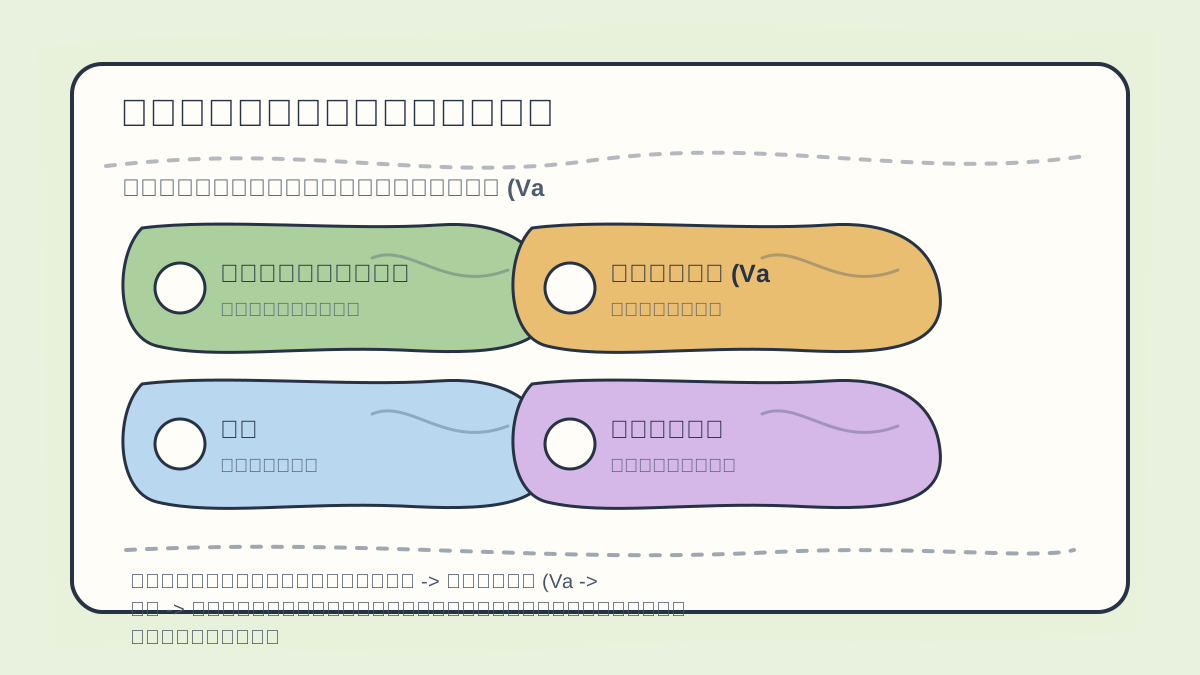
While reading this article, treat the sequence
“Model Architectures → Variational Autoencoder (VAE) → Case Study → Contrastive Learning Models”
as a verification thread: first identify the object, path, and evidence, then return to case studies, code, or evaluation metrics for cross-checking.
1. Variational Autoencoder (VAE)
A VAE learns a latent distribution over the input data to serve as a generative model. Its objective is to maximize the evidence lower bound (ELBO), balancing reconstruction fidelity and regularization:
In self-supervised learning, VAEs are trained by reconstructing input data—thereby encouraging the model to learn meaningful, compact representations.
Case Study
Suppose we have a collection of unlabeled handwritten digit images. We can train a VAE to generate new digit-like samples; these generated images—or more commonly, the learned latent representations—can then be leveraged for downstream classification tasks.
import torch
from torch import nn

class VAE(nn.Module):
    def __init__(self):
        super(VAE, self).__init__()
        self.encoder = nn.Sequential(
            nn.Linear(784, 400),
            nn.ReLU(),
            nn.Linear(400, 20)  # mean
        )
        self.decoder = nn.Sequential(
            nn.Linear(20, 400),
            nn.ReLU(),
            nn.Linear(400, 784),
            nn.Sigmoid()
        )

    def forward(self, x):
        z_mean = self.encoder(x)
        z = self.reparameterize(z_mean)
        return self.decoder(z)

    def reparameterize(self, z_mean):
        std = torch.exp(0.5 * z_mean)  # Assume variance is learned
        eps = torch.randn_like(std)
        return z_mean + eps * std
2. Contrastive Learning Models
Contrastive learning trains models by distinguishing positive pairs (e.g., augmented views of the same sample) from negative pairs (views of different samples). SimCLR and MoCo are two prominent contrastive learning frameworks.
The model learns representations by maximizing similarity between positive pairs while minimizing similarity across negative pairs—typically using cosine similarity and a temperature-scaled InfoNCE loss.
Case Study
For an image classification task, contrastive learning can pretrain feature extractors effectively. Here’s a minimal implementation:
import torch
import torch.nn.functional as F

def contrastive_loss(z_i, z_j, temperature=0.5):
    batch_size = z_i.size(0)
    # Compute similarity matrix
    sim_matrix = F.cosine_similarity(z_i.unsqueeze(1), z_j.unsqueeze(0), dim=-1) / temperature
    labels = torch.arange(batch_size).to(z_i.device)
    # Compute contrastive loss (InfoNCE)
    loss = F.cross_entropy(sim_matrix, labels)
    return loss
3. Self-Supervised Transformers
In natural language processing (NLP), the Transformer architecture has become foundational for self-supervised learning. BERT and GPT are both Transformer-based models pretrained via self-supervised objectives—such as masked language modeling (MLM) and next-sentence prediction—to capture rich contextual representations.
Case Study: BERT
BERT is pretrained by masking random tokens in input text and predicting them. This forces the model to deeply understand context and semantic relationships.
from transformers import BertTokenizer, BertForMaskedLM

tokenizer = BertTokenizer.from_pretrained('bert-base-uncased')
model = BertForMaskedLM.from_pretrained('bert-base-uncased')

# Input example
inputs = tokenizer("The cat sat on the [MASK].", return_tensors="pt")
outputs = model(**inputs)
Here, [MASK] marks the token the model must predict. The loss is computed via backpropagation, updating model weights accordingly.
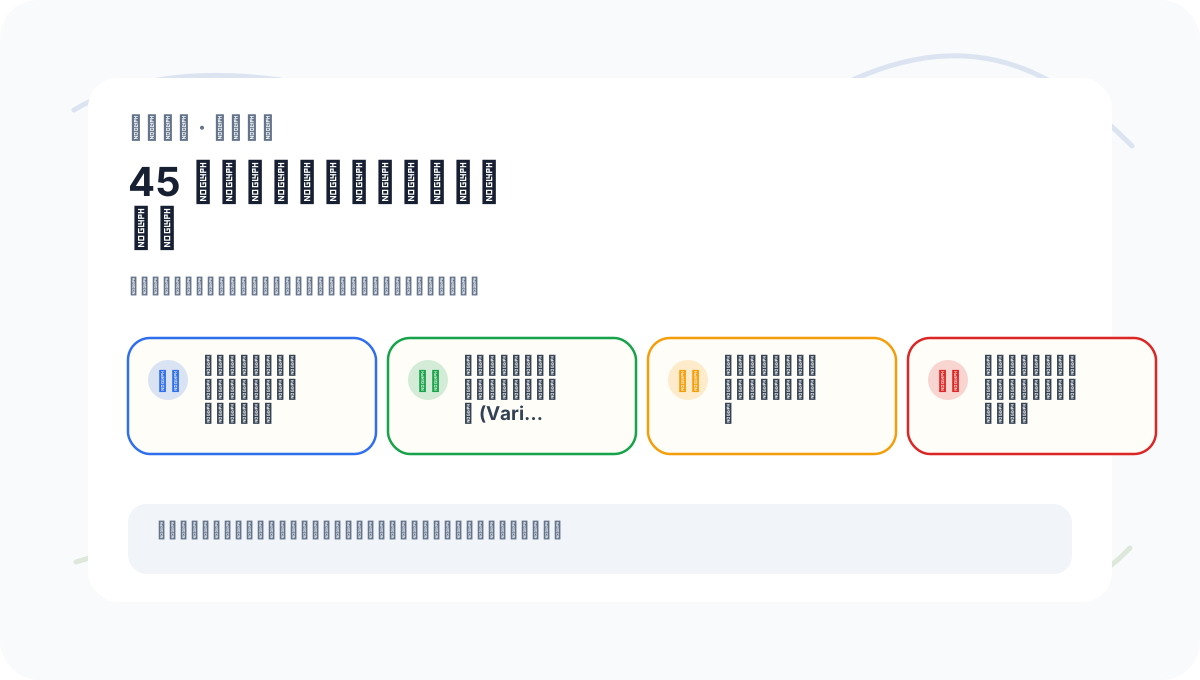
When reviewing “Model Architectures for Self-Supervised Learning”, consolidate key concepts, procedural steps, and observable outcomes onto a single page for efficient revision.
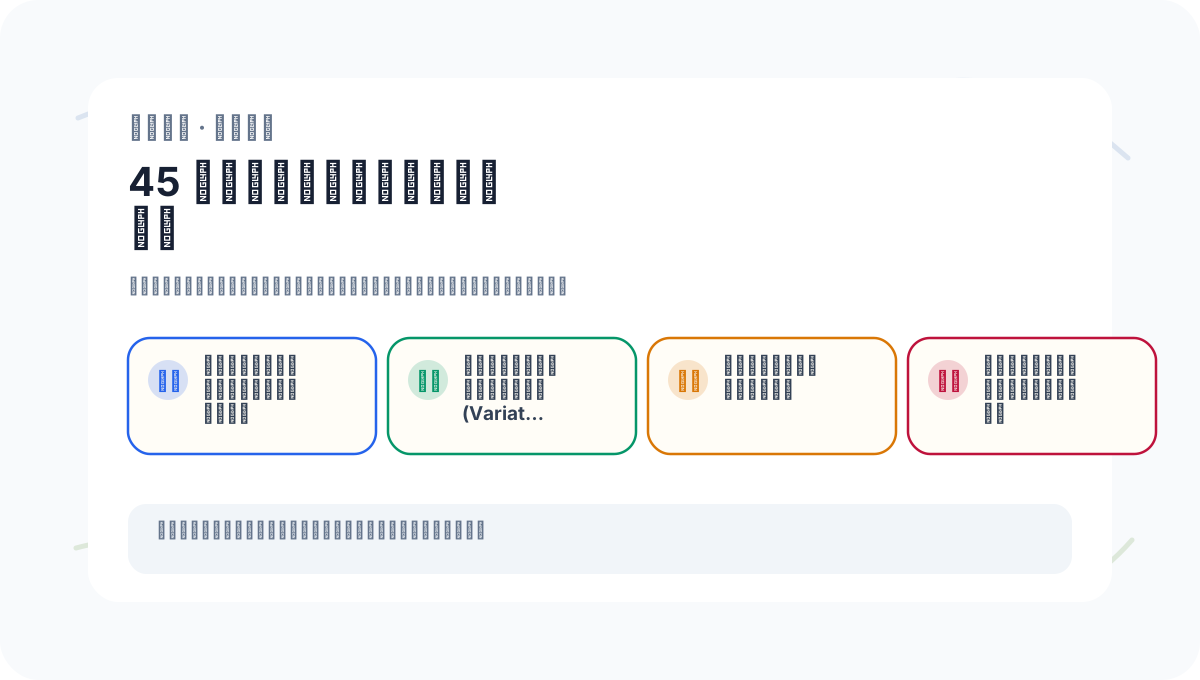
When practicing “Model Architectures for Self-Supervised Learning”, explicitly write down the input conditions, processing actions, and observable outcomes together—making future review and debugging straightforward.
Summary
Self-supervised learning leverages purpose-built model architectures to extract rich, transferable features from unlabeled data—offering a powerful alternative where labeling is costly, impractical, or infeasible. In upcoming articles, we’ll dive deeper into real-world adoption patterns and concrete use cases.
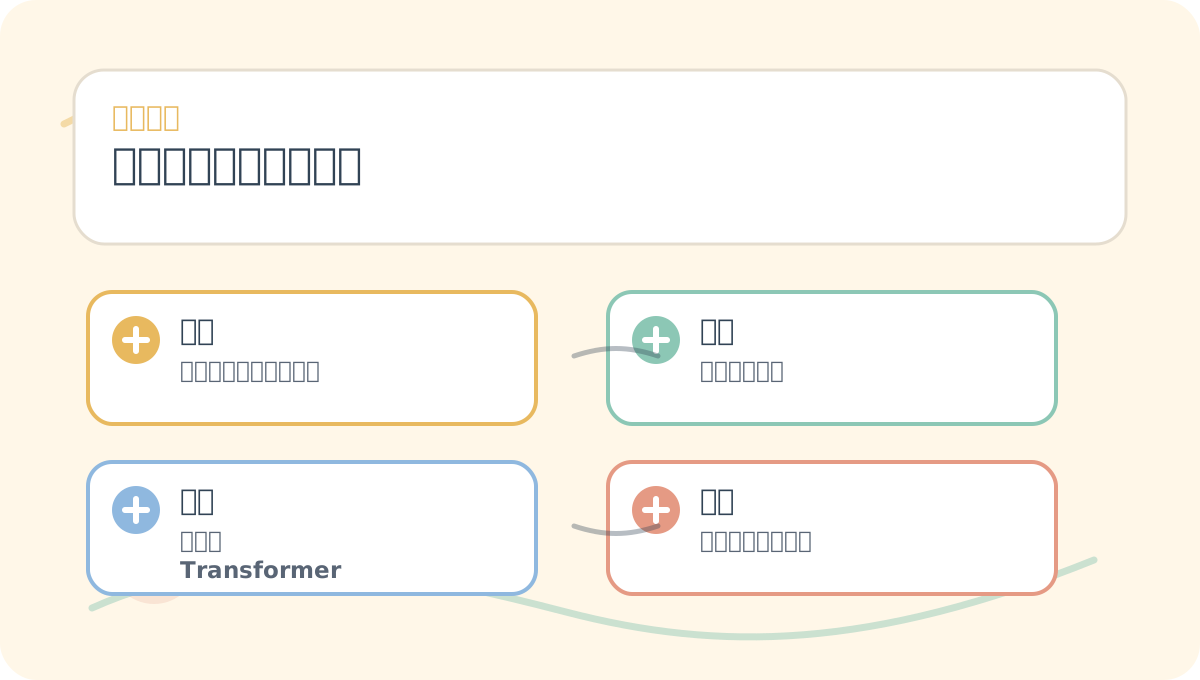
After finishing “Model Architectures for Self-Supervised Learning”, reflect on three questions:
- What problem does it solve?
- Which step is most error-prone?
- Can I implement and run a small working example end-to-end?
Apply This Lesson
Turn this article into AI software, model, API, and security decisions.
English Article FAQ
Use this article as evidence before choosing AI tools
How should I use this AI Tutorials article?
Use it as the implementation or learning layer, then connect the idea to AI software buyer guides, tool comparisons, benchmarks, API choices, and security checks before making a production decision.
Is this English article different from the Chinese original?
The English edition is localized for global AI readers while preserving the original diagrams, screenshots, prompts, code examples, and source context from the Chinese article.
What should I read after Input example?
Continue with AI Software Buyer Guides, AI Tools Workbench, Best AI Coding Agents, AI Model Benchmarks, OpenAI vs Anthropic API, or LLM Security Tools depending on the decision you need to make.
Can this article alone choose an AI product or model?
No. Treat the article as evidence and context, then validate fit with pricing, privacy requirements, integration effort, benchmark results, workflow tests, and fallback planning.
Continue