English translation
Define data preprocessing and augmentation
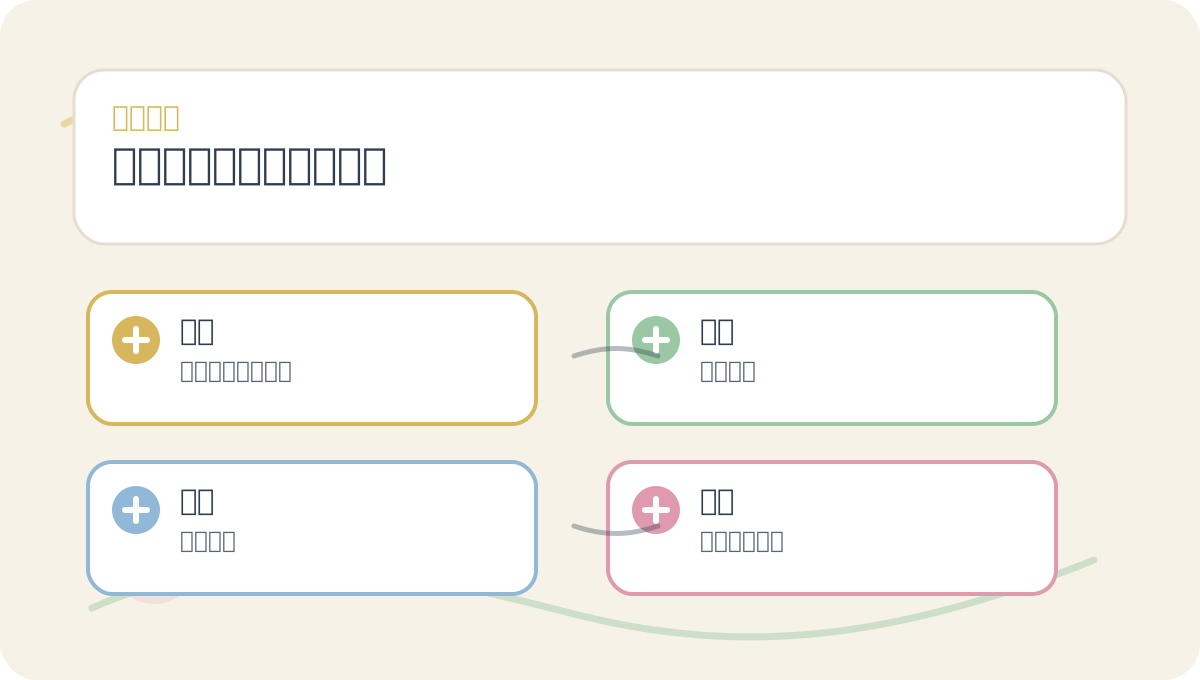
AI Article Decision Snapshot
Turn the lesson into workflow, model, budget, and security checks before choosing tools.
Use this quick snapshot before leaving the article. It keeps the next search tied to practical AI software, model/API, cost, privacy, and implementation questions.
Workflow fit
Identify the real job behind the article: coding, research, document review, support, analytics, content, or internal automation.
Model or tool decision
Decide whether the next step is a software shortlist, an AI tool comparison, an API platform choice, or a model benchmark.
Budget and usage signal
Estimate seats, API calls, prompt volume, retries, review time, and fallback work before assuming the workflow is cheap.
Security and privacy review
Check whether source code, customer data, private documents, prompts, logs, or embeddings will enter the AI workflow.
The core idea of self-supervised learning is to generate supervisory signals directly from the data itself. It excels in scenarios where labeled data is scarce but raw, unlabeled data is abundant. This article focuses on practical application contexts. First, assess whether your task genuinely aligns with self-supervised learning; then evaluate data scale, deployment cost, and performance boundaries.

I will separately examine the pretraining task and the downstream task to verify that representations truly transfer—not merely achieving strong metrics on pretraining objectives alone.
In the previous article, we delved deeply into model architectures for self-supervised learning, laying a solid foundation for understanding the latest advances and technical developments in this field. Next, we shift our focus to the practical introduction and real-world applications of self-supervised learning—exploring how this cutting-edge learning paradigm can be deployed to solve concrete problems and thereby enhance model performance and adaptability.
Definition of Self-Supervised Learning
Self-supervised learning is a machine learning paradigm that leverages unlabeled data to generate pseudo-labels, thereby driving the learning process. By exploring and modeling the intrinsic structure of input data, models autonomously discover underlying patterns and regularities. This approach is especially well-suited for handling large volumes of unlabeled data—and has already achieved remarkable success across numerous tasks.
Application Cases
1. Image Classification
Self-supervised learning has demonstrated exceptional capability in image classification. Using only unlabeled images, models can autonomously learn rich, discriminative visual representations. For instance, the SimCLR method trains models by generating multiple augmented views of each image and learning to recognize their semantic similarity.
import torchvision.transforms as transforms
from torchvision import datasets
from torch.utils.data import DataLoader

# Define data preprocessing and augmentation
transform = transforms.Compose([
    transforms.RandomResizedCrop(224),
    transforms.RandomHorizontalFlip(),
    transforms.ToTensor(),
])

# Load unlabeled dataset
dataset = datasets.CIFAR10(root='./data', train=False, download=True, transform=transform)
dataloader = DataLoader(dataset, batch_size=64, shuffle=True)

# Placeholder: training loop for self-supervised model (to be implemented)
2. Natural Language Processing (NLP)
In natural language processing (NLP), self-supervised learning enables effective generation of task-specific representations through text-based pretraining—most notably exemplified by the BERT model. BERT employs a masked language modeling objective: it randomly masks tokens in input sequences and trains the model to reconstruct them, thereby learning deep contextualized representations.
from transformers import BertTokenizer, BertForMaskedLM
from torch.nn import functional as F

tokenizer = BertTokenizer.from_pretrained('bert-base-uncased')
model = BertForMaskedLM.from_pretrained('bert-base-uncased')

# Encode input text
input_text = "The quick brown fox jumps over the lazy dog."
input_ids = tokenizer.encode(input_text, return_tensors='pt')

# Create mask
labels = input_ids.clone()
input_ids[0][5] = tokenizer.mask_token_id  # Mask the word "fox"

# Forward pass
outputs = model(input_ids, labels=labels)
loss = outputs.loss
logits = outputs.logits

# Compute prediction distribution over masked token
softmax_logits = F.softmax(logits, dim=-1)
predicted_token_ids = softmax_logits[0, 5].topk(5).indices

# Decode top predictions
predicted_words = [tokenizer.decode([idx]) for idx in predicted_token_ids]
3. Speech Recognition
Self-supervised learning has also gained widespread adoption in speech recognition. Models like wav2vec use self-supervised objectives to learn latent representations directly from raw acoustic signals—significantly boosting performance on downstream tasks such as automatic speech recognition (ASR). Trained on massive amounts of unlabeled speech data, these models effectively capture fundamental phonetic and prosodic features.

While reading this article, treat the sequence “Definition → Application Cases → Image Classification → NLP” as a structured checklist: first grasp the core object (what), action (how), and evaluation criteria (why); then revisit specific cases, code snippets, or metrics to verify alignment.
Practical Challenges
Despite its immense promise, deploying self-supervised learning in practice presents several key challenges:
“The Introduction and Application of Self-Supervised Learning” is best read alongside its diagrams. Begin by clarifying the problem and decision criteria; then proceed to conceptual explanations and step-by-step implementation guidance—this helps integrate information into a coherent mental model.
- Data Quality: Self-supervised learning relies heavily on high-quality unlabeled data. Diversity and representativeness of the data are critical determinants of final model performance.
- Task Design: Crafting effective self-supervised pretraining tasks is central to success. Tasks must exhibit strong semantic relevance to downstream goals to ensure meaningful knowledge transfer.
- Computational Resources: Training self-supervised models—especially at scale—demands substantial compute resources. Efficiency considerations (e.g., memory footprint, training time) must be carefully weighed.
After completing “Introduction and Application of Self-Supervised Learning,” try adapting it to your own use case. Pay particular attention to whether inputs, internal processing steps, and outputs form a logically consistent pipeline.
To apply “Introduction and Application of Self-Supervised Learning” to your own task, start small: isolate and rigorously validate just one critical decision point before scaling up.
Conclusion
Self-supervised learning opens new frontiers in machine learning—particularly in unlocking the vast potential of unlabeled data. Through concrete application examples, we’ve seen both its transformative promise and its practical constraints. As algorithms evolve and infrastructure improves, self-supervised learning will increasingly permeate diverse domains—providing robust, scalable foundations for next-generation intelligent systems.
In the next article, we’ll explore recent advances in Deep Belief Networks and emerging neural network architectures—stay tuned.
Apply This Lesson
Turn this article into AI software, model, API, and security decisions.
English Article FAQ
Use this article as evidence before choosing AI tools
How should I use this AI Tutorials article?
Use it as the implementation or learning layer, then connect the idea to AI software buyer guides, tool comparisons, benchmarks, API choices, and security checks before making a production decision.
Is this English article different from the Chinese original?
The English edition is localized for global AI readers while preserving the original diagrams, screenshots, prompts, code examples, and source context from the Chinese article.
What should I read after Define data preprocessing and augmentation?
Continue with AI Software Buyer Guides, AI Tools Workbench, Best AI Coding Agents, AI Model Benchmarks, OpenAI vs Anthropic API, or LLM Security Tools depending on the decision you need to make.
Can this article alone choose an AI product or model?
No. Treat the article as evidence and context, then validate fit with pricing, privacy requirements, integration effort, benchmark results, workflow tests, and fallback planning.
Continue