English translation
In the previous article, we introduced self-supervised learning—its motivation, principles, and practical applications—and saw how it leverages unlabeled data to enhance model learning. In this article, we delve into the novel architectural variants of Deep Belief Networks (DBNs). As an unsupervised learning framework, DBNs offer strong potential for hierarchical feature extraction through their distinctive probabilistic structure.
AI Article Decision Snapshot
Turn the lesson into workflow, model, budget, and security checks before choosing tools.
Use this quick snapshot before leaving the article. It keeps the next search tied to practical AI software, model/API, cost, privacy, and implementation questions.
Workflow fit
Identify the real job behind the article: coding, research, document review, support, analytics, content, or internal automation.
Model or tool decision
Decide whether the next step is a software shortlist, an AI tool comparison, an API platform choice, or a model benchmark.
Budget and usage signal
Estimate seats, API calls, prompt volume, retries, review time, and fallback work before assuming the workflow is cheap.
Security and privacy review
Check whether source code, customer data, private documents, prompts, logs, or embeddings will enter the AI workflow.
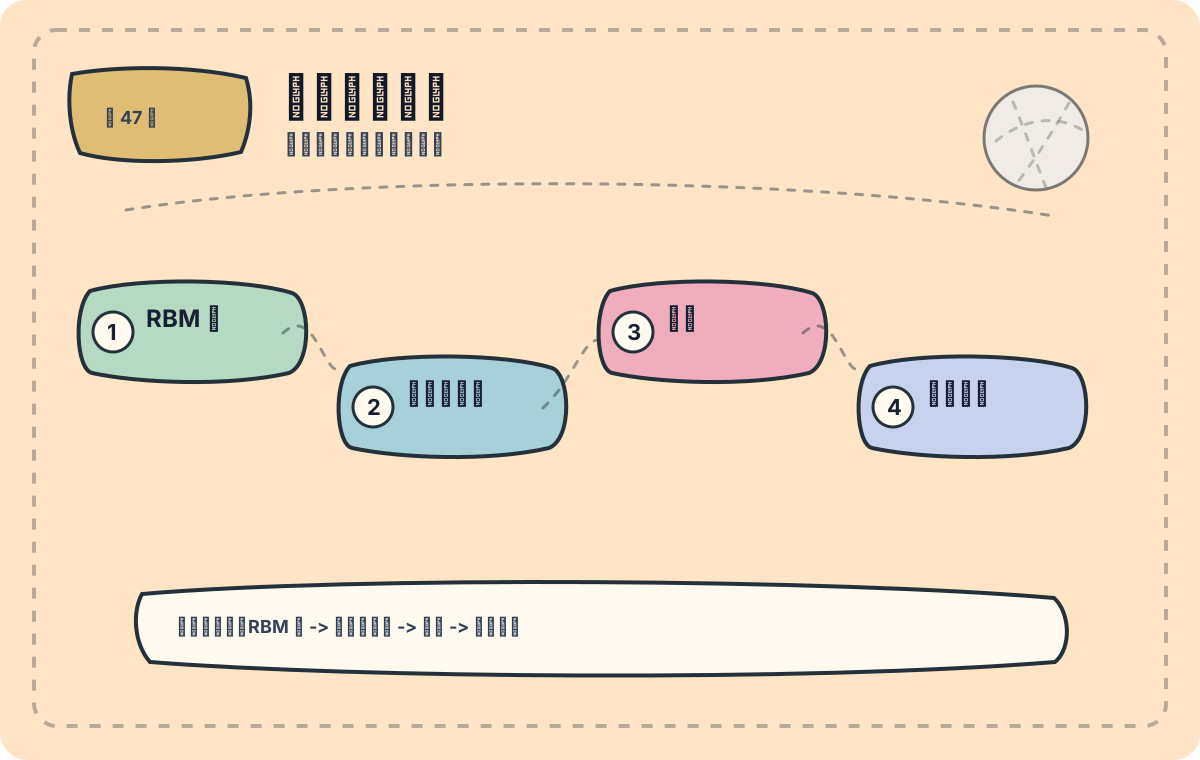
Deep Belief Networks (DBNs) represent an earlier generation of deep learning architectures. Understanding them helps clarify the conceptual and practical differences between layer-wise pretraining and modern end-to-end training paradigms. This article begins by establishing a high-level map: what problem DBNs address, what their core components are, and in which types of tasks they are most appropriately applied.

I will record pretraining objectives, fine-tuning objectives, and final evaluation metrics separately—never mixing metrics across different training stages.
In the previous article, we introduced self-supervised learning—its motivation, principles, and practical applications—and saw how it leverages unlabeled data to enhance model learning. In this article, we delve into the novel architectural variants of Deep Belief Networks (DBNs). As an unsupervised learning framework, DBNs offer strong potential for hierarchical feature extraction through their distinctive probabilistic structure.
Overview of Deep Belief Networks
A Deep Belief Network is a neural network composed of multiple hidden layers and structured as a generative probabilistic model. Its fundamental building block is the Restricted Boltzmann Machine (RBM)—an unsupervised learning model trained via contrastive divergence. Key advantages of DBNs include:

While reading this article, treat the sequence “DBN Overview → Novel Architectures → Application Scenarios → Image Denoising” as a verification checklist: first grasp the object, operation, and decision criteria; then revisit concrete examples, code snippets, or evaluation metrics to verify understanding.
- Automatic learning of high-level, abstract features
- Strong performance on high-dimensional data
- Often outperforms traditional deep learning models on certain tasks
Novel Network Architectures
To improve DBN performance, several innovative architectural variants have emerged in recent years. Below are three notable examples:
-
Convolutional Deep Belief Network (CDBN): Integrates convolutional layers to capture spatially local patterns—especially effective for image processing tasks.
import torch import torch.nn as nn import torch.nn.functional as F class CDBN(nn.Module): def __init__(self): super(CDBN, self).__init__() self.conv1 = nn.Conv2d(1, 16, kernel_size=5, stride=1, padding=2) self.pool = nn.MaxPool2d(kernel_size=2, stride=2, padding=0) self.fc1 = nn.Linear(16 * 14 * 14, 120) self.fc2 = nn.Linear(120, 84) self.fc3 = nn.Linear(84, 10) def forward(self, x): x = self.pool(F.relu(self.conv1(x))) x = x.view(-1, 16 * 14 * 14) x = F.relu(self.fc1(x)) x = F.relu(self.fc2(x)) x = self.fc3(x) return x -
Parallel Deep Belief Network (PDBN): Trains multiple subnetworks concurrently to accelerate data processing and improve model robustness.
-
Variational Deep Belief Network (VDBN): Incorporates ideas from variational autoencoders (VAEs), enabling explicit modeling of uncertainty in latent representations.
Application Scenarios
DBNs have been widely adopted across diverse domains—particularly in image and text processing. Here are two representative use cases:
Image Denoising
In image denoising, DBNs learn rich latent representations of clean image structures, enabling effective noise suppression. CDBNs, in particular, leverage convolutional filters to capture local spatial correlations—yielding superior denoising performance compared to standard DBNs.
Text Classification
For text classification, DBNs first perform unsupervised feature learning on raw text (e.g., word embeddings or n-gram statistics), then feed those learned features into downstream supervised classifiers—often resulting in significantly improved accuracy.
If you haven’t fully internalized “Novel Architectures of Deep Belief Networks”, revisit this card and walk through its four actionable steps.
When reviewing “Novel Architectures of Deep Belief Networks”, avoid jumping straight into large-scale projects. Instead, start with one simple, runnable example to confirm whether the core logic is clear.
Conclusion
This article introduced key architectural innovations in Deep Belief Networks—including Convolutional DBNs (CDBNs)—and highlighted their strengths in handling image data. These advances continue to push the boundaries of deep learning, enabling increasingly complex real-world applications. In the next article, we will explore practical implementations of DBNs, demonstrating their effectiveness in concrete scenarios.
Stay tuned for our upcoming article—where we’ll dive deeper into real-world DBN applications and examine their behavior in specific, mission-critical settings.
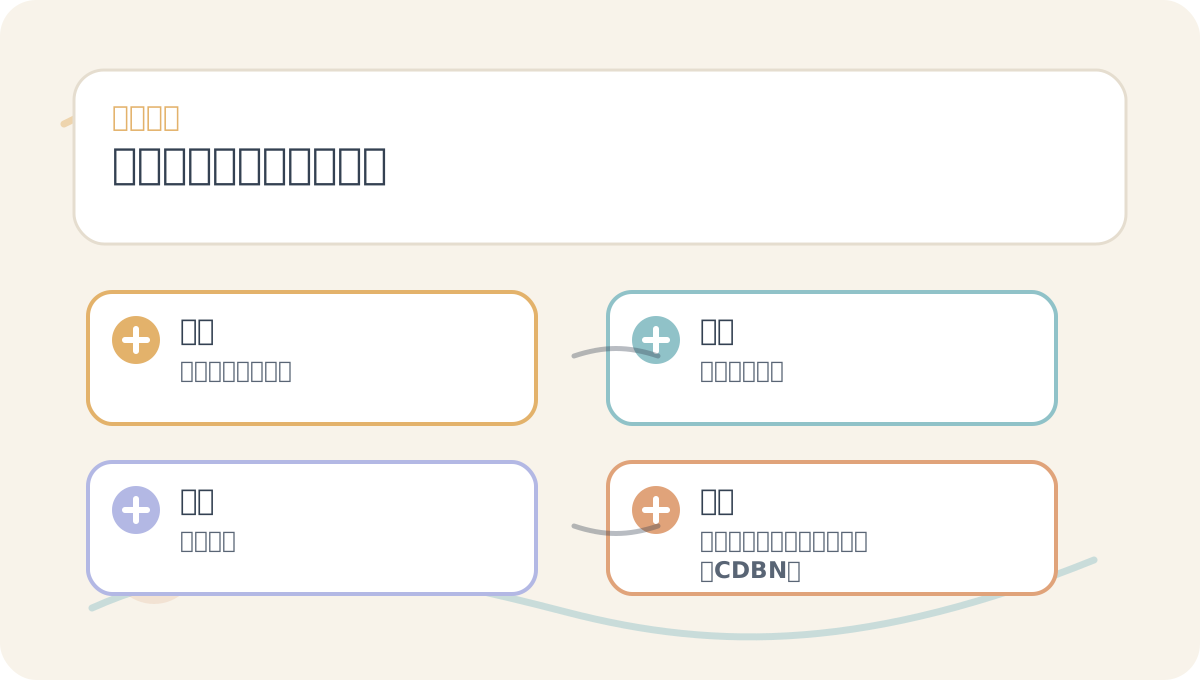
Before reading “Novel Architectures of Deep Belief Networks”, use the accompanying diagram to orient yourself to the central narrative. After reading, revisit it to identify which steps you can execute immediately—and which require additional background study.
Apply This Lesson
Turn this article into AI software, model, API, and security decisions.
English Article FAQ
Use this article as evidence before choosing AI tools
How should I use this AI Tutorials article?
Use it as the implementation or learning layer, then connect the idea to AI software buyer guides, tool comparisons, benchmarks, API choices, and security checks before making a production decision.
Is this English article different from the Chinese original?
The English edition is localized for global AI readers while preserving the original diagrams, screenshots, prompts, code examples, and source context from the Chinese article.
What should I read after In the previous article, we introduced self-supervised learning—its motivation, principles, and practical applications—and saw how it leverages unlabeled data to enhance model learning. In this article, we delve into the novel architectural variants of Deep Belief Networks (DBNs). As an unsupervised learning framework, DBNs offer strong potential for hierarchical feature extraction through their distinctive probabilistic structure.?
Continue with AI Software Buyer Guides, AI Tools Workbench, Best AI Coding Agents, AI Model Benchmarks, OpenAI vs Anthropic API, or LLM Security Tools depending on the decision you need to make.
Can this article alone choose an AI product or model?
No. Treat the article as evidence and context, then validate fit with pricing, privacy requirements, integration effort, benchmark results, workflow tests, and fallback planning.
Continue