English translation
Load the MNIST dataset
AI Article Decision Snapshot
Turn the lesson into workflow, model, budget, and security checks before choosing tools.
Use this quick snapshot before leaving the article. It keeps the next search tied to practical AI software, model/API, cost, privacy, and implementation questions.
Workflow fit
Identify the real job behind the article: coding, research, document review, support, analytics, content, or internal automation.
Model or tool decision
Decide whether the next step is a software shortlist, an AI tool comparison, an API platform choice, or a model benchmark.
Budget and usage signal
Estimate seats, API calls, prompt volume, retries, review time, and fallback work before assuming the workflow is cheap.
Security and privacy review
Check whether source code, customer data, private documents, prompts, logs, or embeddings will enter the AI workflow.
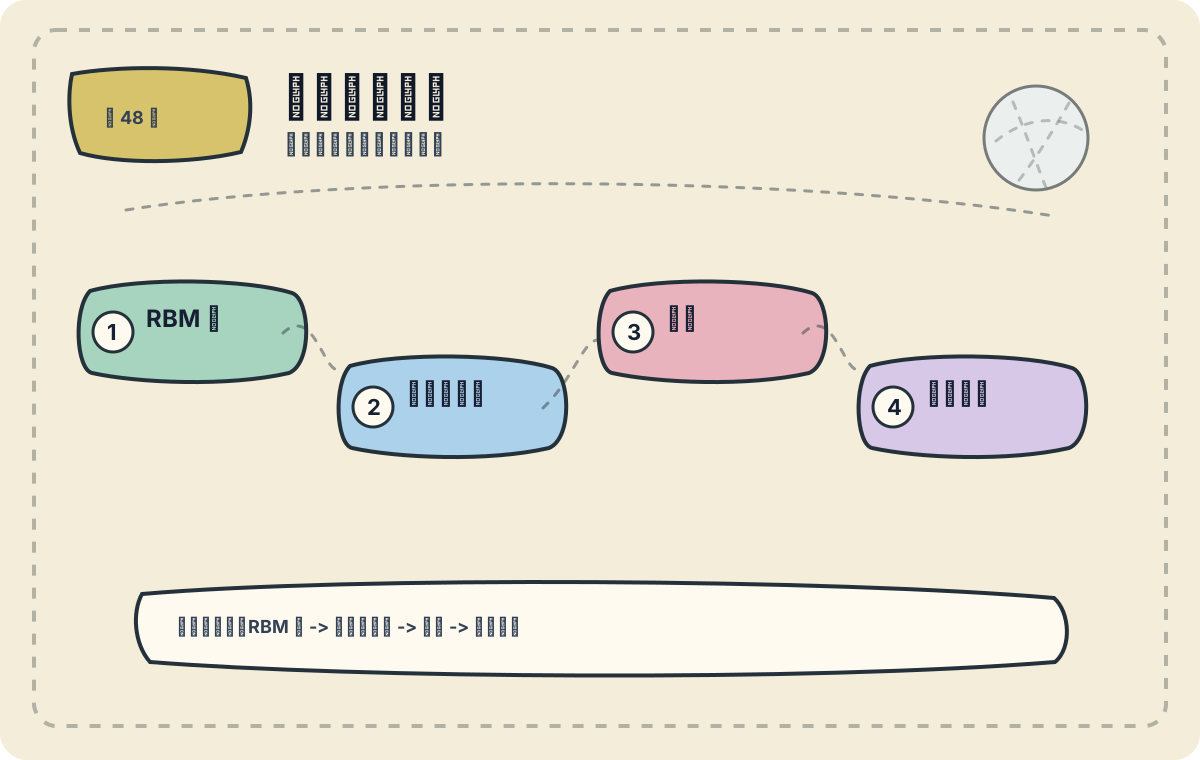
Deep Belief Networks (DBNs) represent an earlier generation of deep learning architectures. Understanding them helps clarify the conceptual and practical differences between layer-wise pretraining and modern end-to-end training paradigms. This article focuses on real-world applications. Before adopting a DBN, first assess whether the task genuinely aligns with its strengths; then evaluate data scale, deployment cost, and performance boundaries.
I record pretraining objectives, fine-tuning objectives, and final evaluation metrics separately—never mixing metrics across different training stages.
In the previous article, we explored the architecture, characteristics, and significance of Deep Belief Networks (DBNs) within the broader landscape of deep learning. Building on that foundation, this article examines concrete application scenarios of DBNs across diverse domains—and how their unique structural design and training methodology can be leveraged to solve real-world problems.
Overview of Deep Belief Networks
A Deep Belief Network consists of multiple sparse, bidirectionally connected probabilistic generative models—typically Restricted Boltzmann Machines (RBMs)—stacked hierarchically. It is trained in two phases: unsupervised layer-wise pretraining followed by supervised fine-tuning. This enables DBNs to learn complex, hierarchical data distributions. Their distinguishing feature lies in this staged, greedy layer-wise learning strategy—contrasting sharply with standard backpropagation-based end-to-end training—and confers advantages in certain specialized applications.
1. Image Classification
Application Example
Image classification is one of the most common tasks in deep learning. DBNs can be employed for feature extraction and subsequent classification. For instance, in handwritten digit recognition, feeding a large collection of digit images into a DBN allows it to learn latent representations of digits and classify them accordingly.
Code Implementation Example
Below is a simple Python implementation using scikit-learn to build a DBN-based classifier:
from sklearn.neural_network import BernoulliRBM
from sklearn.pipeline import Pipeline
from sklearn.ensemble import RandomForestClassifier
from sklearn.datasets import fetch_openml
from sklearn.model_selection import train_test_split

# Load the MNIST dataset
mnist = fetch_openml('mnist_784')
X = mnist.data
y = mnist.target

# Split into training and test sets
X_train, X_test, y_train, y_test = train_test_split(X, y, test_size=0.2, random_state=42)

# Construct a DBN pipeline
dbn = Pipeline(steps=[
    ('rbm', BernoulliRBM(n_components=64, learning_rate=0.01, n_iter=10, random_state=42)),
    ('classifier', RandomForestClassifier(n_estimators=100))
])

# Train the model
dbn.fit(X_train, y_train)

# Evaluate accuracy
accuracy = dbn.score(X_test, y_test)
print(f"DBN classification accuracy: {accuracy:.2f}")
In this example, the DBN performs unsupervised feature extraction from handwritten digit images, and a Random Forest classifier operates on those learned features. Leveraging DBN’s ability to capture discriminative visual patterns improves overall classification accuracy.
2. Feature Extraction and Dimensionality Reduction
DBNs are also widely used for unsupervised feature extraction and dimensionality reduction. Their strong capability to discover latent structure in high-dimensional data makes them valuable as preprocessing modules for downstream machine learning tasks—including classification, clustering, or visualization.
Application Example
In medical imaging, DBNs can extract salient features from radiological scans, significantly enhancing downstream analysis. For example, in cancer detection, a DBN may identify subtle texture or morphological patterns in MRI or CT scans—patterns that support more accurate clinical diagnosis.
Code Implementation Example
Here is a code snippet demonstrating DBN-based feature extraction and subsequent dimensionality reduction:
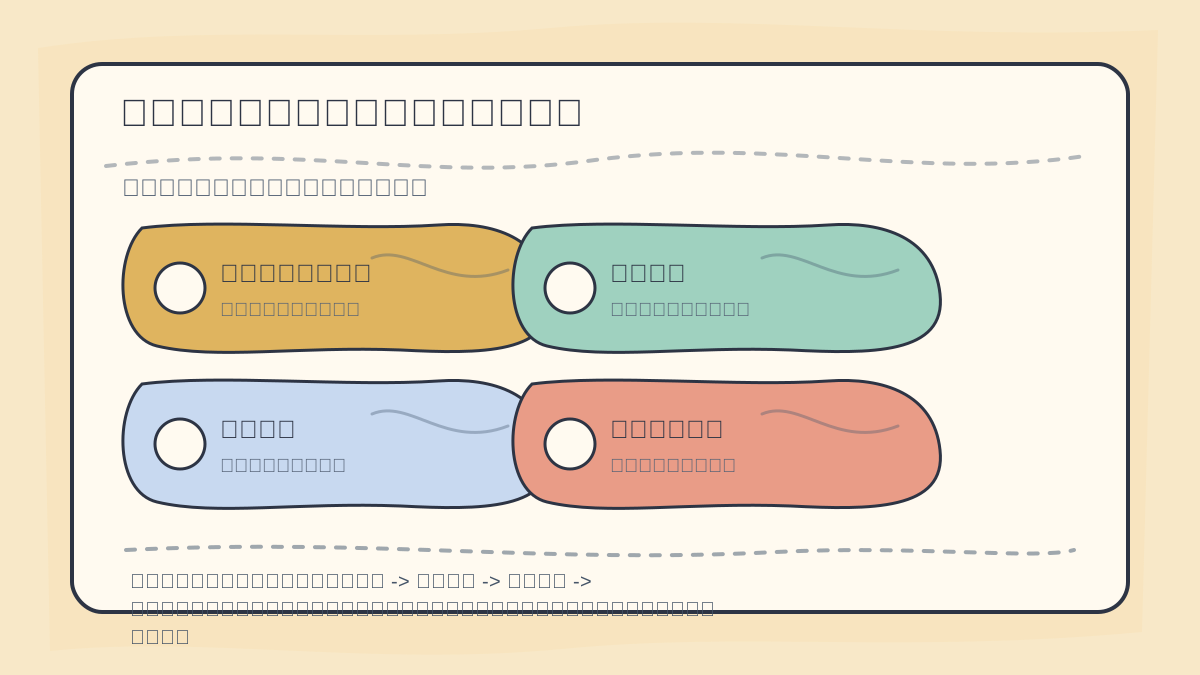
While reading this article, treat the sequence “DBN Overview → Image Classification → Use Case → Code Example” as a verification checklist: first clarify the topic, workflow, and validation points—then revisit specific cases, code, or metrics for cross-checking.
from sklearn.decomposition import PCA
import numpy as np

# Simulated medical imaging data: 1000 samples × 784 features
X = np.random.rand(1000, 784)

# Extract features using DBN (via RBM)
rbm = BernoulliRBM(n_components=64, learning_rate=0.01, n_iter=10, random_state=42)
X_transformed = rbm.fit_transform(X)

# Further reduce dimensionality using PCA
pca = PCA(n_components=2)
X_pca = pca.fit_transform(X_transformed)

print(f"Shape after dimensionality reduction: {X_pca.shape}")
Here, the DBN first compresses the original high-dimensional input into a compact 64-dimensional representation; PCA then projects it into 2D for visualization or lightweight downstream modeling.
3. Natural Language Processing
DBNs have found meaningful applications in Natural Language Processing (NLP), particularly in text feature learning and generative modeling. They effectively capture latent semantic structures in textual data—even without explicit linguistic supervision.
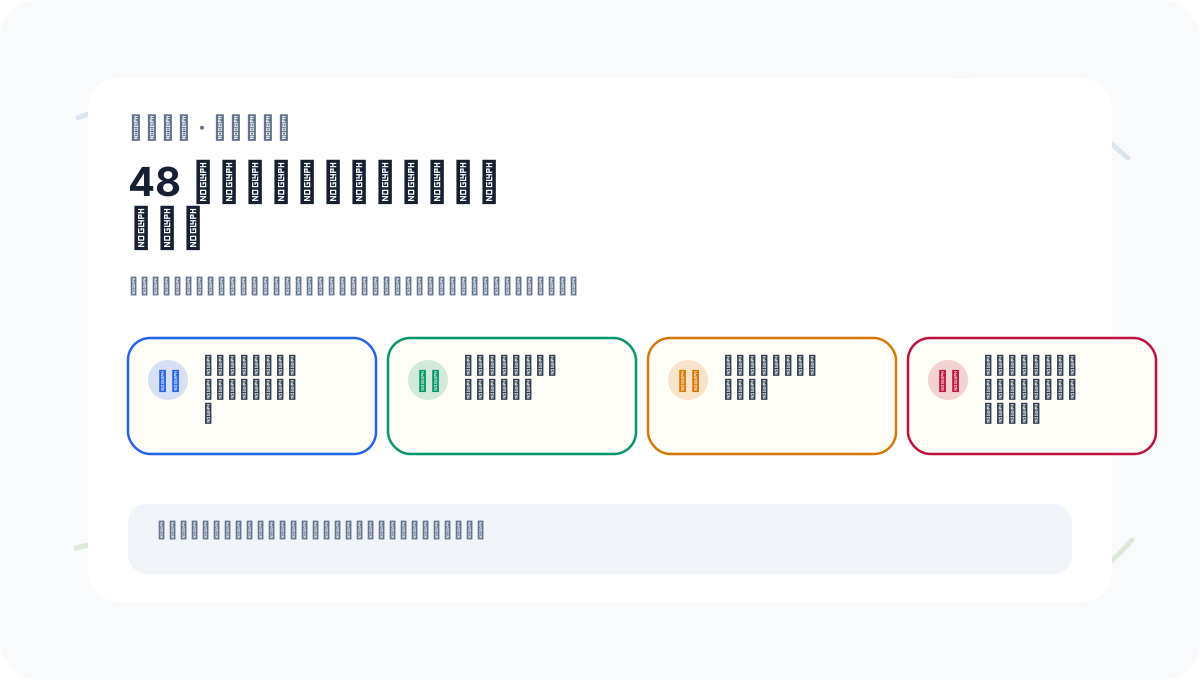
After reading Practical Applications of Deep Belief Networks, try walking through a small end-to-end example first—then assess which steps you can now execute independently.
At this point, summarize Practical Applications of Deep Belief Networks into a retrospective table: articulate the core narrative first, then validate it against a concrete mini-task.
Application Example
In sentiment analysis, DBNs can extract robust textual features from user reviews—enabling reliable binary classification (e.g., positive vs. negative sentiment). Given a corpus of labeled customer feedback, a DBN learns distributed representations capturing sentiment-relevant lexical and syntactic cues.
Read Practical Applications of Deep Belief Networks through the lens of “Scenario → Concept → Action → Outcome.” First align these four dimensions—then return to parameters, code snippets, or procedural details in the main text for deeper grounding.
Conclusion
Deep Belief Networks demonstrate broad applicability across domains—from computer vision to biomedical analytics and NLP—and continue to offer pedagogical and practical value. Their layer-wise pretraining mechanism not only facilitates effective feature learning but also enhances generalization—especially when labeled data is scarce. In the next article, we will delve into Siamese Networks: their training strategies, optimization techniques, and distinctive use cases—continuing our journey through foundational deep learning architectures.
We hope this overview of practical DBN applications has been both informative and actionable!
Apply This Lesson
Turn this article into AI software, model, API, and security decisions.
English Article FAQ
Use this article as evidence before choosing AI tools
How should I use this AI Tutorials article?
Use it as the implementation or learning layer, then connect the idea to AI software buyer guides, tool comparisons, benchmarks, API choices, and security checks before making a production decision.
Is this English article different from the Chinese original?
The English edition is localized for global AI readers while preserving the original diagrams, screenshots, prompts, code examples, and source context from the Chinese article.
What should I read after Load the MNIST dataset?
Continue with AI Software Buyer Guides, AI Tools Workbench, Best AI Coding Agents, AI Model Benchmarks, OpenAI vs Anthropic API, or LLM Security Tools depending on the decision you need to make.
Can this article alone choose an AI product or model?
No. Treat the article as evidence and context, then validate fit with pricing, privacy requirements, integration effort, benchmark results, workflow tests, and fallback planning.
Continue