English translation
Model definition
AI Article Decision Snapshot
Turn the lesson into workflow, model, budget, and security checks before choosing tools.
Use this quick snapshot before leaving the article. It keeps the next search tied to practical AI software, model/API, cost, privacy, and implementation questions.
Workflow fit
Identify the real job behind the article: coding, research, document review, support, analytics, content, or internal automation.
Model or tool decision
Decide whether the next step is a software shortlist, an AI tool comparison, an API platform choice, or a model benchmark.
Budget and usage signal
Estimate seats, API calls, prompt volume, retries, review time, and fallback work before assuming the workflow is cheap.
Security and privacy review
Check whether source code, customer data, private documents, prompts, logs, or embeddings will enter the AI workflow.
Siamese networks excel at determining whether two inputs are similar. Their core design focuses on shared encoders and distance-based learning—not standard classification heads. This article centers on training: only when data preprocessing, loss functions, optimizers, and logging form a closed loop can training outcomes be meaningfully reviewed and reproduced.

I’ll verify positive/negative pair construction, distance function choice, and margin selection. Poorly constructed sample pairs cause the model to quickly learn biased representations.
In the previous article, we explored practical applications of Deep Belief Networks (DBNs), highlighting their capabilities in feature extraction and unsupervised learning. This article delves into training and optimization techniques for Siamese Networks—enabling more effective handling of similarity-learning tasks. We’ll analyze network architecture, the training pipeline, loss function selection, key optimization strategies, and conclude with concrete code examples for reference.
Overview of Siamese Networks
A Siamese network is a specialized neural network architecture typically composed of two or more subnetworks that share identical weights. This structure is commonly used to assess the similarity between two input samples. In practice, Siamese networks are widely applied in face recognition, image retrieval, and matching of semantically related objects.
Network Architecture
The fundamental architecture of a Siamese network consists of:
- Two (or more) structurally identical neural networks—often CNNs or RNNs—with shared weights.
- Two input samples fed separately into each subnetwork for feature extraction.
- The resulting feature vectors concatenated—or otherwise compared—to compute similarity.
Example Architecture Diagram
Input A ----> [Network 1] ----|
                              |----> [Similarity Computation] ----> Output
Input B ----> [Network 2] ----|
Training Process
Training a Siamese network relies on paired samples labeled as “similar” or “dissimilar.” Given an input pair with label , we define if the pair is similar and otherwise.
Loss Functions
Selecting an appropriate loss function is critical. Common choices include:
-
Contrastive Loss:
Measures distances between similar and dissimilar pairs:where is the Euclidean distance between the two feature vectors, and is a predefined margin.
-
Triplet Loss:
Designed for triplets . Its objective is to ensure the distance between the anchor and positive is smaller than that between the anchor and negative, plus a safety margin :where denotes the distance function and is a hyperparameter controlling the required margin.
Optimization Strategies
1. Data Preparation and Augmentation
Appropriate data augmentation significantly improves model generalization. Examples include:
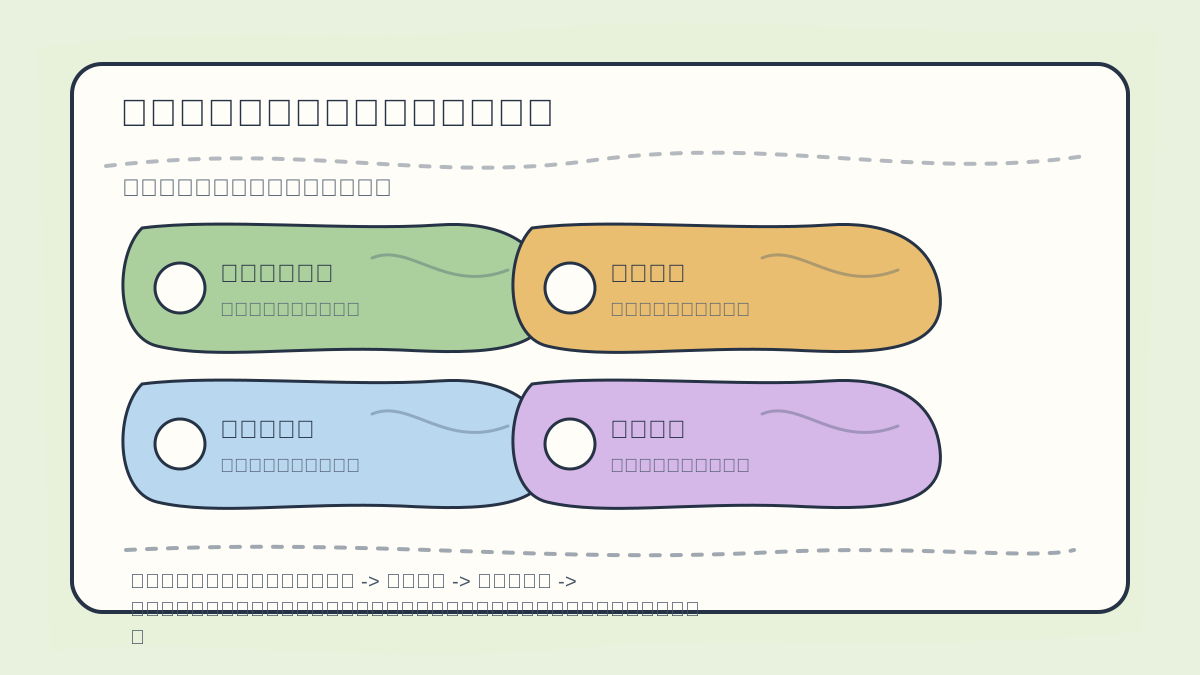
While reading this article, treat the sequence “Overview → Architecture → Example Diagram → Training Process” as a verification checklist: first align the object, steps, and evidence; then revisit case studies, code, or metrics for validation.
- Random cropping
- Rotation
- Color jittering
2. Learning Rate Scheduling
Learning rate schedulers—such as ReduceLROnPlateau—are especially valuable during training. They automatically reduce the learning rate when performance plateaus, enabling finer-grained optimization.
3. Early Stopping
Monitoring validation loss helps prevent overfitting. Training halts early once validation performance begins to degrade.
4. Regularization
L2 regularization can be added to the loss function by penalizing large weight values via the L2 norm—effectively constraining model complexity and mitigating overfitting.
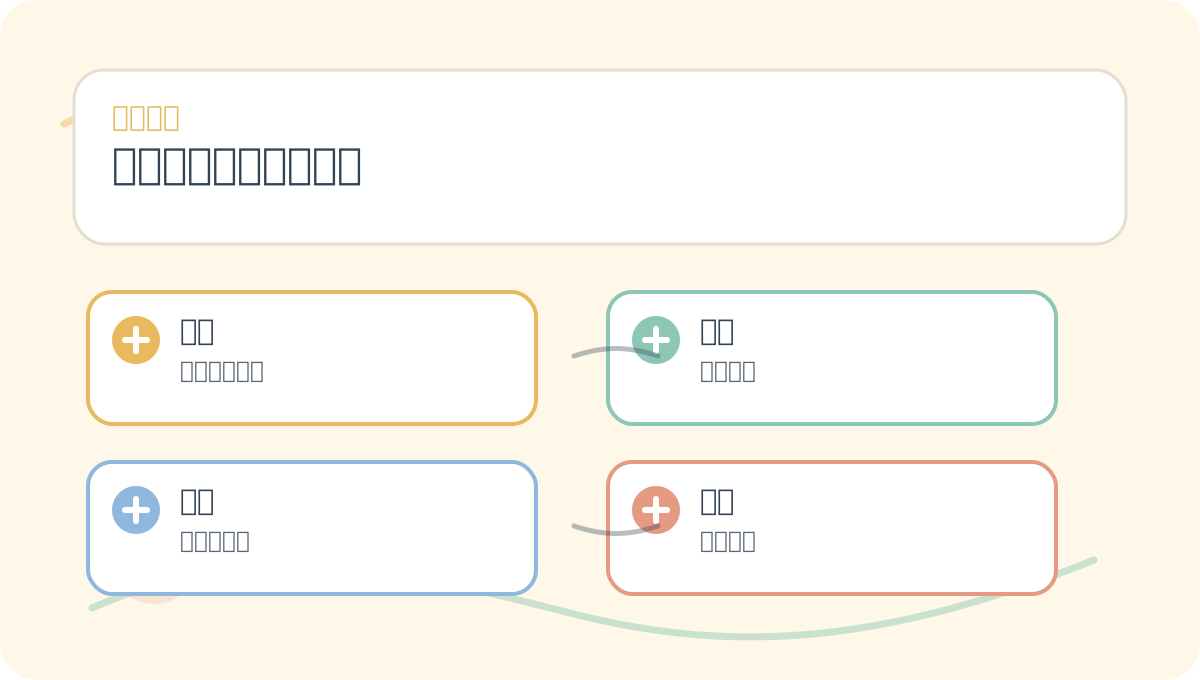
After finishing “Siamese Network Training and Optimization,” use the diagram’s workflow as a checklist: Is the problem clearly defined? Are actions concretely implemented? Can evaluation criteria be reused across contexts?
Case Study: Implementing a Siamese Network
Below is a minimal implementation of a Siamese network for image similarity matching.
import tensorflow as tf
from tensorflow.keras import layers, Model
from tensorflow.keras.losses import BinaryCrossentropy

def create_base_network(input_shape):
    input = layers.Input(shape=input_shape)
    x = layers.Conv2D(64, (3, 3), activation='relu')(input)
    x = layers.MaxPooling2D(pool_size=(2, 2))(x)
    x = layers.Flatten()(x)
    x = layers.Dense(128, activation='relu')(x)
    return Model(input, x)

def create_siamese_network(input_shape):
    base_network = create_base_network(input_shape)

    input_a = layers.Input(shape=input_shape)
    input_b = layers.Input(shape=input_shape)

    processed_a = base_network(input_a)
    processed_b = base_network(input_b)

    distance = layers.Lambda(lambda tensors: tf.norm(tensors[0] - tensors[1], axis=1))([processed_a, processed_b])

    model = Model(inputs=[input_a, input_b], outputs=distance)
    return model

# Model definition
input_shape = (64, 64, 3)
siamese_network = create_siamese_network(input_shape)
siamese_network.compile(loss=BinaryCrossentropy(from_logits=False), optimizer='adam')

# Training example (uncomment and adapt for actual use)
# siamese_network.fit([input_a, input_b], labels, epochs=50, batch_size=32)
When reviewing “Siamese Network Training and Optimization,” place key concepts, procedural steps, and observable outcomes side-by-side on a single page for efficient reflection.
When practicing “Siamese Network Training and Optimization,” explicitly write down the input conditions, processing actions, and observable results together—making future review straightforward.
Summary
This article thoroughly examined Siamese network training and optimization, emphasizing critical aspects including data preparation, loss function selection, and practical optimization techniques. In upcoming articles, we will compare different Siamese network variants and analyze their performance and implementation details across diverse tasks.
We hope this article deepens your understanding of how to effectively train and optimize Siamese networks.
Apply This Lesson
Turn this article into AI software, model, API, and security decisions.
English Article FAQ
Use this article as evidence before choosing AI tools
How should I use this AI Tutorials article?
Use it as the implementation or learning layer, then connect the idea to AI software buyer guides, tool comparisons, benchmarks, API choices, and security checks before making a production decision.
Is this English article different from the Chinese original?
The English edition is localized for global AI readers while preserving the original diagrams, screenshots, prompts, code examples, and source context from the Chinese article.
What should I read after Model definition?
Continue with AI Software Buyer Guides, AI Tools Workbench, Best AI Coding Agents, AI Model Benchmarks, OpenAI vs Anthropic API, or LLM Security Tools depending on the decision you need to make.
Can this article alone choose an AI product or model?
No. Treat the article as evidence and context, then validate fit with pricing, privacy requirements, integration effort, benchmark results, workflow tests, and fallback planning.
Continue