English translation
Siamese Networks: Model Comparison
AI Article Decision Snapshot
Turn the lesson into workflow, model, budget, and security checks before choosing tools.
Use this quick snapshot before leaving the article. It keeps the next search tied to practical AI software, model/API, cost, privacy, and implementation questions.
Workflow fit
Identify the real job behind the article: coding, research, document review, support, analytics, content, or internal automation.
Model or tool decision
Decide whether the next step is a software shortlist, an AI tool comparison, an API platform choice, or a model benchmark.
Budget and usage signal
Estimate seats, API calls, prompt volume, retries, review time, and fallback work before assuming the workflow is cheap.
Security and privacy review
Check whether source code, customer data, private documents, prompts, logs, or embeddings will enter the AI workflow.
Siamese networks are designed to assess how similar two inputs are. Their core design focuses on shared encoders and distance-based learning, rather than conventional classification heads. This article begins by establishing a high-level conceptual map: what problem it solves, what its key components are, and in which types of tasks it fits best.

I will verify three critical aspects: positive/negative pair construction, the distance function, and the margin. Poorly constructed sample pairs cause the model to quickly learn biased or meaningless representations.
In the previous article, we delved deeply into training and optimization strategies for Siamese networks. This article shifts focus to comparing several distinct Siamese network variants—highlighting their respective strengths, weaknesses, and ideal application scenarios. Finally, we’ll lay the groundwork for the upcoming article on ResNeXt-based object detection.
Introduction to Siamese Networks
A Siamese Network is a specialized neural network architecture designed to learn similarity relationships between input data samples. It typically consists of two (or more) identical subnetworks—often called “twins”—that share weights and structure. Each twin independently processes one input, and their outputs are compared using a metric function (e.g., Euclidean distance, cosine similarity) to produce a similarity score.
Comparative Analysis of Siamese Network Models
1. Convolutional Siamese Networks
For image data, CNNs (Convolutional Neural Networks) are the most common backbone. Convolutional Siamese networks are widely used in tasks such as image similarity assessment, image retrieval, and face recognition.
-
Advantages:
- Effectively extract hierarchical visual features.
- Exhibit invariance to local transformations (e.g., translation, small rotations).
-
Disadvantages:
- May be sensitive to complex geometric or photometric distortions between images.
Example
import tensorflow as tf
from tensorflow.keras import layers, Model

def create_siamese_cnn(input_shape):
    input_a = layers.Input(shape=input_shape)
    input_b = layers.Input(shape=input_shape)

    base_cnn = tf.keras.Sequential([
        layers.Conv2D(32, (3, 3), activation='relu'),
        layers.MaxPooling2D(pool_size=(2, 2)),
        layers.Conv2D(64, (3, 3), activation='relu'),
        layers.MaxPooling2D(pool_size=(2, 2)),
        layers.Flatten(),
        layers.Dense(128, activation='relu')
    ])

    encoded_a = base_cnn(input_a)
    encoded_b = base_cnn(input_b)

    # Compute Euclidean distance
    distance = layers.Lambda(lambda tensors: tf.sqrt(tf.reduce_sum(tf.square(tensors[0] - tensors[1]))))([encoded_a, encoded_b])

    model = Model(inputs=[input_a, input_b], outputs=distance)
    return model

siamese_cnn_model = create_siamese_cnn((28, 28, 1))
siamese_cnn_model.summary()
2. LSTM-based Siamese Networks
For sequential data—such as text or time-series signals—LSTMs (Long Short-Term Memory networks) serve as a natural choice. LSTM-based Siamese networks excel at tasks like textual similarity estimation and semantic matching.
-
Advantages:
- Capture long-range temporal dependencies effectively.
- Handle variable-length sequences robustly.
-
Disadvantages:
- Training is computationally intensive and slower due to sequential processing.
Example
from tensorflow.keras.models import Model
from tensorflow.keras.layers import Input, LSTM, Dense

def create_siamese_lstm(input_shape):
    input_a = Input(shape=input_shape)
    input_b = Input(shape=input_shape)

    lstm_layer = LSTM(64)

    encoded_a = lstm_layer(input_a)
    encoded_b = lstm_layer(input_b)

    distance = layers.Lambda(lambda tensors: tf.sqrt(tf.reduce_sum(tf.square(tensors[0] - tensors[1]))))([encoded_a, encoded_b])

    model = Model(inputs=[input_a, input_b], outputs=distance)
    return model

siamese_lstm_model = create_siamese_lstm((None, 100))  # Assume variable-length sequence of 100-D features
siamese_lstm_model.summary()
3. Transformer-based Siamese Networks
In recent years, the Transformer architecture has risen rapidly due to its exceptional performance across domains. Transformer-based Siamese networks are now widely applied in both natural language processing and vision tasks—including semantic similarity, cross-modal alignment, and few-shot learning.
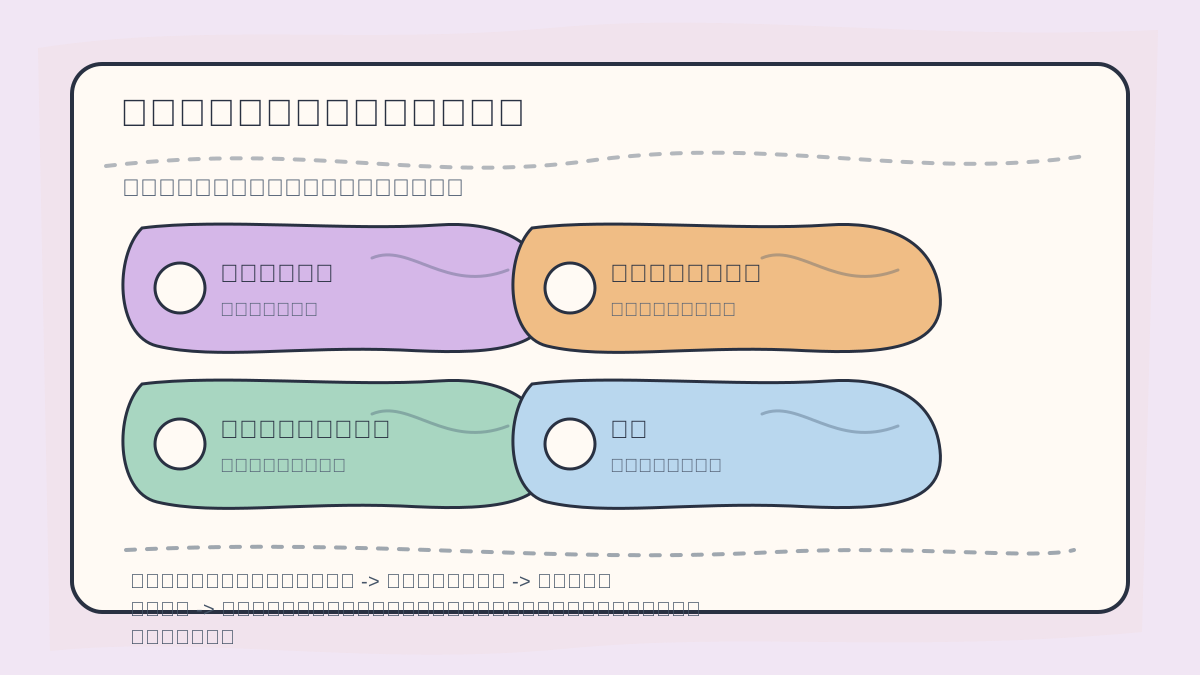
While reading this article, treat the flow “Introduction → Model Comparison → Convolutional Siamese Networks → Example” as a verification checklist: first align the object, steps, and evidence; then revisit concrete examples, code, or evaluation metrics for validation.
-
Advantages:
- Efficiently model long-range dependencies without recurrence.
- Enable full parallelization during training, significantly improving throughput.
-
Disadvantages:
- Require large-scale datasets for stable training.
- Higher parameter count and computational overhead.
Example
from tensorflow.keras.layers import MultiHeadAttention

def create_siamese_transformer(input_shape):
    input_a = Input(shape=input_shape)
    input_b = Input(shape=input_shape)

    transformer_layer = MultiHeadAttention(num_heads=4, key_dim=64)

    encoded_a = transformer_layer(input_a, input_a)
    encoded_b = transformer_layer(input_b, input_b)

    distance = layers.Lambda(lambda tensors: tf.sqrt(tf.reduce_sum(tf.square(tensors[0] - tensors[1]))))([encoded_a, encoded_b])

    model = Model(inputs=[input_a, input_b], outputs=distance)
    return model

siamese_transformer_model = create_siamese_transformer((10, 64))  # Assume 10 timesteps × 64-D features per step
siamese_transformer_model.summary()
After completing “Siamese Network Model Comparison”, try adapting it to your own use case. Pay close attention to whether the inputs, processing logic, and outputs remain logically consistent and aligned.
To apply “Siamese Network Model Comparison” to your own task, start small: isolate and validate just one critical decision point—e.g., how positive/negative pairs are defined or which distance metric yields the clearest separation.
Conclusion
By comparing different Siamese network variants, we observe that each excels—and falters—in distinct contexts. Model selection must therefore balance task requirements with practical constraints: data scale, available compute resources, latency budgets, and desired accuracy. In the next article, we’ll introduce the ResNeXt architecture and explore its application in object detection—stay tuned!
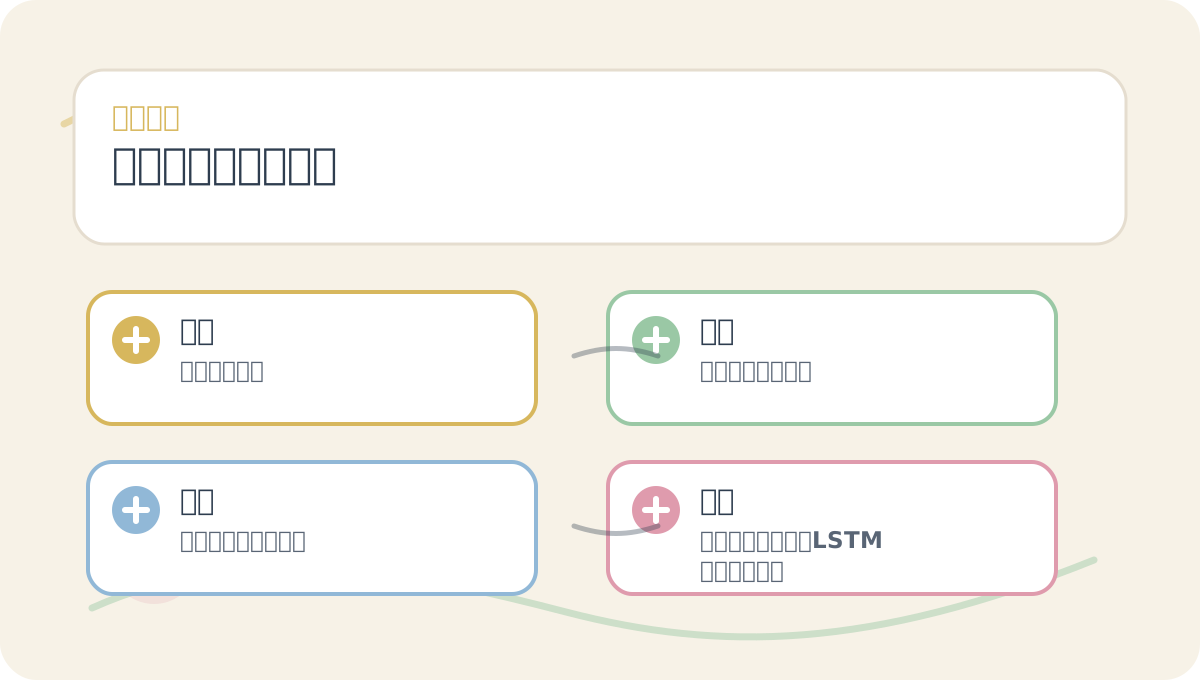
Before diving into the main text of “Siamese Network Model Comparison”, scan the accompanying illustrations: What question does the diagram pose? Which concepts need clear distinction? Which step invites hands-on experimentation? And finally—what criteria define successful completion?
Apply This Lesson
Turn this article into AI software, model, API, and security decisions.
English Article FAQ
Use this article as evidence before choosing AI tools
How should I use this AI Tutorials article?
Use it as the implementation or learning layer, then connect the idea to AI software buyer guides, tool comparisons, benchmarks, API choices, and security checks before making a production decision.
Is this English article different from the Chinese original?
The English edition is localized for global AI readers while preserving the original diagrams, screenshots, prompts, code examples, and source context from the Chinese article.
What should I read after Siamese Networks: Model Comparison?
Continue with AI Software Buyer Guides, AI Tools Workbench, Best AI Coding Agents, AI Model Benchmarks, OpenAI vs Anthropic API, or LLM Security Tools depending on the decision you need to make.
Can this article alone choose an AI product or model?
No. Treat the article as evidence and context, then validate fit with pricing, privacy requirements, integration effort, benchmark results, workflow tests, and fallback planning.
Continue