English translation
Build ResNeXt-based Faster R-CNN
AI Article Decision Snapshot
Turn the lesson into workflow, model, budget, and security checks before choosing tools.
Use this quick snapshot before leaving the article. It keeps the next search tied to practical AI software, model/API, cost, privacy, and implementation questions.
Workflow fit
Identify the real job behind the article: coding, research, document review, support, analytics, content, or internal automation.
Model or tool decision
Decide whether the next step is a software shortlist, an AI tool comparison, an API platform choice, or a model benchmark.
Budget and usage signal
Estimate seats, API calls, prompt volume, retries, review time, and fallback work before assuming the workflow is cheap.
Security and privacy review
Check whether source code, customer data, private documents, prompts, logs, or embeddings will enter the AI workflow.
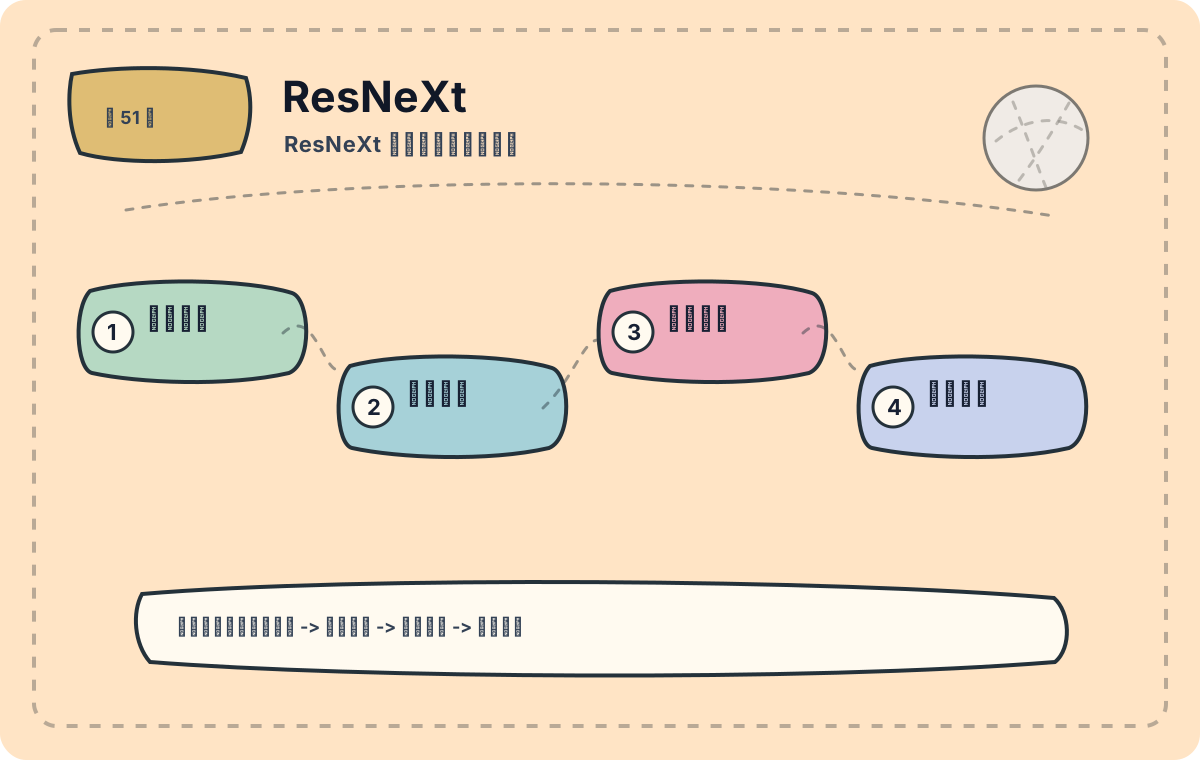
ResNeXt incorporates grouped convolutions into ResNet’s residual framework, enabling the network to extract features through more parallel pathways. To understand it effectively, consider depth, width, and the number of groups simultaneously. This article focuses on practical application scenarios: first assess whether the task truly aligns with ResNeXt’s strengths; then evaluate data scale, deployment cost, and performance boundaries.
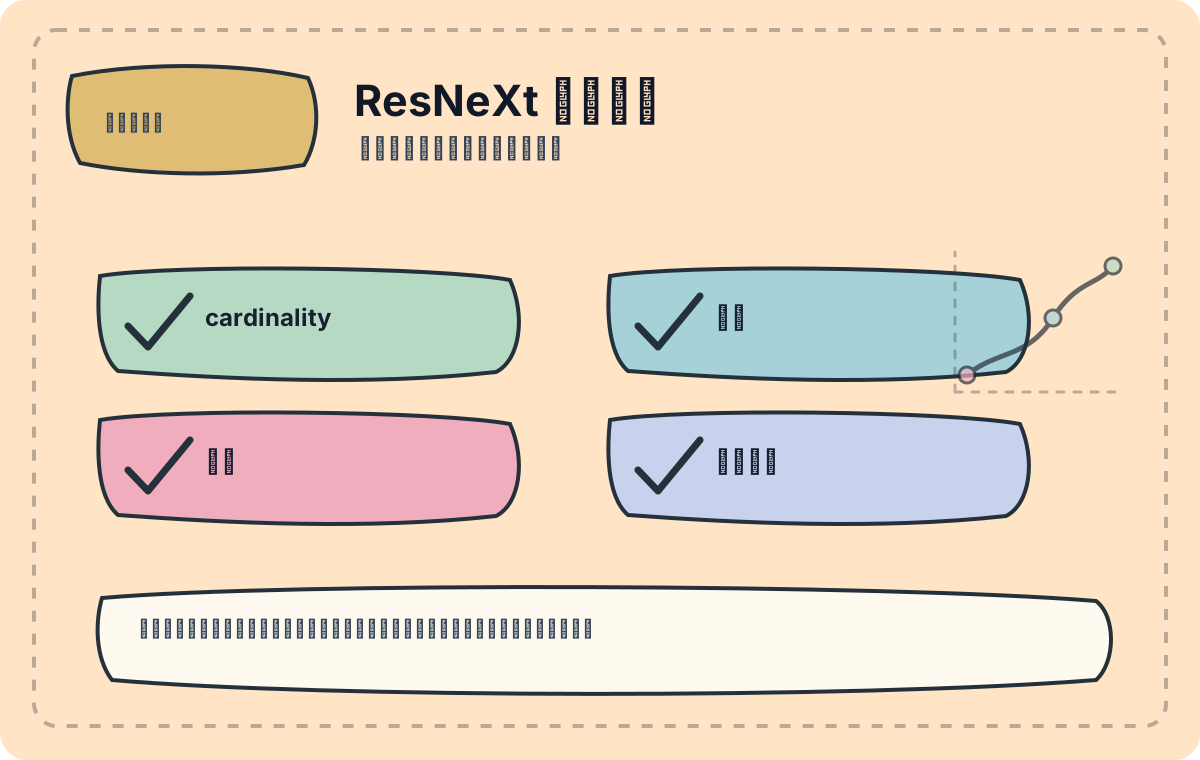
I will explicitly list the number of groups, channel count, and output feature map dimensions—then determine whether the architecture is suitable for attaching an object detection or classification head.
In the previous article, we compared various Siamese network architectures and examined their effectiveness in similarity matching and image retrieval. In this article, we focus specifically on ResNeXt’s application in object detection, particularly how its innovative architectural design enhances detection accuracy.
Overview of ResNeXt
ResNeXt is an enhanced convolutional neural network (CNN) built upon ResNet. Its core innovation lies in introducing grouped convolutions and a new dimension called cardinality—a measure of “width” distinct from channel count—to boost model expressiveness. This design strikes a balance between feature extraction depth and computational efficiency. By delivering more robust feature representations, ResNeXt handles the diversity of real-world object detection data more effectively.
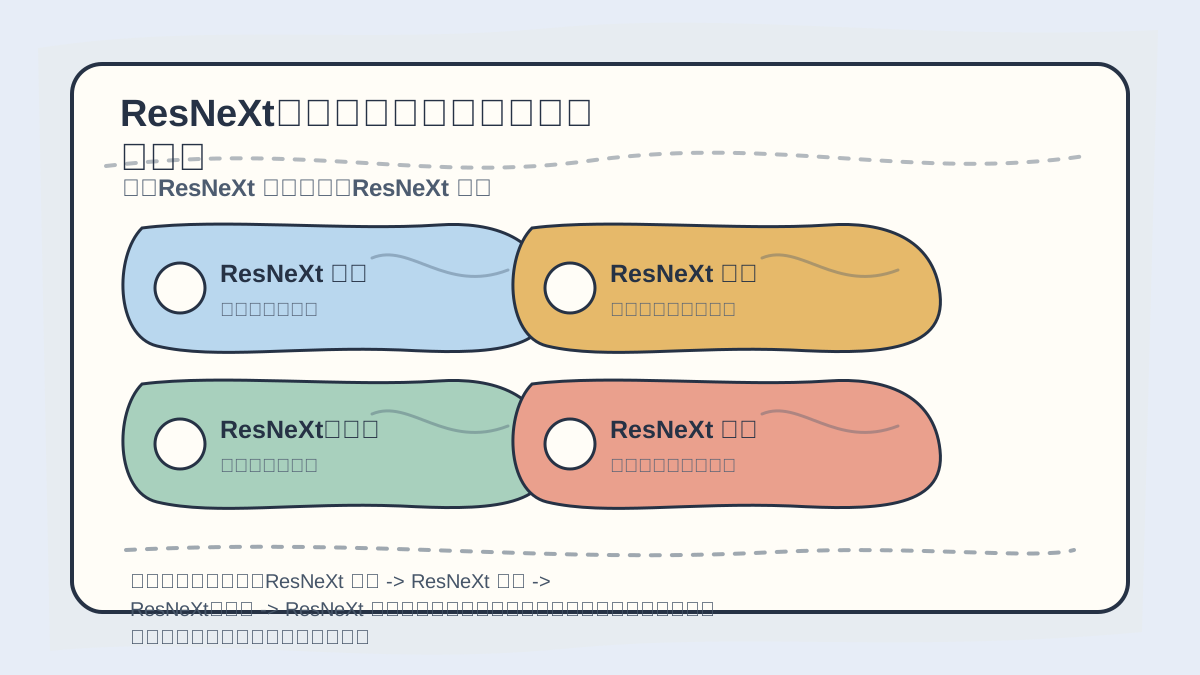
While reading this article, treat the sequence “ResNeXt Overview → ResNeXt Architecture → ResNeXt in Object Detection → ResNeXt as Backbone” as a structured checklist: first clarify the materials (components), operations (transformations), and outcomes (outputs); then revisit concrete examples, code snippets, or evaluation metrics for verification.
ResNeXt Architecture
The core idea behind ResNeXt can be expressed mathematically via the standard residual formulation. For a given layer, the output is typically defined as:
where denotes a nonlinear transformation applied to input . By integrating grouped convolutions, ResNeXt enables multiple, parallel instantiations of —effectively expanding representational capacity without significantly increasing parameter count.
How ResNeXt Works in Object Detection
In object detection pipelines, ResNeXt commonly serves as a backbone feature extractor, integrated with established frameworks such as Faster R-CNN or YOLO. Below, we use Faster R-CNN as a representative example to illustrate how ResNeXt improves detection performance.
Articles like “ResNeXt in Object Detection” risk getting lost in technical details. Start by tracing the main conceptual thread shown in the diagram—then return to the text to verify the environment setup, input/output specifications, and evaluation criteria.
ResNeXt as Feature Extractor
Within Faster R-CNN, object detection proceeds in two primary stages:
- Region Proposal Generation
- Classification and Localization based on those proposals
When ResNeXt replaces the default backbone (e.g., ResNet-50), its superior feature representation capability yields higher-quality feature maps—leading to more accurate region proposals and ultimately improved detection precision.
Example Code
Below is a minimal working example demonstrating how to integrate ResNeXt as the backbone in a Faster R-CNN model:
import torchvision
from torchvision.models.detection import FasterRCNN
from torchvision.models import resnet50
import torch.nn as nn

# Build ResNeXt-based Faster R-CNN
def get_resnext_model():
    # Load pretrained ResNeXt-50 (32x4d)
    backbone = torchvision.models.resnext50_32x4d(pretrained=True)
    # Remove final FC layer; retain only feature extraction layers
    backbone = nn.Sequential(*list(backbone.children())[:-2])

    # ResNeXt-50 outputs 2048 channels at final spatial resolution
    out_channels = 2048

    # Instantiate Faster R-CNN with custom backbone
    model = FasterRCNN(backbone, num_classes=91)  # COCO has 91 classes
    return model

# Initialize and set to evaluation mode
model = get_resnext_model()
model.eval()
Practical Performance Gains
Using ResNeXt as backbone typically yields measurable improvements across key metrics:
- Mean Average Precision (mAP): Especially on large-scale benchmarks like COCO, ResNeXt consistently lifts mAP over baseline ResNet backbones.
- Small Object Detection: Grouped convolutions enhance local pattern sensitivity, improving feature fidelity for small objects.
Empirical comparisons—e.g., ResNet-50 vs. ResNeXt-50 on COCO—confirm these gains: ResNeXt achieves higher detection accuracy while maintaining comparable inference latency.
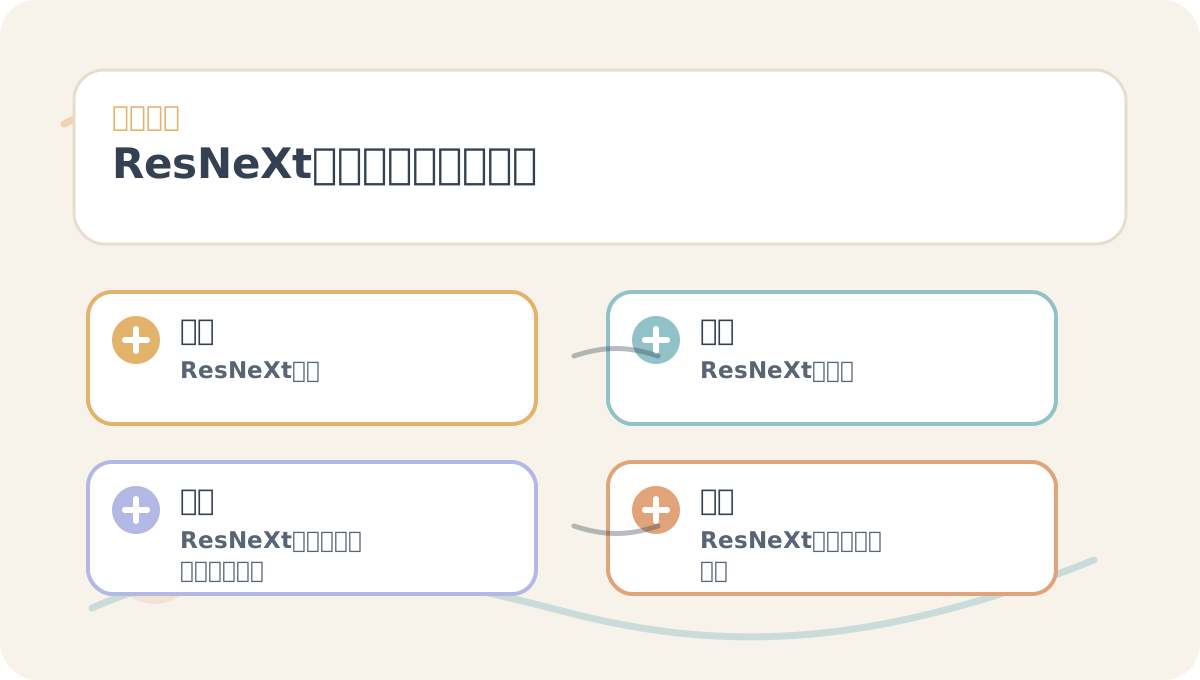
If you haven’t fully internalized “ResNeXt in Object Detection”, walk through the four actions outlined on this card to reinforce understanding.
When revisiting “ResNeXt in Object Detection”, avoid launching full-scale projects upfront. Instead, validate the core logic using one simple, runnable example.
Conclusion
ResNeXt demonstrates exceptional feature extraction capability in object detection—particularly under challenging conditions involving complex scenes and highly diverse object categories. In upcoming case studies, we’ll reproduce these benefits in practice and analyze how architectural choices affect model behavior across varying configurations.
In the next article, we’ll extend this analysis with concrete implementation examples, exploring ResNeXt’s performance across diverse object detection tasks—and addressing practical challenges encountered during deployment, along with proven mitigation strategies.
Apply This Lesson
Turn this article into AI software, model, API, and security decisions.
English Article FAQ
Use this article as evidence before choosing AI tools
How should I use this AI Tutorials article?
Use it as the implementation or learning layer, then connect the idea to AI software buyer guides, tool comparisons, benchmarks, API choices, and security checks before making a production decision.
Is this English article different from the Chinese original?
The English edition is localized for global AI readers while preserving the original diagrams, screenshots, prompts, code examples, and source context from the Chinese article.
What should I read after Build ResNeXt-based Faster R-CNN?
Continue with AI Software Buyer Guides, AI Tools Workbench, Best AI Coding Agents, AI Model Benchmarks, OpenAI vs Anthropic API, or LLM Security Tools depending on the decision you need to make.
Can this article alone choose an AI product or model?
No. Treat the article as evidence and context, then validate fit with pricing, privacy requirements, integration effort, benchmark results, workflow tests, and fallback planning.
Continue