English translation
Instantiate generators and discriminators
AI Article Decision Snapshot
Turn the lesson into workflow, model, budget, and security checks before choosing tools.
Use this quick snapshot before leaving the article. It keeps the next search tied to practical AI software, model/API, cost, privacy, and implementation questions.
Workflow fit
Identify the real job behind the article: coding, research, document review, support, analytics, content, or internal automation.
Model or tool decision
Decide whether the next step is a software shortlist, an AI tool comparison, an API platform choice, or a model benchmark.
Budget and usage signal
Estimate seats, API calls, prompt volume, retries, review time, and fallback work before assuming the workflow is cheap.
Security and privacy review
Check whether source code, customer data, private documents, prompts, logs, or embeddings will enter the AI workflow.
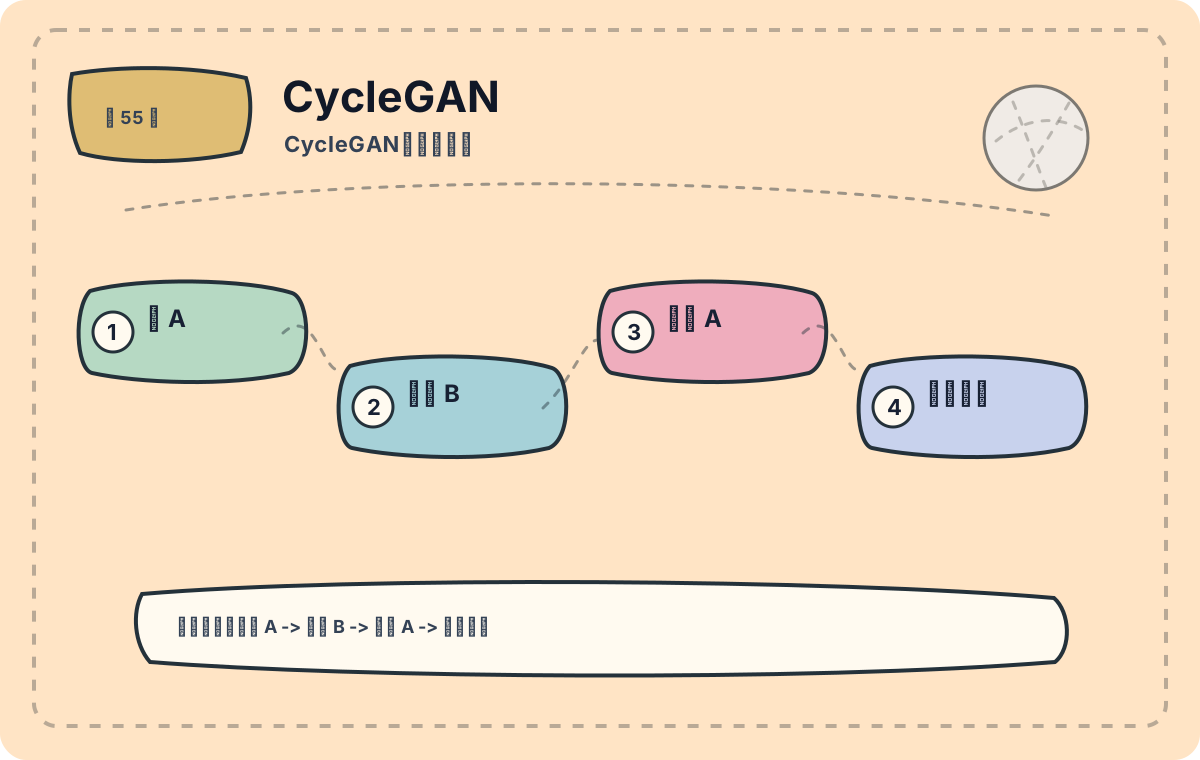
CycleGAN’s key innovation lies in its ability to learn mappings between two visual domains without requiring paired training data. The cycle-consistency constraint is essential—it prevents semantic content from drifting during translation. This article first establishes the big picture: what problem CycleGAN solves, what its core components are, and which types of tasks it best suits.
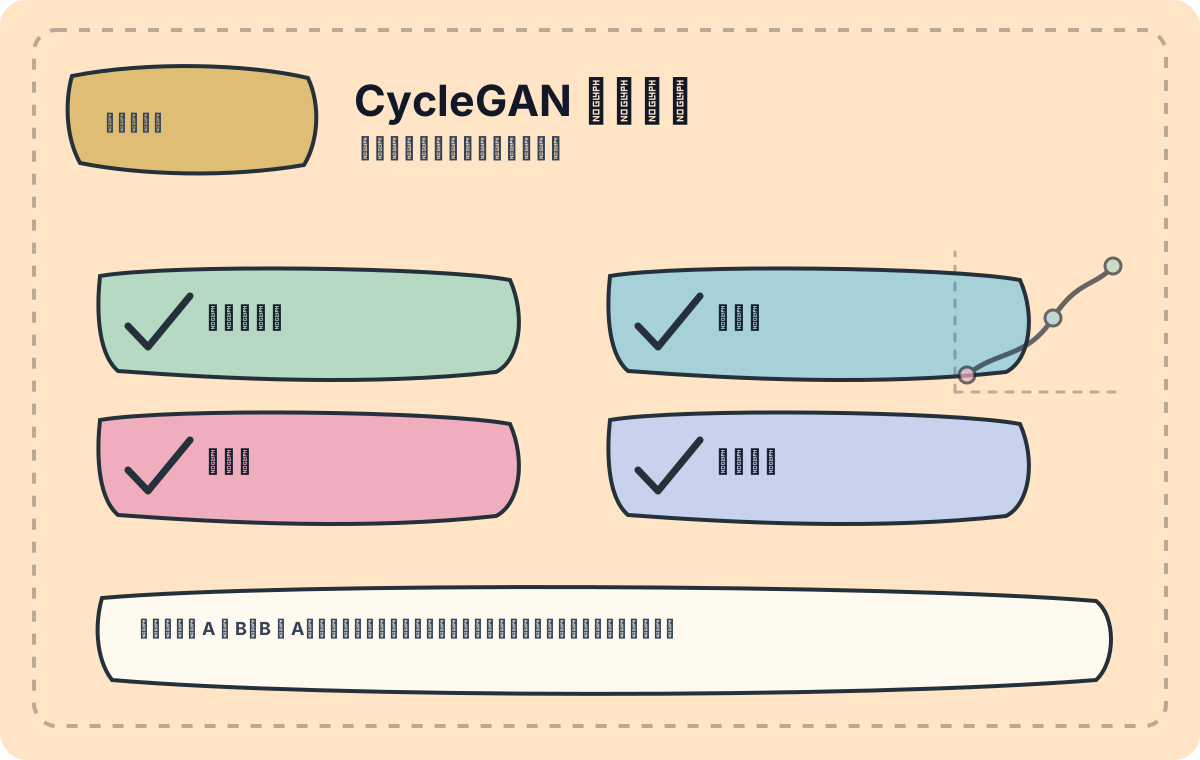
I simultaneously monitor four signals: translation from domain A to B, translation from B to A, reconstruction fidelity (i.e., how well the original image is recovered), and discriminator losses. Relying solely on subjective visual quality of generated images risks overlooking semantic misalignment or content distortion.
In the previous article, we summarized the application of Pix2Pix, examining its performance and advantages in image-to-image translation tasks. This article shifts focus to CycleGAN—an unsupervised adversarial generative network widely adopted for style transfer and unpaired image-to-image translation. We will delve into CycleGAN’s architecture and operational principles, illustrated with concrete examples.
Core Concepts of CycleGAN
CycleGAN aims to perform image-to-image translation—especially when no paired training samples are available. Unlike Pix2Pix, CycleGAN constructs a cycle-consistent framework, enabling bidirectional translation between two distinct domains. Its objective is to jointly learn two generators (G and F) and two discriminators (D_X and D_Y):
- G maps images from source domain X to target domain Y;
- F maps images from Y back to X.
Crucially, CycleGAN introduces a cycle-consistency loss to ensure that translated images can be faithfully reconstructed back to their originals.
Network Architecture of CycleGAN
CycleGAN comprises the following key components:
-
Generators (G and F):
- Generator G transforms source-domain images into target-domain images .
- Generator F performs the inverse mapping: .
-
Discriminators ( and ):
- Discriminator distinguishes real images from domain versus those synthesized by G.
- Discriminator performs the analogous task for domain and generator F.
-
Cycle-Consistency Loss:
- This is the cornerstone of CycleGAN, defined as:
It enforces that round-trip translations preserve structural and semantic content.
-
Adversarial Loss:
- Designed to push generated images toward realism, this loss follows the standard GAN formulation:
Training Procedure of CycleGAN
- Network Initialization: Randomly initialize parameters of both generators and discriminators.
- Adversarial Training: Alternately optimize discriminators (to better distinguish real vs. fake) and generators (to fool discriminators).
- Cycle-Consistency Optimization: At each iteration, compute the cycle-consistency loss and update generators to minimize it.
Below is a Python code snippet illustrating how to implement CycleGAN’s basic architecture using PyTorch:
import torch
import torch.nn as nn

class Generator(nn.Module):
    def __init__(self):
        super(Generator, self).__init__()
        # Define network architecture
        self.model = nn.Sequential(
            # Convolutional layers, activation functions, etc.
        )

    def forward(self, x):
        return self.model(x)

class Discriminator(nn.Module):
    def __init__(self):
        super(Discriminator, self).__init__()
        # Define network architecture
        self.model = nn.Sequential(
            # Convolutional layers, activation functions, etc.
        )

    def forward(self, x):
        return self.model(x)

# Instantiate generators and discriminators
G = Generator()
F = Generator()
D_X = Discriminator()
D_Y = Discriminator()
With this foundational structure, you can implement computation and optimization of both the cycle-consistency and adversarial losses. Subsequent sections will analyze CycleGAN’s application in specific style-reconstruction tasks.
Real-World Application Examples of CycleGAN
CycleGAN has achieved remarkable results across diverse domains—particularly in artistic style transfer and unpaired image translation. Representative applications include:
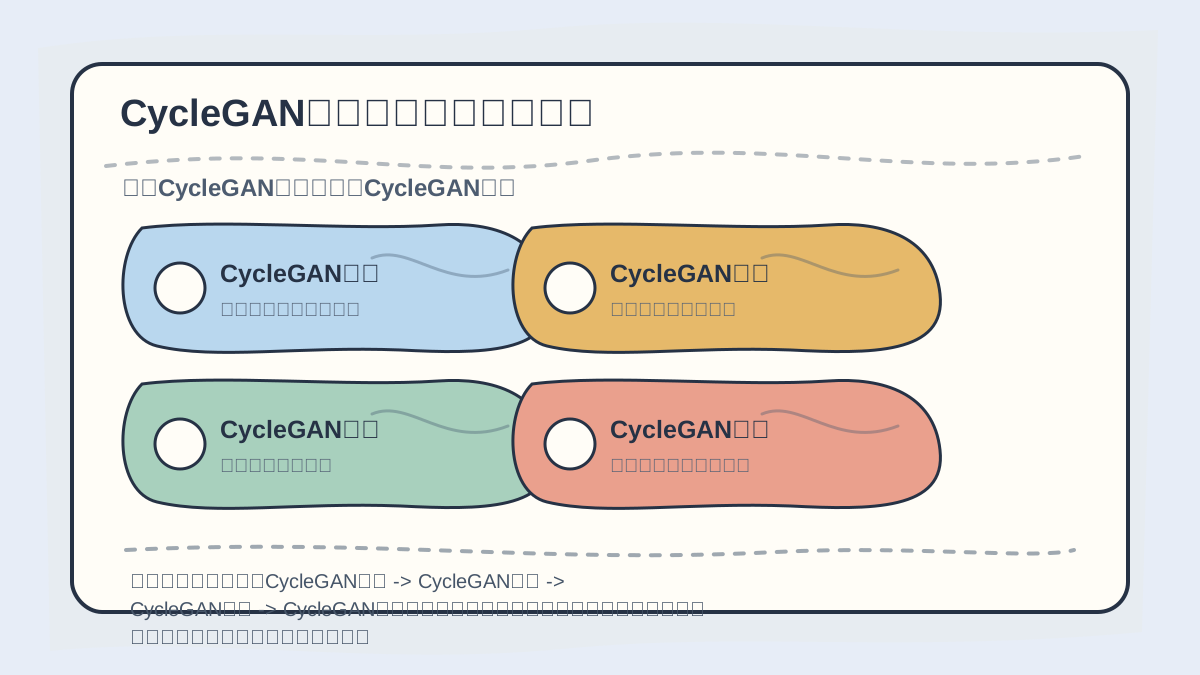
While reading this article, treat the progression “CycleGAN’s foundation → network → training → implementation” as a verification checklist: First align the problem definition, procedural steps, and empirical evidence; then revisit case studies, code, or evaluation metrics for validation.
- Image Style Transfer: Converting horse photos into zebra-like appearances—and vice versa.
- Seasonal Transformation: Translating summer landscape photos into winter scenes, capturing seasonal shifts.
- Photograph-to-Painting Translation: Rendering natural photographs in oil-painting style to evoke distinct artistic aesthetics.
Here’s a simplified example: translating horses into zebras.
# Pseudocode example
def train_cyclegan(epochs):
    for epoch in range(1, epochs + 1):
        for real_x, real_y in data_loader:
            # Update discriminators
            ...
            # Update generators
            ...
If you haven’t fully internalized “CycleGAN’s Neural Network”, use the four actions on this card to retrace your understanding step-by-step.
When revisiting “CycleGAN’s Neural Network”, avoid launching large-scale projects upfront. Instead, start with one simple example to verify whether the core workflow is clear.
Summary
This article comprehensively introduced CycleGAN’s neural network architecture and underlying principles. By integrating cycle consistency with adversarial learning, CycleGAN enables effective unsupervised image-to-image translation. In upcoming sections, we will explore CycleGAN’s concrete applications in style reconstruction—demonstrating both its transformation efficiency and visual fidelity.
Before reading “CycleGAN’s Neural Network”, use the accompanying illustrations to confirm the central narrative. After reading, revisit each step to identify which parts are immediately actionable—and which require further background study.
Apply This Lesson
Turn this article into AI software, model, API, and security decisions.
English Article FAQ
Use this article as evidence before choosing AI tools
How should I use this AI Tutorials article?
Use it as the implementation or learning layer, then connect the idea to AI software buyer guides, tool comparisons, benchmarks, API choices, and security checks before making a production decision.
Is this English article different from the Chinese original?
The English edition is localized for global AI readers while preserving the original diagrams, screenshots, prompts, code examples, and source context from the Chinese article.
What should I read after Instantiate generators and discriminators?
Continue with AI Software Buyer Guides, AI Tools Workbench, Best AI Coding Agents, AI Model Benchmarks, OpenAI vs Anthropic API, or LLM Security Tools depending on the decision you need to make.
Can this article alone choose an AI product or model?
No. Treat the article as evidence and context, then validate fit with pricing, privacy requirements, integration effort, benchmark results, workflow tests, and fallback planning.
Continue