English translation
Data loading and preprocessing
AI Article Decision Snapshot
Turn the lesson into workflow, model, budget, and security checks before choosing tools.
Use this quick snapshot before leaving the article. It keeps the next search tied to practical AI software, model/API, cost, privacy, and implementation questions.
Workflow fit
Identify the real job behind the article: coding, research, document review, support, analytics, content, or internal automation.
Model or tool decision
Decide whether the next step is a software shortlist, an AI tool comparison, an API platform choice, or a model benchmark.
Budget and usage signal
Estimate seats, API calls, prompt volume, retries, review time, and fallback work before assuming the workflow is cheap.
Security and privacy review
Check whether source code, customer data, private documents, prompts, logs, or embeddings will enter the AI workflow.
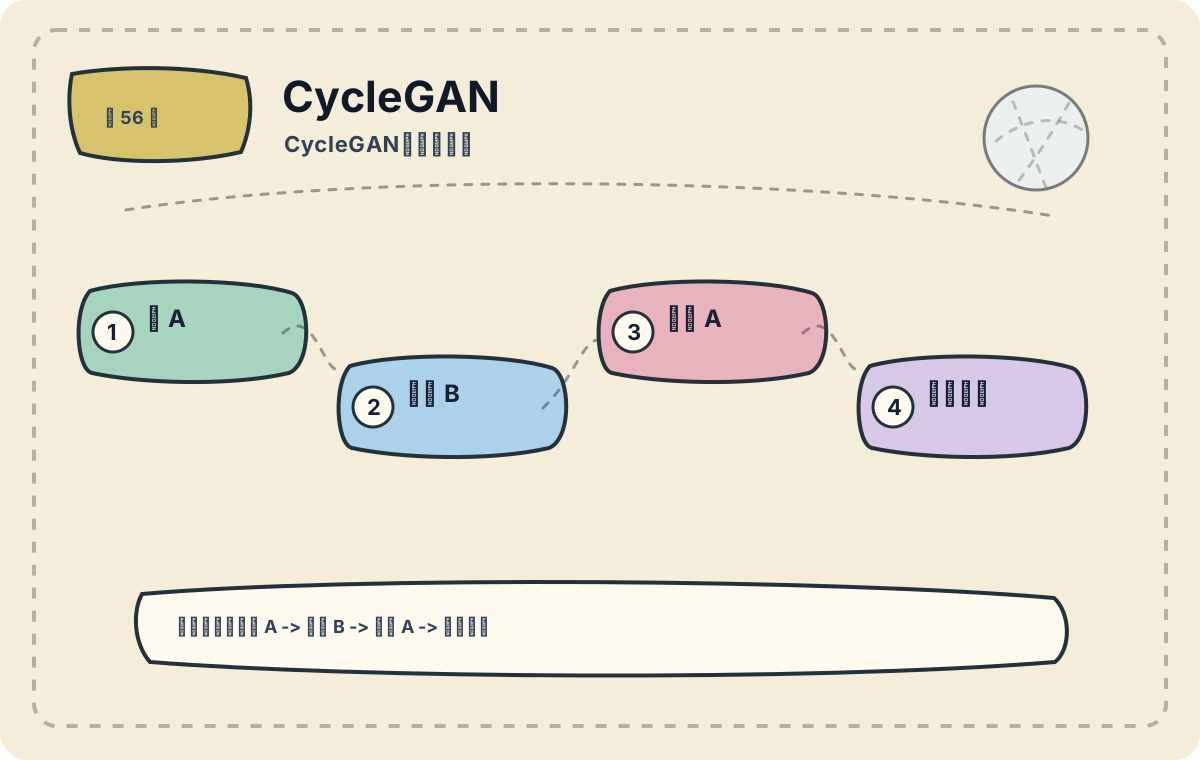
CycleGAN’s key innovation is its ability to learn mappings between two visual domains without requiring paired training data. The cycle-consistency constraint is essential—it prevents content distortion and ensures structural fidelity across translations. This article first establishes the big picture: what problem it solves, what its core components are, and which types of tasks it best suits.
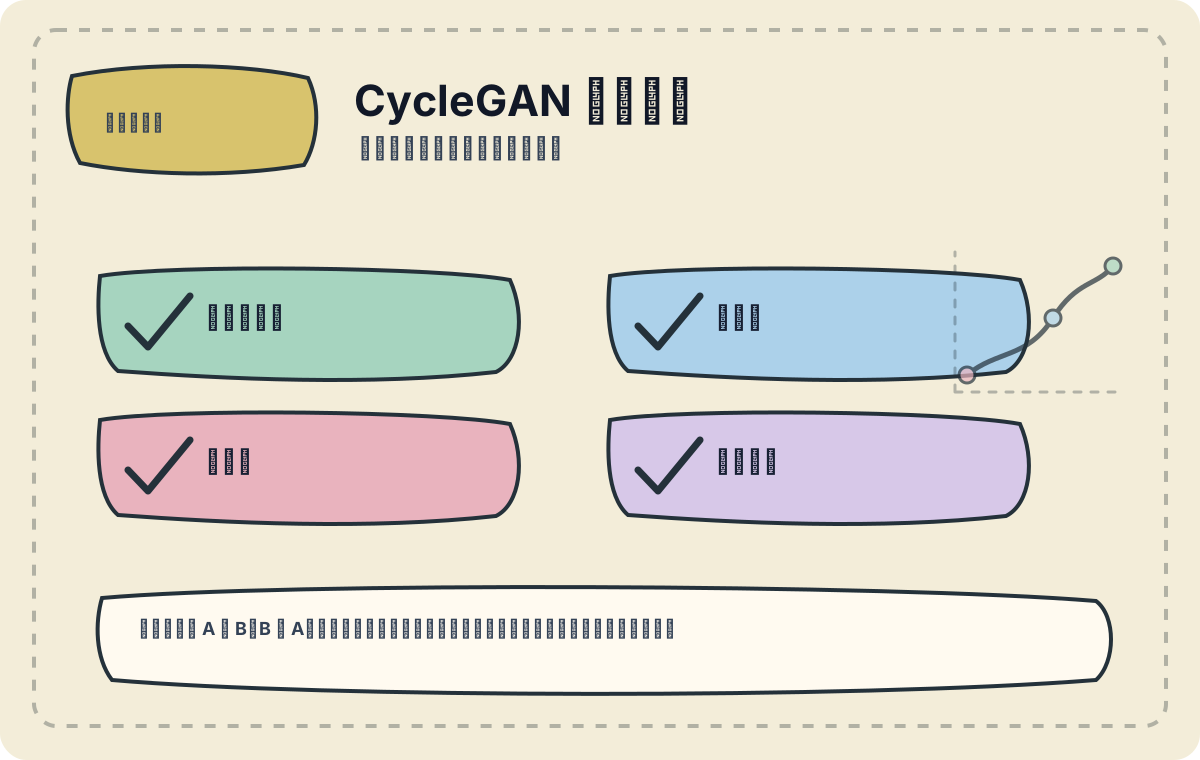
I simultaneously monitor four critical signals:
- Forward translation (A → B),
- Backward translation (B → A),
- Reconstruction quality (e.g., whether ), and
- Discriminator losses.
Relying solely on subjective visual assessment of generated images risks overlooking subtle but critical content shifts.
In the previous article, we introduced the fundamental architecture and working principles of the CycleGAN neural network. This article focuses specifically on its application in style reconstruction—how CycleGAN enables unpaired image-to-image translation for artistic style transfer.
What Is Style Reconstruction?
Style reconstruction refers to the technique of synthesizing a new image that preserves the content of one image while adopting the artistic style of another. Classic applications include transforming real-world photographs into artworks—for instance, converting an ordinary landscape photo into an impressionist painting. Crucially, CycleGAN achieves this without requiring pixel-aligned or semantically matched image pairs during training.
Core Principles of CycleGAN
CycleGAN comprises two generators and two discriminators:
-
Generators:
- : maps images from domain (e.g., photos) to domain (e.g., paintings);
- : performs the inverse mapping—from back to .
-
Discriminators:
- : distinguishes real images in domain from those synthesized by ;
- : distinguishes real images in domain from those synthesized by .
The cornerstone of CycleGAN is the cycle-consistency loss, which enforces that translating an image through both generators brings it back close to its original. This ensures faithful preservation of content structure despite radical stylistic transformation. Formally:
-
For any source-domain image :
-
For any target-domain image :
This bidirectional consistency guarantees that style transfer does not compromise semantic integrity—resulting in outputs that are both stylistically authentic and structurally coherent.
Applying CycleGAN to Style Reconstruction
Consider a concrete use case: converting realistic landscape photographs into oil-painting-style renditions. To apply CycleGAN, we prepare two unpaired image collections:
- Source domain (): Real-world landscape photographs
- Target domain (): Oil paintings (ideally depicting similar scenes or themes)
Data Preparation
Assume we have gathered representative sets of landscape photos and corresponding oil paintings. These serve as our unpaired training data—no image-level alignment is needed.
Training CycleGAN
Below is a minimal PyTorch implementation outline for training CycleGAN:
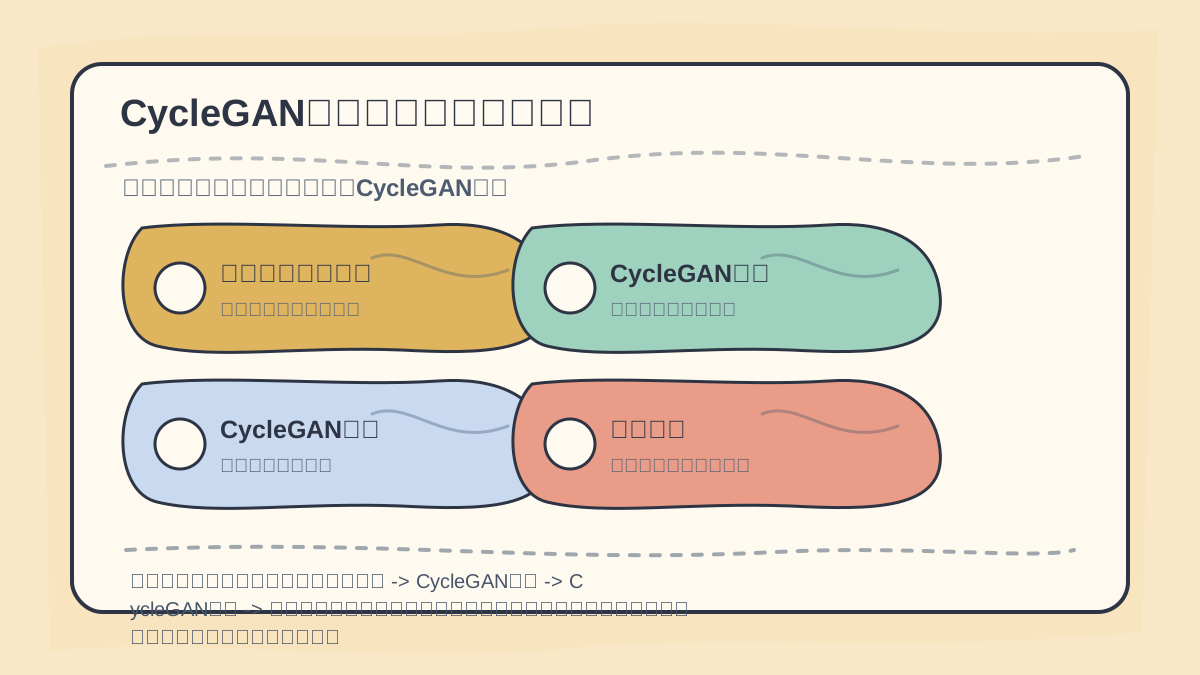
While reading this article, treat the progression “What is style reconstruction? → CycleGAN basics → CycleGAN in practice → Data preparation” as a verification checklist: first clarify inputs, operations, and expected outcomes—then revisit concrete examples, code snippets, or evaluation metrics to validate understanding.
import torch
from torchvision import datasets, transforms
from cycle_gan import CycleGAN  # Assume cycle_gan.py implements the model

# Data loading and preprocessing
transform = transforms.Compose([
    transforms.Resize(256),
    transforms.CenterCrop(256),
    transforms.ToTensor(),
])
train_dataset_X = datasets.ImageFolder(root='path/to/real/images', transform=transform)
train_dataset_Y = datasets.ImageFolder(root='path/to/oil/paintings', transform=transform)

# Load with DataLoaders
train_loader_X = torch.utils.data.DataLoader(dataset=train_dataset_X, batch_size=1, shuffle=True)
train_loader_Y = torch.utils.data.DataLoader(dataset=train_dataset_Y, batch_size=1, shuffle=True)

# Initialize and train
cycle_gan = CycleGAN()
cycle_gan.train(train_loader_X, train_loader_Y, num_epochs=200)
This snippet illustrates how to instantiate and train CycleGAN. Over time, the model learns to disentangle and recombine content and style across domains—enabling high-fidelity, unpaired style reconstruction.
Style Reconstruction Example
Once trained, inference proceeds as follows:
# Load the trained model
cycle_gan.load_model('path/to/saved/model')

# Generate oil-painting-style output
sample_image = transforms.ToTensor()(Image.open('path/to/sample/real/image.jpg')).unsqueeze(0)
generated_image = cycle_gan.generate(sample_image, style='oil_painting')

# Save result
generated_image.save('path/to/generated/oil_painting.jpg')
Results and Analysis
After training and inference, we compare generated oil-painting-style images against their original photographic counterparts. Typically, outputs retain the original scene’s layout, objects, and spatial relationships—while convincingly adopting brushwork, color palettes, and textural qualities characteristic of oil painting. Such results demonstrate CycleGAN’s robustness and practical utility in artistic style transfer.
After finishing “CycleGAN for Style Reconstruction”, begin with a small end-to-end example—then assess which steps you can now execute independently.
At this point, consolidate “CycleGAN for Style Reconstruction” into a retrospective summary: first articulate the central narrative, then verify it using a concrete mini-task.
When studying “CycleGAN for Style Reconstruction”, start with a small, reproducible scenario you can implement yourself—then explore related concepts and procedural steps. After reading, retell the entire workflow using your own example.
Summary
CycleGAN achieves compelling style reconstruction by leveraging cycle-consistency loss—a mechanism that enables effective learning from unpaired data alone. This property makes it exceptionally versatile across diverse domains, from digital art generation to medical imaging and beyond. In this article, we demonstrated its practical deployment for artistic style transfer—laying the conceptual groundwork for the next article, which will delve into theoretical analysis of lightweight CNN architectures.
Before advancing to lightweight CNN design and applications, readers are encouraged to implement their own style-reconstruction task—experiencing firsthand how CycleGAN bridges creative expression and algorithmic precision.
Apply This Lesson
Turn this article into AI software, model, API, and security decisions.
English Article FAQ
Use this article as evidence before choosing AI tools
How should I use this AI Tutorials article?
Use it as the implementation or learning layer, then connect the idea to AI software buyer guides, tool comparisons, benchmarks, API choices, and security checks before making a production decision.
Is this English article different from the Chinese original?
The English edition is localized for global AI readers while preserving the original diagrams, screenshots, prompts, code examples, and source context from the Chinese article.
What should I read after Data loading and preprocessing?
Continue with AI Software Buyer Guides, AI Tools Workbench, Best AI Coding Agents, AI Model Benchmarks, OpenAI vs Anthropic API, or LLM Security Tools depending on the decision you need to make.
Can this article alone choose an AI product or model?
No. Treat the article as evidence and context, then validate fit with pricing, privacy requirements, integration effort, benchmark results, workflow tests, and fallback planning.
Continue