English translation
Example usage
AI Article Decision Snapshot
Turn the lesson into workflow, model, budget, and security checks before choosing tools.
Use this quick snapshot before leaving the article. It keeps the next search tied to practical AI software, model/API, cost, privacy, and implementation questions.
Workflow fit
Identify the real job behind the article: coding, research, document review, support, analytics, content, or internal automation.
Model or tool decision
Decide whether the next step is a software shortlist, an AI tool comparison, an API platform choice, or a model benchmark.
Budget and usage signal
Estimate seats, API calls, prompt volume, retries, review time, and fallback work before assuming the workflow is cheap.
Security and privacy review
Check whether source code, customer data, private documents, prompts, logs, or embeddings will enter the AI workflow.
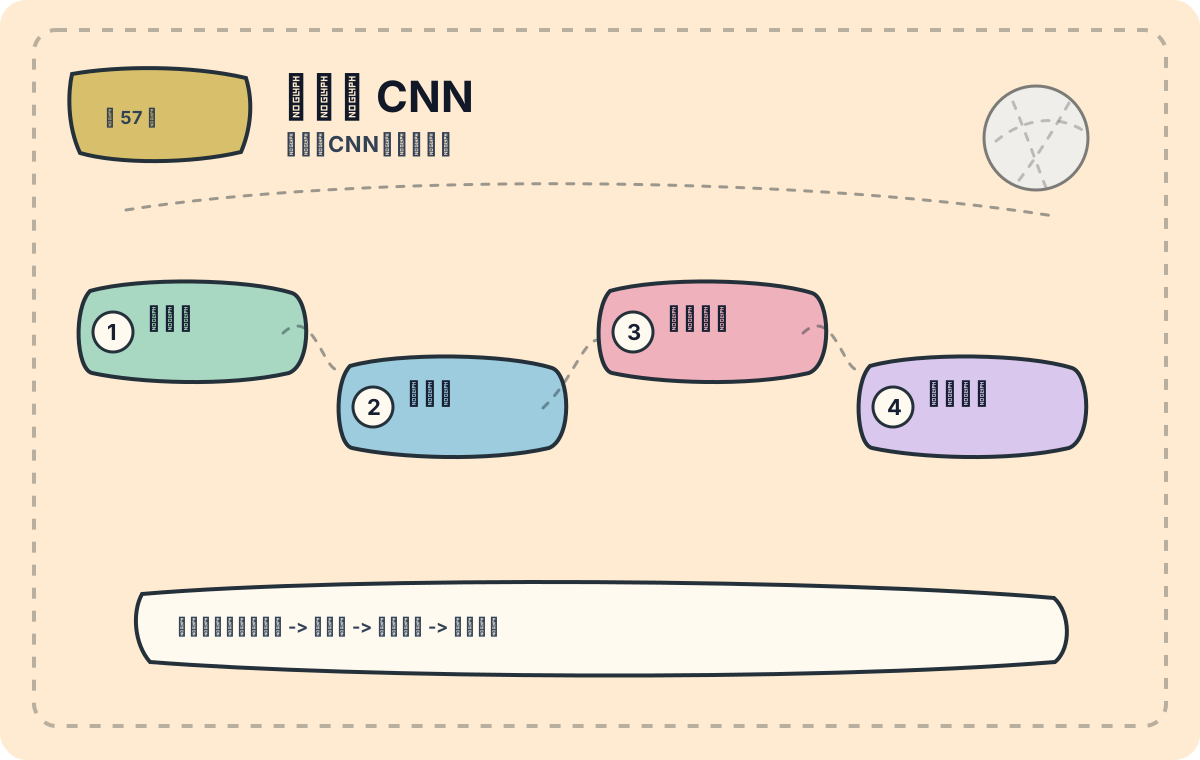
A lightweight CNN is not merely a shallow network with fewer layers; rather, it involves deliberate trade-offs among accuracy, inference speed, power consumption, and model size. This article focuses on evaluation. Latency, accuracy, GPU memory usage, and reproducible experimental settings must all be recorded together—no single metric alone suffices to characterize overall performance.
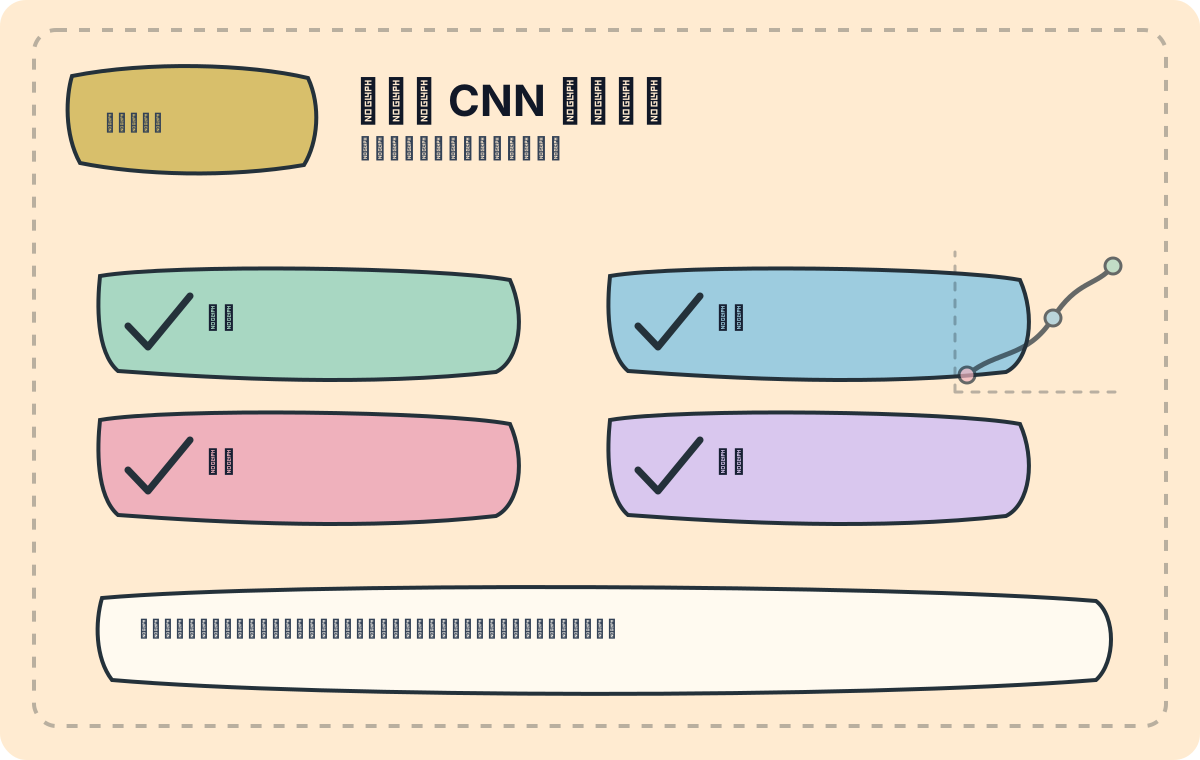
I will measure latency and memory usage on the same physical device, then evaluate accuracy. Without real-device benchmarking, conclusions about model lightweighting lack reliability.
In the previous article, we explored CycleGAN, a powerful image style transfer model. By introducing cycle-consistency loss, CycleGAN enables more realistic and faithful image translation between source and target domains. This article shifts focus to the theoretical foundations and design principles of Lightweight CNNs, helping readers understand their advantages and application scenarios. In the next article, we will examine concrete applications of lightweight CNNs.
Background of Lightweight CNNs
With the rapid advancement of mobile devices and edge computing, demands for computational efficiency and memory footprint of deep learning models have grown significantly. Traditional convolutional neural networks (CNNs)—such as ResNet and VGG—deliver strong performance in image classification and recognition tasks, but their large model sizes and high computational complexity limit their practicality on mobile or real-time platforms. Lightweight CNNs were thus developed to address these constraints.
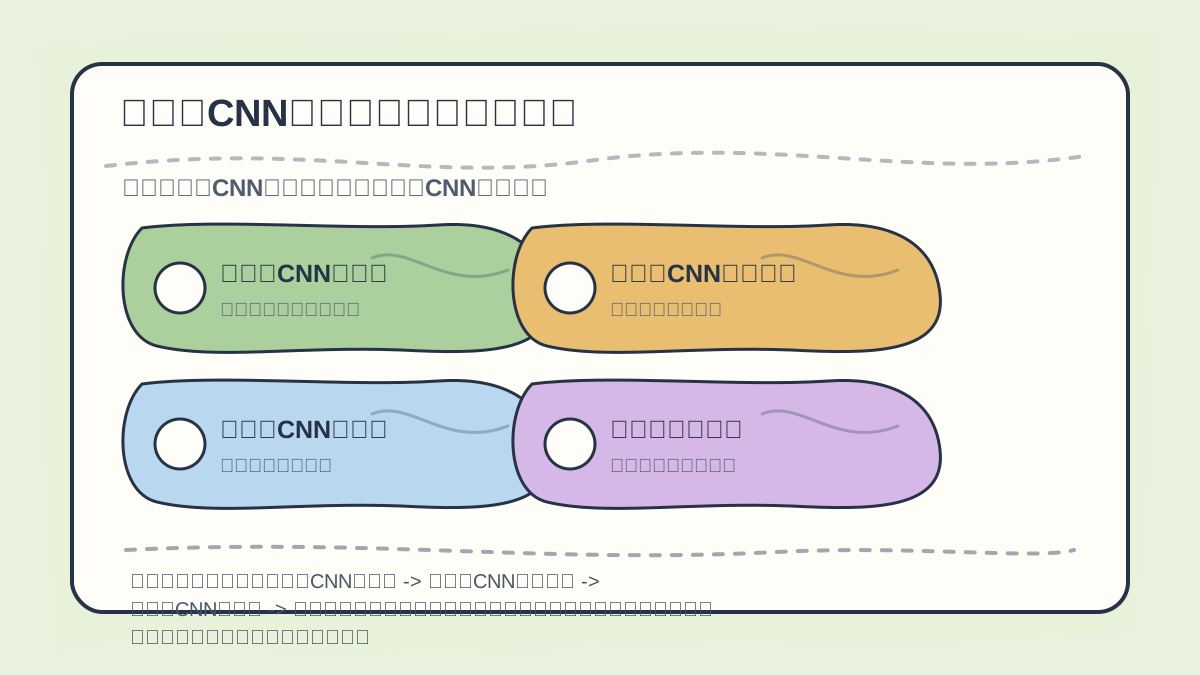
While reading this article, treat the progression “Background → Core Design Principles → Concrete Examples → Theoretical Analysis & Performance” as a verification checklist: first identify the object, path, and evidence; then revisit case studies, code, or metrics to cross-check.
Core Design Principles of Lightweight CNNs
Lightweight CNNs aim primarily to reduce both parameter count and computational cost while preserving predictive performance as much as possible. Key design principles include:
-
Depthwise Separable Convolution:
This technique decomposes standard convolution into two sequential operations: depthwise convolution (filtering each input channel independently) and pointwise convolution (a 1×1 convolution that projects across channels). This decomposition drastically reduces both parameters and FLOPs.
Standard convolution is expressed as:where denotes the convolution kernel and the input feature map. After decomposition:
Here, and represent the depthwise and pointwise convolution kernels, respectively.
-
Channel Compression:
Introducing lightweight projection layers—especially 1×1 convolutions—to reduce the number of channels in intermediate feature maps, thereby lowering computational load. -
Model Pruning:
Removing redundant or less important parameters to shrink model size. Common pruning strategies includeL1-norm-based pruning. -
Knowledge Distillation:
Transferring knowledge from a large, high-performing “teacher” model to a compact “student” model, enabling the smaller model to achieve higher accuracy than it would attain through training alone.
Representative Lightweight CNN Architectures
Based on the above principles, several widely adopted lightweight CNN models have been proposed and deployed across computer vision tasks:
-
MobileNet:
- Employs depthwise separable convolutions to dramatically reduce computation while maintaining competitive accuracy.
-
SqueezeNet:
- Uses “Fire modules” (combinations of squeeze and expand layers) to compress parameters, reducing model size and accelerating inference.
-
ShuffleNet:
- Introduces channel shuffling to enhance cross-channel information flow and improve feature representation, all while keeping computational cost low.
Theoretical Analysis and Performance Evaluation
From a theoretical perspective, FLOPS (floating-point operations per second) serves as a key metric for quantifying the computational efficiency gains of lightweight CNNs. Compared to conventional CNNs, lightweight variants achieve significantly lower FLOPS—yet still maintain high accuracy, especially on small-to-medium-scale datasets.
Take MobileNet as an example: its theoretical characteristics include:
- Parameter count reduced to the order of a few million;
- Optimized FLOPs reaching tens of billions;
- Top-1 classification accuracy exceeding 70% on the
ImageNetdataset.
Code Example
Below is a minimal implementation of a lightweight CNN using Keras:
from keras.models import Sequential
from keras.layers import Conv2D, DepthwiseConv2D, GlobalAveragePooling2D, Dense

def lightweight_cnn(input_shape):
    model = Sequential()

    # Depthwise Separable Convolution
    model.add(DepthwiseConv2D(kernel_size=3, padding='same', input_shape=input_shape))
    model.add(Conv2D(filters=32, kernel_size=1, padding='same', activation='relu'))

    # Global Average Pooling
    model.add(GlobalAveragePooling2D())
    model.add(Dense(10, activation='softmax'))  # for 10 classes

    return model

# Example usage
input_shape = (224, 224, 3)
model = lightweight_cnn(input_shape)
model.summary()
In this example, we construct a lightweight CNN using Keras, leveraging DepthwiseConv2D to implement depthwise separable convolution. The architecture can be extended or fine-tuned according to specific application requirements.
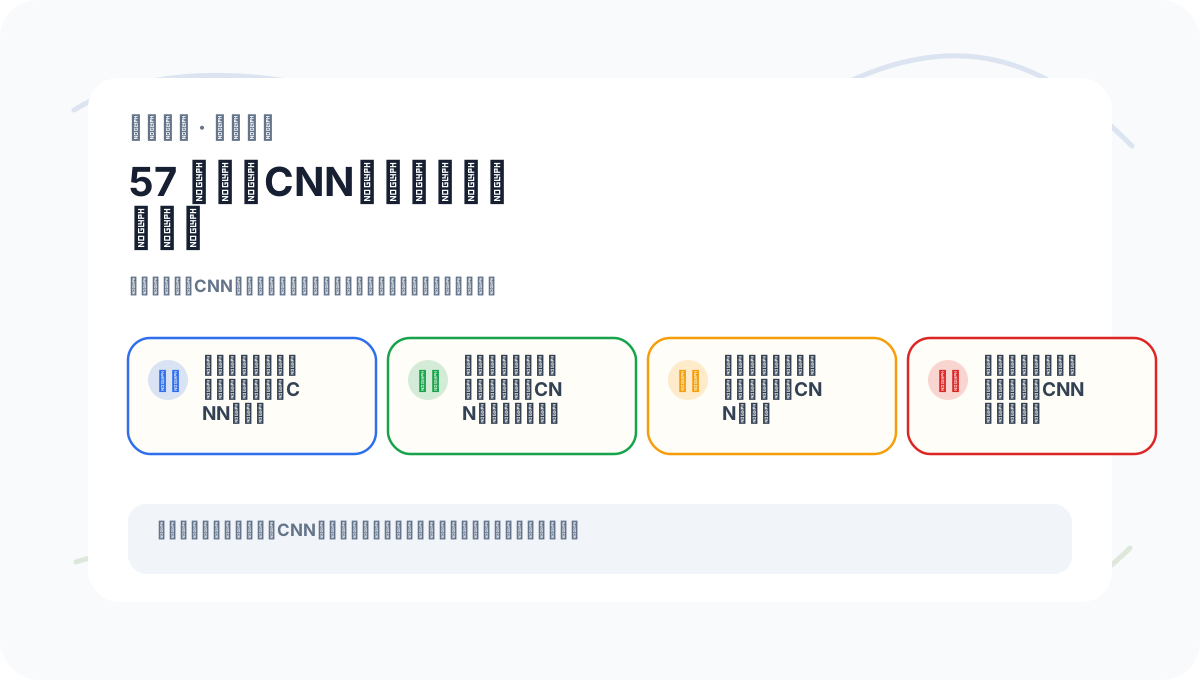
When reviewing “Theoretical Analysis of Lightweight CNNs”, place key concepts, procedural steps, and observable outcomes side-by-side on a single page for efficient revision.
When practicing “Theoretical Analysis of Lightweight CNNs”, explicitly write down the input conditions, processing actions, and observable outcomes together—this facilitates systematic rechecking later.
Summary
This article comprehensively examined the theoretical foundations, core design principles, and performance analysis of lightweight CNNs. These models demonstrate exceptional efficiency and robust performance—particularly in resource-constrained environments such as mobile and edge devices. In the next article, we will delve into practical applications of lightweight CNNs, illustrating how theoretical insights translate into real-world implementations.
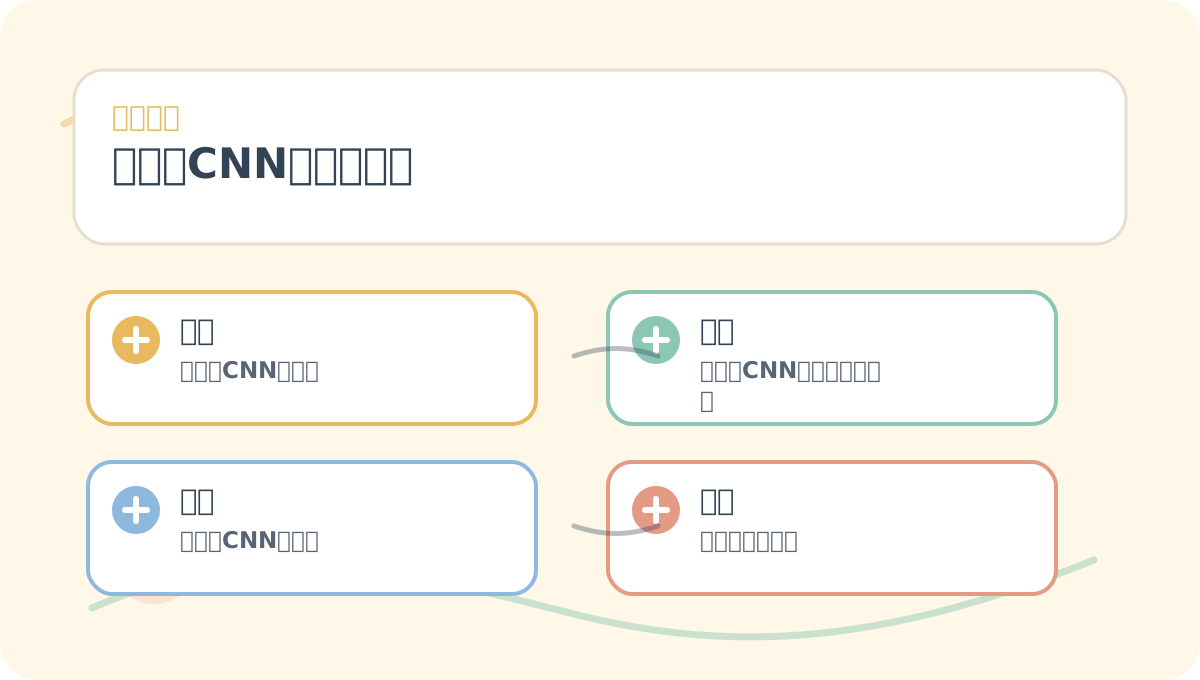
After reading “Theoretical Analysis of Lightweight CNNs”, don’t stop at “I understand.” Instead, pick one step—implement it hands-on—and document exactly where you get stuck. That grounded practice makes subsequent learning far more stable and effective.
Apply This Lesson
Turn this article into AI software, model, API, and security decisions.
English Article FAQ
Use this article as evidence before choosing AI tools
How should I use this AI Tutorials article?
Use it as the implementation or learning layer, then connect the idea to AI software buyer guides, tool comparisons, benchmarks, API choices, and security checks before making a production decision.
Is this English article different from the Chinese original?
The English edition is localized for global AI readers while preserving the original diagrams, screenshots, prompts, code examples, and source context from the Chinese article.
What should I read after Example usage?
Continue with AI Software Buyer Guides, AI Tools Workbench, Best AI Coding Agents, AI Model Benchmarks, OpenAI vs Anthropic API, or LLM Security Tools depending on the decision you need to make.
Can this article alone choose an AI product or model?
No. Treat the article as evidence and context, then validate fit with pricing, privacy requirements, integration effort, benchmark results, workflow tests, and fallback planning.
Continue