English translation
Load pre-trained MobileNet
AI Article Decision Snapshot
Turn the lesson into workflow, model, budget, and security checks before choosing tools.
Use this quick snapshot before leaving the article. It keeps the next search tied to practical AI software, model/API, cost, privacy, and implementation questions.
Workflow fit
Identify the real job behind the article: coding, research, document review, support, analytics, content, or internal automation.
Model or tool decision
Decide whether the next step is a software shortlist, an AI tool comparison, an API platform choice, or a model benchmark.
Budget and usage signal
Estimate seats, API calls, prompt volume, retries, review time, and fallback work before assuming the workflow is cheap.
Security and privacy review
Check whether source code, customer data, private documents, prompts, logs, or embeddings will enter the AI workflow.
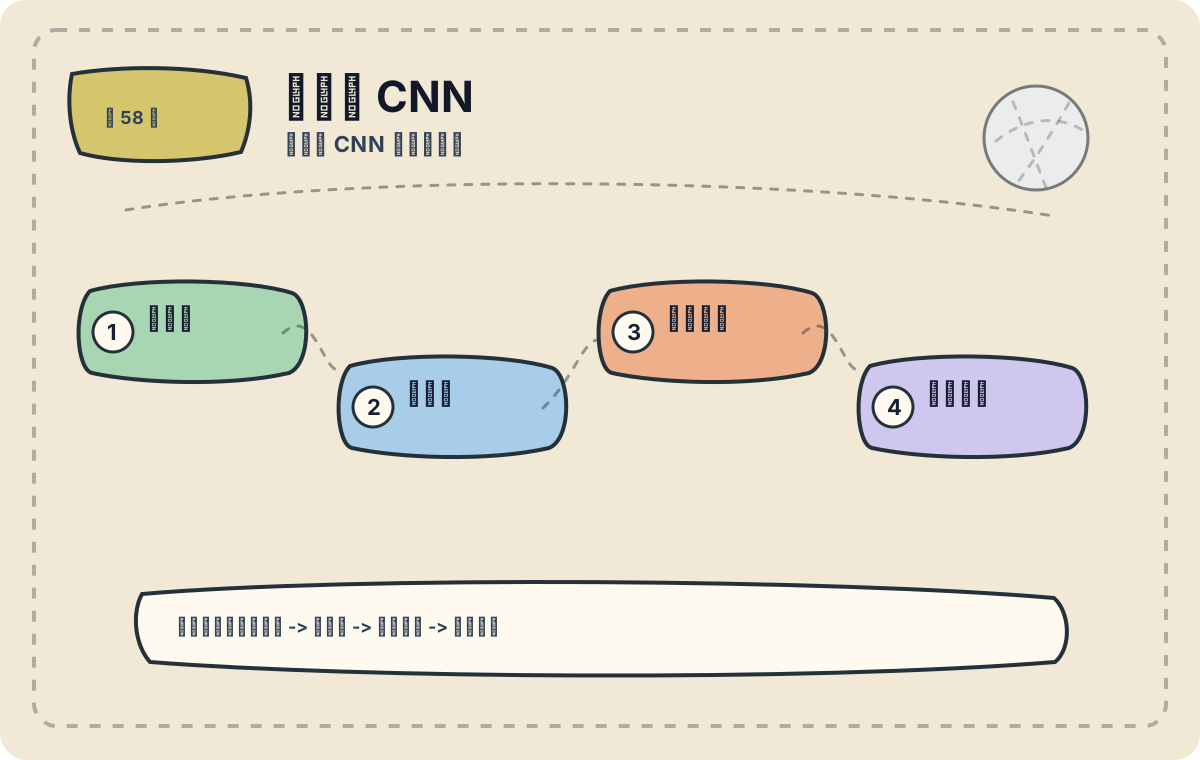
Lightweight CNNs are not merely achieved by reducing the number of layers; rather, they involve carefully balancing trade-offs among accuracy, inference speed, power consumption, and model size. This article focuses on practical application scenarios. Before deploying a lightweight CNN, first assess whether the task truly aligns with the network’s capabilities—then evaluate data scale, deployment cost, and performance boundaries.
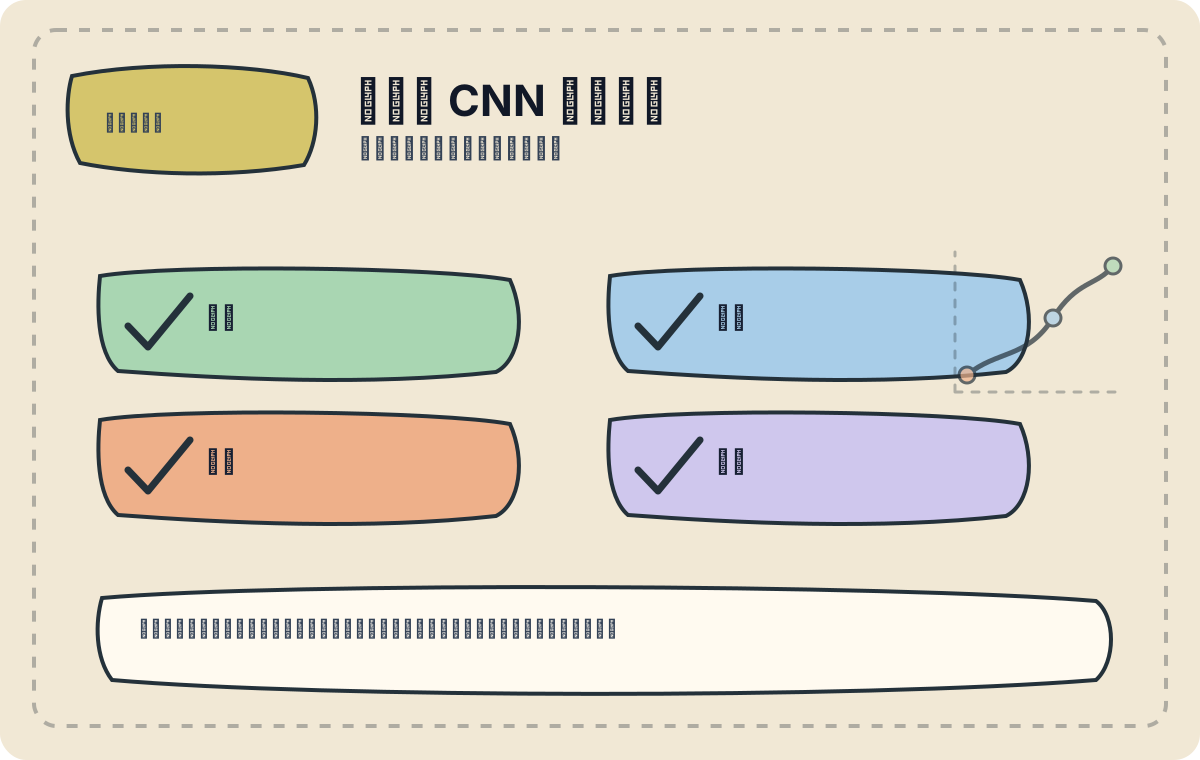
I measure latency and memory usage on the same physical device, then assess accuracy. Without real-device testing, conclusions about model lightweighting lack reliability.
In the previous article, we explored the theoretical foundations of lightweight CNNs—covering architectural design principles, computational efficiency, and advantages under constrained hardware resources. This article shifts focus to practical deployment: how lightweight CNNs are applied to concrete computer vision tasks—including image classification, object detection, and semantic segmentation.
Introduction to Lightweight CNN Models
Lightweight Convolutional Neural Networks (CNNs) aim to significantly reduce parameter count and computational complexity, enabling efficient execution on resource-constrained devices such as mobile phones or edge computing platforms. Popular lightweight CNN architectures include MobileNet, SqueezeNet, and ShuffleNet. These models leverage techniques like depthwise separable convolutions and bottleneck structures to achieve high efficiency without severe accuracy degradation.
Application Scenarios
1. Image Classification
Lightweight CNNs excel in image classification tasks. Their streamlined architecture minimizes computation, making real-time classification feasible even on mobile devices.
Case Study: Image Classification Using MobileNet
We can easily implement MobileNet using TensorFlow and Keras. Below is a basic code example:
import tensorflow as tf
from tensorflow.keras.applications import MobileNet
from tensorflow.keras.preprocessing.image import ImageDataGenerator

# Load pre-trained MobileNet
model = MobileNet(weights='imagenet')

# Data preprocessing
datagen = ImageDataGenerator(rescale=1./255)
train_generator = datagen.flow_from_directory(
    'data/train',
    target_size=(224, 224),
    class_mode='categorical'
)

# Compile and train
model.compile(optimizer='adam', loss='categorical_crossentropy', metrics=['accuracy'])
model.fit(train_generator, steps_per_epoch=len(train_generator), epochs=5)
In this example, we load a pre-trained MobileNet model, apply image augmentation via ImageDataGenerator, and fine-tune it on custom data.
2. Object Detection
In object detection, lightweight CNNs help reduce inference latency and boost processing throughput—especially critical for real-time applications.
Case Study: Lightweight YOLOv3 Implementation
YOLO (“You Only Look Once”) is a widely adopted real-time object detection framework. Its lightweight variants—such as Tiny-YOLO—enable robust performance on low-resource hardware. Here's a minimal TensorFlow-based implementation:
import cv2
import numpy as np

# Load YOLO model
net = cv2.dnn.readNetFromDarknet("yolov3.cfg", "yolov3.weights")
layer_names = net.getLayerNames()
output_layers = [layer_names[i - 1] for i in net.getUnconnectedOutLayers()]

# Perform object detection
def detect_objects(image):
    height, width, channels = image.shape
    blob = cv2.dnn.blobFromImage(image, 0.00392, (416, 416), (0, 0, 0), True, crop=False)
    net.setInput(blob)
    outs = net.forward(output_layers)

    # Parse detection outputs
    # (Parsing logic omitted here—includes confidence scores, bounding boxes, and class labels)

# Load and process an image
image = cv2.imread("image.jpg")
detect_objects(image)
3. Semantic Segmentation
Semantic segmentation requires pixel-level classification across the entire input image. Lightweight CNNs dramatically accelerate this dense prediction task.
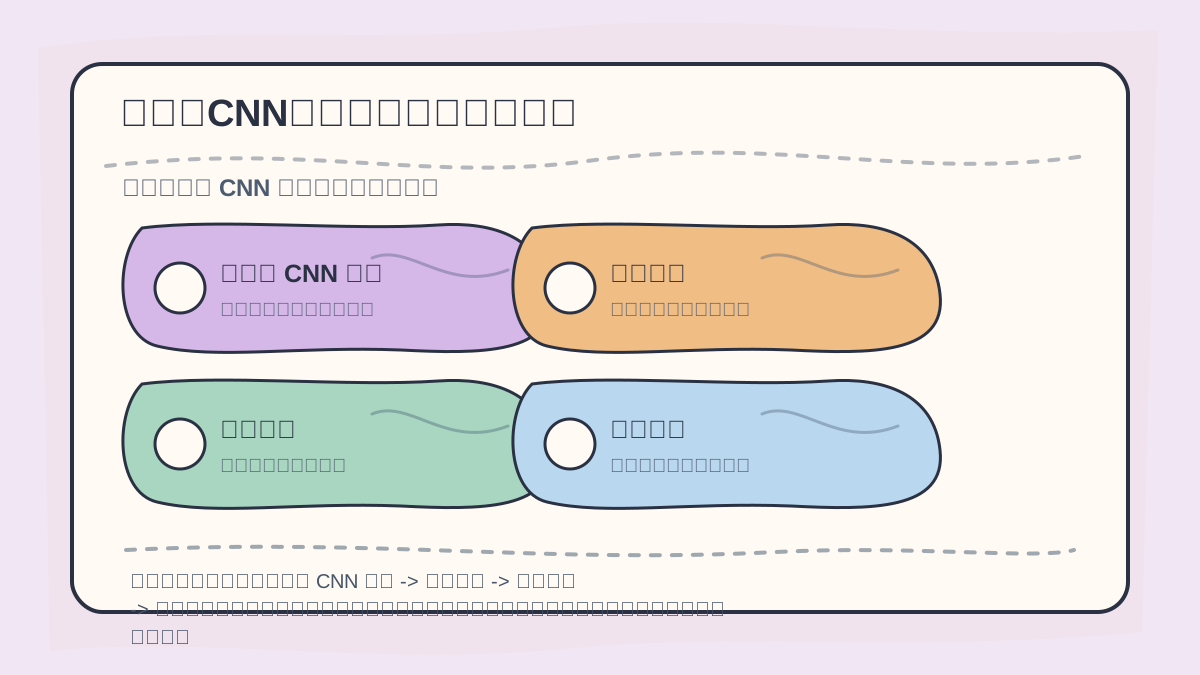
While reading this article, treat the progression “Lightweight CNN Model → Application Scenario → Image Classification → Object Detection” as a verification checklist: first identify the target object, intended action, and decision criteria—then revisit case studies, code snippets, or evaluation metrics to validate alignment.
Case Study: Lightweight U-Net for Semantic Segmentation
U-Net is a canonical architecture for semantic segmentation. By simplifying its encoder-decoder structure, we can derive a lightweight variant suitable for edge deployment. Below is a Keras implementation:
from tensorflow.keras.layers import Input, Conv2D, MaxPooling2D, UpSampling2D, concatenate
from tensorflow.keras.models import Model

def lightweight_unet(input_shape):
    inputs = Input(shape=input_shape)
    # Encoder
    conv1 = Conv2D(32, 3, activation='relu', padding='same')(inputs)
    pool1 = MaxPooling2D(pool_size=(2, 2))(conv1)

    conv2 = Conv2D(64, 3, activation='relu', padding='same')(pool1)
    pool2 = MaxPooling2D(pool_size=(2, 2))(conv2)

    # Decoder
    up1 = UpSampling2D(size=(2, 2))(pool2)
    merge1 = concatenate([up1, conv1], axis=3)
    conv3 = Conv2D(32, 3, activation='relu', padding='same')(merge1)

    outputs = Conv2D(1, 1, activation='sigmoid')(conv3)

    return Model(inputs, outputs)

# Instantiate model
model = lightweight_unet((128, 128, 1))
model.compile(optimizer='adam', loss='binary_crossentropy', metrics=['accuracy'])
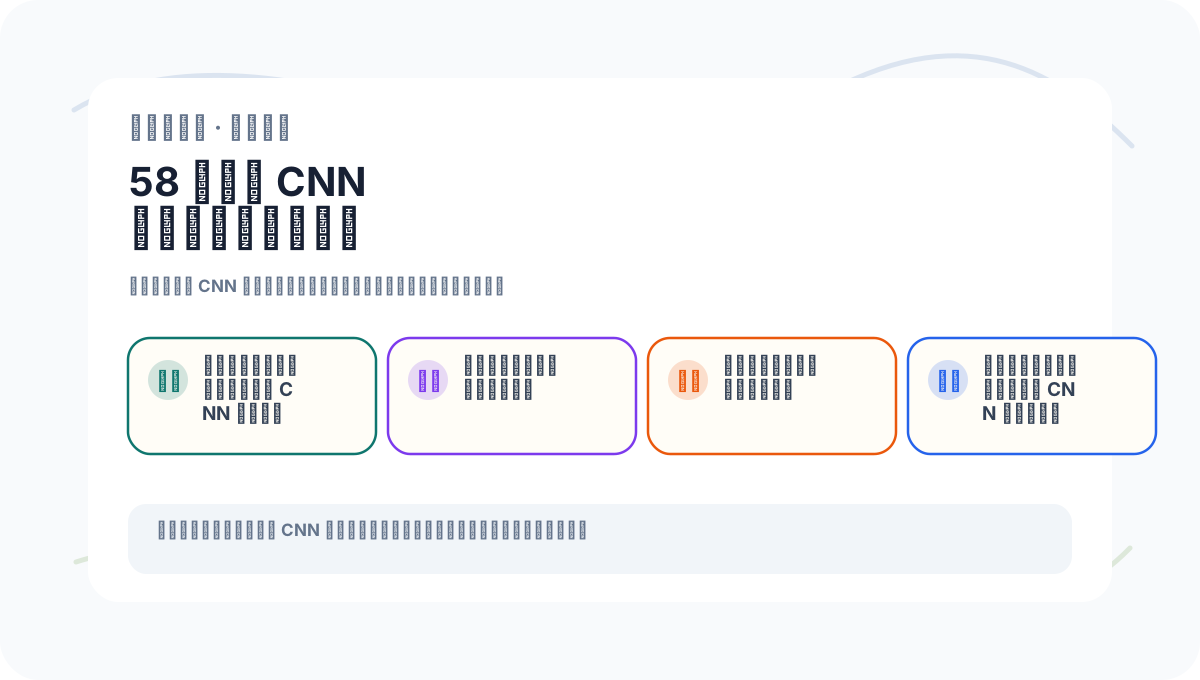
After studying “Lightweight CNN Model Applications”, try adapting it to your own use case. Pay close attention to whether inputs, internal processing, and outputs form a coherent, end-to-end pipeline.
To apply “Lightweight CNN Model Applications” to your project, start small: isolate and rigorously validate just one critical decision point before scaling up.
Summary
Lightweight CNN models demonstrate clear advantages across diverse vision tasks—including image classification, object detection, and semantic segmentation—thanks to their computational efficiency and compact footprint. Through strategic architectural simplification and optimization, they meet stringent real-time requirements. As deep learning continues to evolve, we anticipate increasingly efficient and deployable CNN variants entering widespread production use.
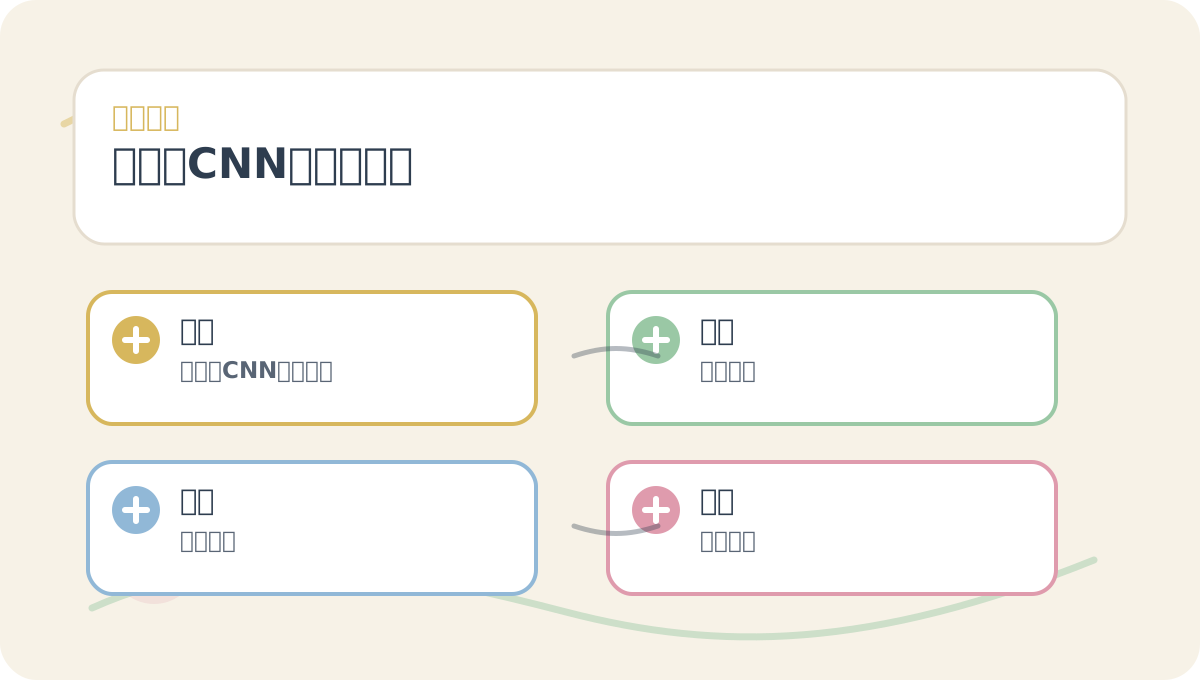
When reading “Lightweight CNN Model Applications”, first align the diagram’s questions, keywords, actions, and acceptance criteria—then proceed to the main text. After finishing, try re-explaining the content using your own project as context.
In the next chapter, we’ll explore lightweight design strategies for Spatial Transformer Networks (STNs), analyzing how to balance computational efficiency against modeling fidelity. Stay tuned for more installments in this tutorial series.
Apply This Lesson
Turn this article into AI software, model, API, and security decisions.
English Article FAQ
Use this article as evidence before choosing AI tools
How should I use this AI Tutorials article?
Use it as the implementation or learning layer, then connect the idea to AI software buyer guides, tool comparisons, benchmarks, API choices, and security checks before making a production decision.
Is this English article different from the Chinese original?
The English edition is localized for global AI readers while preserving the original diagrams, screenshots, prompts, code examples, and source context from the Chinese article.
What should I read after Load pre-trained MobileNet?
Continue with AI Software Buyer Guides, AI Tools Workbench, Best AI Coding Agents, AI Model Benchmarks, OpenAI vs Anthropic API, or LLM Security Tools depending on the decision you need to make.
Can this article alone choose an AI product or model?
No. Treat the article as evidence and context, then validate fit with pricing, privacy requirements, integration effort, benchmark results, workflow tests, and fallback planning.
Continue