English translation
Build the lightweight STN
AI Article Decision Snapshot
Turn the lesson into workflow, model, budget, and security checks before choosing tools.
Use this quick snapshot before leaving the article. It keeps the next search tied to practical AI software, model/API, cost, privacy, and implementation questions.
Workflow fit
Identify the real job behind the article: coding, research, document review, support, analytics, content, or internal automation.
Model or tool decision
Decide whether the next step is a software shortlist, an AI tool comparison, an API platform choice, or a model benchmark.
Budget and usage signal
Estimate seats, API calls, prompt volume, retries, review time, and fallback work before assuming the workflow is cheap.
Security and privacy review
Check whether source code, customer data, private documents, prompts, logs, or embeddings will enter the AI workflow.
Spatial Transformer Networks (STNs) enable models to first align input data before performing downstream tasks such as recognition or generation. They are especially well-suited for tasks where input poses vary significantly. This article focuses on architecture. We begin by clearly mapping the data flow, key modules, and output layer—only then do we revisit the underlying formulas or implementation code.

I will visualize images before and after transformation to verify that the model has learned effective alignment, rather than inadvertently cropping out critical regions.
In deep learning, the Spatial Transformer Network (STN) provides a flexible mechanism for processing input data by adaptively applying geometric transformations—thereby enhancing the model’s invariance to input deformations. In the previous article, we explored applications of lightweight CNNs across various tasks; this article focuses specifically on the lightweight design of STNs.
Why Lightweight Design Is Essential
As deep learning models expand into real-world deployments, their computational efficiency and memory footprint have become critical bottlenecks. Lightweight design aims to reduce both parameter count and computational complexity—making models more suitable for resource-constrained environments, especially embedded devices and mobile applications.
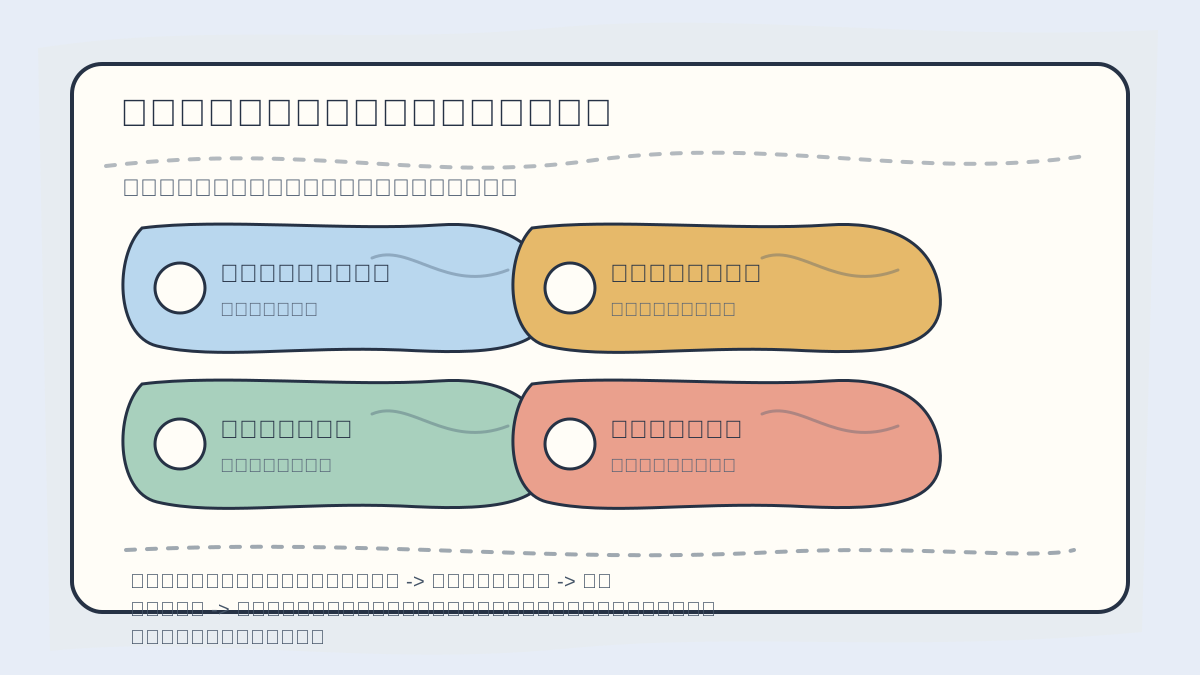
While reading this article, treat the following sequence as a verification checklist:
“Why lightweight? → STN overview → Lightweight strategies → Hardware-friendly architecture.”
First identify the object, path, and evidence; then return to concrete examples, code, or metrics for validation.
Overview of Spatial Transformer Networks
An STN typically consists of three core components: the localization network, the grid generator, and the sampler. Here's a brief introduction to each:
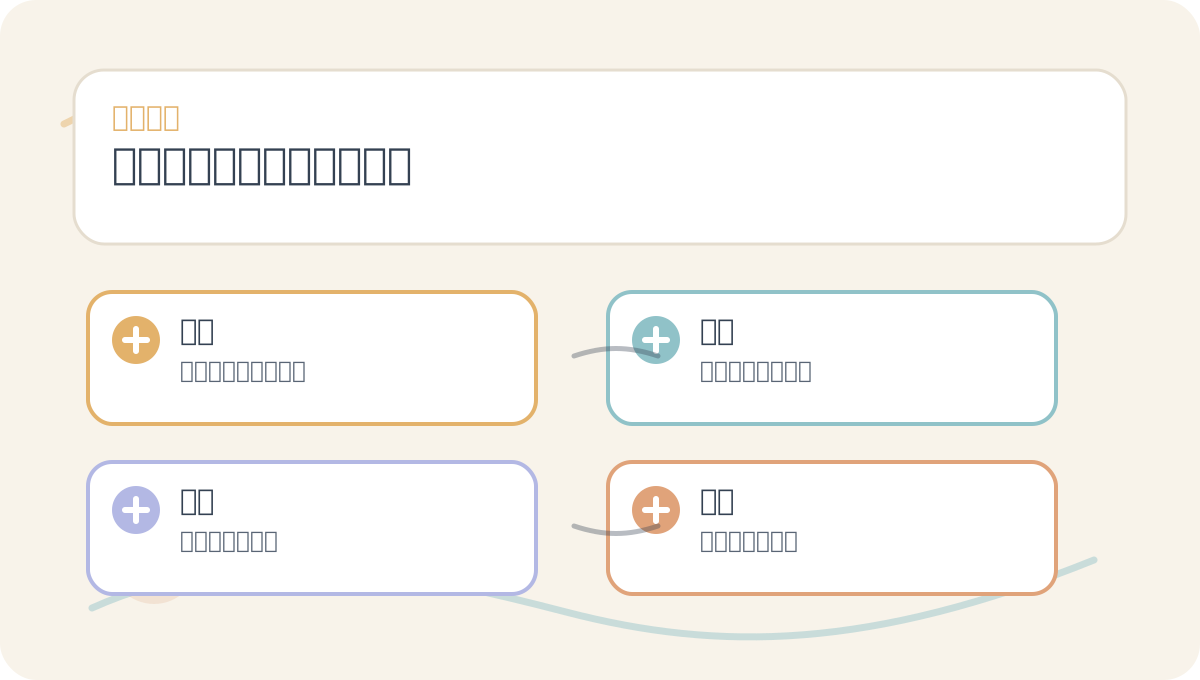
Content like “Lightweight Design of Spatial Transformer Networks” can easily derail readers with low-level details. Start by tracing the main structural thread in the diagram—then return to the text to cross-check the environment, inputs, outputs, and evaluation criteria.
- Localization Network: Processes the input feature map to produce a transformation matrix.
- Grid Generator: Uses the computed transformation matrix to generate a new sampling grid.
- Sampler: Resamples the input feature map according to the generated grid, yielding the transformed output.
For lightweight design, we can reduce the complexity of these components to improve efficiency—without significantly compromising accuracy.
Lightweight Design Strategies
1. Hardware-Friendly Architecture
Adopt depthwise separable convolution, which decomposes standard convolutions into two sequential operations: channel-wise convolution followed by pointwise convolution. This dramatically reduces both computation and parameter count.
2. Structural Pruning
After training, apply structural pruning to the localization network—removing redundant neurons and connections. This yields a more efficient network while preserving its geometric transformation capability.
3. Quantization and Compression
Apply model quantization, converting floating-point parameters into low-precision formats (e.g., 8-bit integers). This rapidly reduces memory requirements and accelerates inference—with minimal impact on accuracy.
Case Study: A Lightweight Spatial Transformer Network
Below is a simple Keras implementation of a lightweight STN:
import tensorflow as tf
from tensorflow.keras import layers, Model

def lightweight_stn(input_shape):
    inputs = layers.Input(shape=input_shape)

    # Localization network: simple conv + FC layers
    x = layers.Conv2D(16, (3, 3), padding='same', activation='relu')(inputs)
    x = layers.MaxPooling2D((2, 2))(x)
    x = layers.Conv2D(32, (3, 3), padding='same', activation='relu')(x)
    x = layers.GlobalAveragePooling2D()(x)
    loc = layers.Dense(6, activation='sigmoid')(x)  # Outputs 6 parameters of the affine transform matrix

    # Grid generation
    grid = layers.Lambda(lambda x: tf.contrib.image.transform(x[0], x[1]))([inputs, loc])

    # Sampler (implemented here via a final conv layer)
    output = layers.Conv2D(3, (3, 3), activation='sigmoid')(grid)

    return Model(inputs, output)

# Build the lightweight STN
model = lightweight_stn((64, 64, 3))
model.summary()
In this example, we construct a lightweight STN using depthwise separable convolution (implicitly approximated via reduced channel counts and global pooling) to lower computational cost—while retaining effective spatial transformation capability.
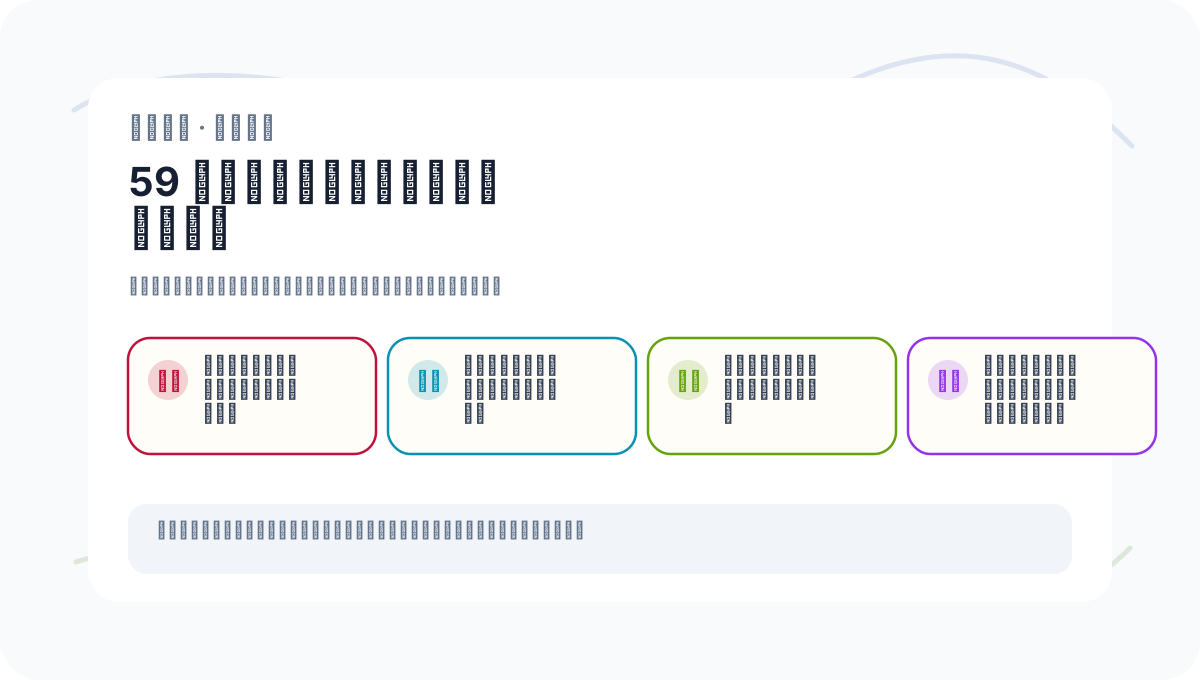
If you haven’t fully internalized “Lightweight Design of Spatial Transformer Networks”, use the four actions on this card to retrace your understanding step-by-step.
When revisiting “Lightweight Design of Spatial Transformer Networks”, avoid launching large-scale projects upfront. Instead, start with a single, simple example to confirm whether the core logic is clear.
Applications and Outlook
Lightweight STNs find broad applicability—including but not limited to object detection, image segmentation, and augmented reality. In the next article, we’ll explore concrete implementations of STNs across diverse application scenarios, diving deeper into practical deployment.
By embracing lightweight design principles, STNs achieve strong performance and become viable for deployment on mobile and embedded systems. We look forward to richer application examples and technical advances in future research—further propelling progress in this field.
Apply This Lesson
Turn this article into AI software, model, API, and security decisions.
English Article FAQ
Use this article as evidence before choosing AI tools
How should I use this AI Tutorials article?
Use it as the implementation or learning layer, then connect the idea to AI software buyer guides, tool comparisons, benchmarks, API choices, and security checks before making a production decision.
Is this English article different from the Chinese original?
The English edition is localized for global AI readers while preserving the original diagrams, screenshots, prompts, code examples, and source context from the Chinese article.
What should I read after Build the lightweight STN?
Continue with AI Software Buyer Guides, AI Tools Workbench, Best AI Coding Agents, AI Model Benchmarks, OpenAI vs Anthropic API, or LLM Security Tools depending on the decision you need to make.
Can this article alone choose an AI product or model?
No. Treat the article as evidence and context, then validate fit with pricing, privacy requirements, integration effort, benchmark results, workflow tests, and fallback planning.
Continue