English translation
Assume a simplified STN implementation
AI Article Decision Snapshot
Turn the lesson into workflow, model, budget, and security checks before choosing tools.
Use this quick snapshot before leaving the article. It keeps the next search tied to practical AI software, model/API, cost, privacy, and implementation questions.
Workflow fit
Identify the real job behind the article: coding, research, document review, support, analytics, content, or internal automation.
Model or tool decision
Decide whether the next step is a software shortlist, an AI tool comparison, an API platform choice, or a model benchmark.
Budget and usage signal
Estimate seats, API calls, prompt volume, retries, review time, and fallback work before assuming the workflow is cheap.
Security and privacy review
Check whether source code, customer data, private documents, prompts, logs, or embeddings will enter the AI workflow.
Spatial Transformer Networks (STNs) enable models to first align input data before performing downstream tasks such as recognition or generation. They are especially suitable for tasks where input poses exhibit significant variation. This article focuses on real-world application scenarios. Before adopting STN, carefully assess whether your task genuinely matches its strengths—then evaluate data scale, deployment cost, and performance boundaries.

I visualize images before and after transformation to verify that the model has learned meaningful alignment, rather than simply cropping out critical regions.
In the previous article, we discussed lightweight design strategies for Spatial Transformer Networks (STNs), enhancing their efficiency under resource-constrained conditions. In this article, we explore STNs’ practical applications—particularly in image processing—and how they support subsequent neural style transfer.
Overview of Spatial Transformer Networks
A Spatial Transformer Network (STN) is a learnable module that endows neural networks with spatial transformation capabilities. It dynamically applies geometric transformations—such as rotation, scaling, and translation—to input feature maps, enabling the network to better handle deformations and viewpoint variations in images. Its core components include:

While reading this article, treat the progression “STN Overview → Application Scenarios → Use in Image Classification → Case Study: Handwritten Digit Recognition” as a verification checklist: first clarify the scenario, concept, action, and outcome; then revisit concrete parameters, code snippets, or evaluation metrics to cross-check.
- Localization Network: Generates transformation parameters.
- Grid Generator & Sampler: Produces sampling grids based on those parameters and performs differentiable resampling.
- Transformation Module: Applies the geometric transformation to the input.
Together, these components allow the model to adaptively preprocess inputs.
Application Scenarios
1. Image Classification
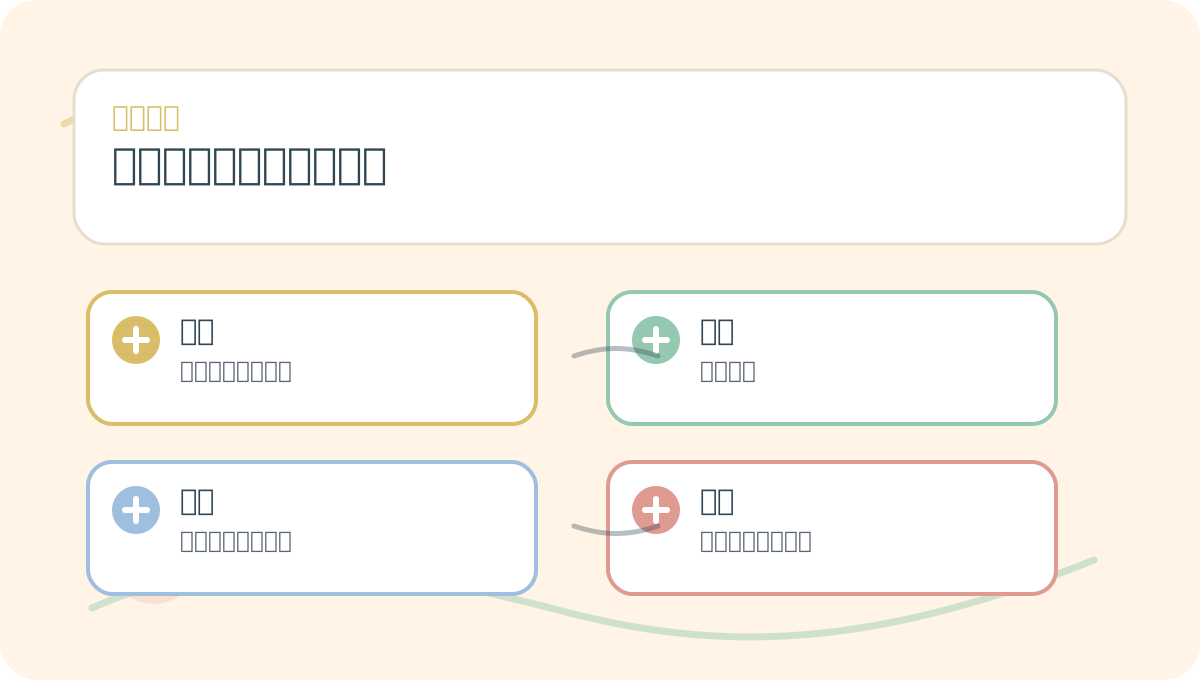
Read “Applications of Spatial Transformer Networks” through the lens of “Scenario → Concept → Action → Outcome.” First align these four dimensions, then return to parameters, code, or workflow details in the main text.
In image classification, rotations, translations, and other geometric distortions often degrade classifier performance. STNs mitigate this by automatically correcting such deformations before feeding data into the classifier.
Case Study: Handwritten Digit Recognition
Handwritten digits vary widely in size, orientation, and stroke thickness. By integrating an STN upstream of convolutional layers, the network can perform standardized preprocessing—e.g., normalizing digit scale and orientation—prior to feature extraction. This significantly improves classification accuracy.
import torch
import torch.nn as nn
import torchvision.transforms as transforms
from torchvision import datasets

# Assume a simplified STN implementation
class STN(nn.Module):
    # Define STN architecture here
    pass

def preprocess_images(images):
    stn = STN()
    transformed_images = stn(images)  # Apply spatial transformation
    return transformed_images
2. Object Detection
In object detection, targets frequently appear at varying scales and angles. Integrating STN as a preprocessing module enhances the detector’s robustness to such geometric variations.
Case Study: Integrating STN into Faster R-CNN
An STN can be inserted before the Region Proposal Network (RPN) in Faster R-CNN to normalize input images—improving proposal quality and final detection accuracy.
class FasterRCNNWithSTN(nn.Module):
    def __init__(self):
        super(FasterRCNNWithSTN, self).__init__()
        self.stn = STN()
        self.rcnn = FasterRCNN()  # Predefined Faster R-CNN backbone

    def forward(self, x):
        x = self.stn(x)  # Preprocess input via STN
        return self.rcnn(x)  # Feed aligned input to detector
3. Image Segmentation
In semantic or instance segmentation, appearance variations—including rotation and scale shifts—can severely impair mask accuracy. STNs help preserve structural integrity across transformations, especially when segmenting objects of diverse sizes and orientations.
Case Study: STN-Augmented U-Net
Integrating STN into U-Net—either at the input stage or within encoder-decoder pathways—yields more precise segmentation masks. Layer-wise spatial adaptation strengthens robustness to viewpoint changes and improves boundary localization.

At this point, summarize “Applications of Spatial Transformer Networks” into a retrospective table: clearly state the central narrative first, then validate it using a small-scale task.

After finishing “Applications of Spatial Transformer Networks,” try walking through a minimal working example end-to-end. Then assess which steps you can now implement independently.
Outlook and Summary
The case studies above demonstrate STNs’ broad applicability across image classification, object detection, and image segmentation. By enabling models to adaptively compensate for geometric variations in input data, STNs enhance both accuracy and robustness.
In upcoming articles, we’ll explore how STNs can be leveraged in neural style transfer—providing powerful geometric stabilization when transferring artistic styles across domains. Stay tuned to our tutorial series to uncover how these cutting-edge techniques unlock new possibilities in computer vision.
Apply This Lesson
Turn this article into AI software, model, API, and security decisions.
English Article FAQ
Use this article as evidence before choosing AI tools
How should I use this AI Tutorials article?
Use it as the implementation or learning layer, then connect the idea to AI software buyer guides, tool comparisons, benchmarks, API choices, and security checks before making a production decision.
Is this English article different from the Chinese original?
The English edition is localized for global AI readers while preserving the original diagrams, screenshots, prompts, code examples, and source context from the Chinese article.
What should I read after Assume a simplified STN implementation?
Continue with AI Software Buyer Guides, AI Tools Workbench, Best AI Coding Agents, AI Model Benchmarks, OpenAI vs Anthropic API, or LLM Security Tools depending on the decision you need to make.
Can this article alone choose an AI product or model?
No. Treat the article as evidence and context, then validate fit with pricing, privacy requirements, integration effort, benchmark results, workflow tests, and fallback planning.
Continue