English translation
Example usage
AI Article Decision Snapshot
Turn the lesson into workflow, model, budget, and security checks before choosing tools.
Use this quick snapshot before leaving the article. It keeps the next search tied to practical AI software, model/API, cost, privacy, and implementation questions.
Workflow fit
Identify the real job behind the article: coding, research, document review, support, analytics, content, or internal automation.
Model or tool decision
Decide whether the next step is a software shortlist, an AI tool comparison, an API platform choice, or a model benchmark.
Budget and usage signal
Estimate seats, API calls, prompt volume, retries, review time, and fallback work before assuming the workflow is cheap.
Security and privacy review
Check whether source code, customer data, private documents, prompts, logs, or embeddings will enter the AI workflow.

When evaluating a Dify application, you cannot rely solely on one or two demonstration runs. Instead, prepare a fixed set of inputs and repeatedly test different versions—only then can you determine whether changes to prompts, models, or knowledge bases actually improve performance.

I categorize failure cases into four types: off-topic responses, factual inaccuracies, incorrect formatting, and inappropriate tone. Once classified, the direction for optimization becomes significantly clearer.
In the previous tutorial, we explored how to perform custom model training, mastering the fundamental workflow for fine-tuning models on the Dify platform to meet specific requirements. Today, we’ll delve deeper into the importance of effectiveness evaluation and optimization in generative AI applications—and how precise evaluation methods and effective tuning techniques can enhance model performance.
The quality of a generative AI model depends not only on its training data but also critically on how well it is evaluated and optimized. These steps directly impact the quality and relevance of model outputs in real-world use cases.
Why Effectiveness Evaluation Matters
Effectiveness evaluation is a core component of the entire generative AI development lifecycle. It helps us:

When evaluating and optimizing a Dify application, first fix your test cases, then compare response quality, cost, latency, failure examples, and parameter changes.
- Understand Model Performance: Using quantitative metrics such as
BLEUandROUGE, we can objectively measure the quality of generated content. - Identify Weaknesses: Evaluation reveals where the model underperforms on specific tasks—guiding targeted improvements.
- Optimize Resource Use: Based on evaluation results, teams can decide whether to modify model architecture, adjust training data, or refine inference logic.
Example Evaluation Metrics
Here are two widely used evaluation metrics:
-
BLEU Score: Measures similarity between generated text and reference text. The formula is:
where
BPis the brevity penalty,p_nis the n-gram precision, andw_nare weights. -
ROUGE Score: Primarily evaluates recall—especially useful for summarization tasks. Its formulation resembles BLEU’s, but emphasizes recall over precision.
Optimization Strategies
After evaluating model performance, the next step is optimization—to improve output quality. Below are several proven strategies.
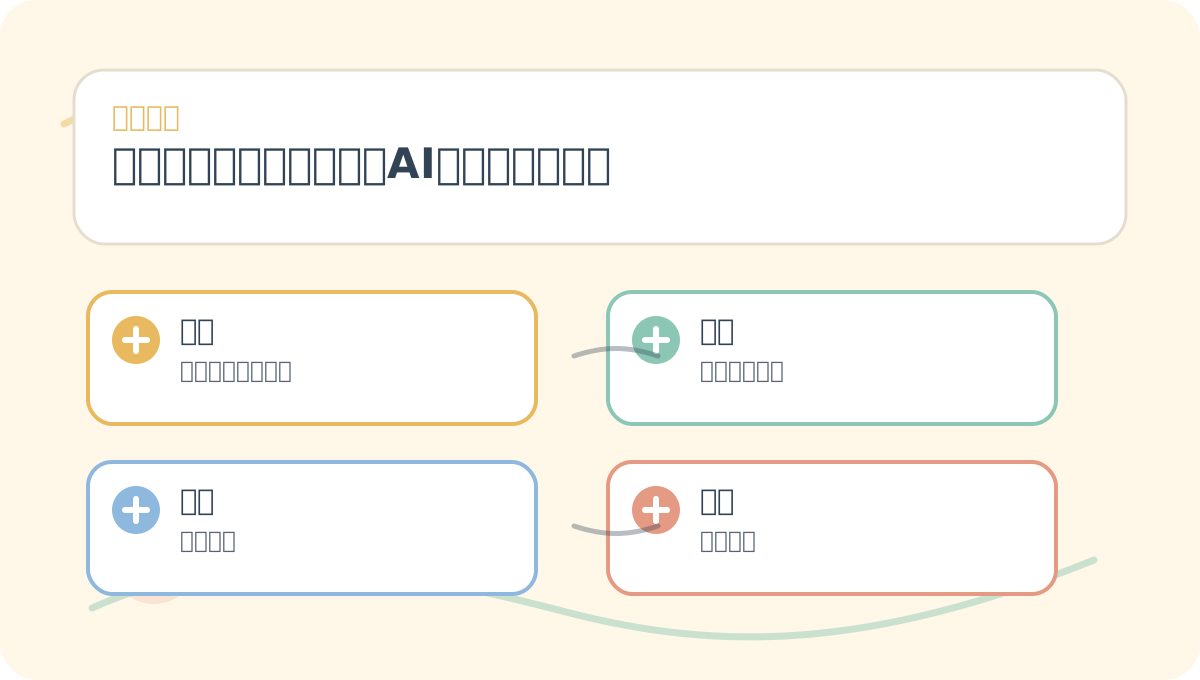
After reading “Effectiveness Evaluation and Optimization: Key Steps for Generative AI Applications”, reflect on three questions: What problem does this solve? Which step is most error-prone? Can I run a small example end-to-end?
1. Data Augmentation
Use data augmentation techniques to increase training data diversity—for instance, synonym replacement or random sentence shuffling.
def synonym_replace(text, synonyms_dict):
    words = text.split()
    for i, word in enumerate(words):
        if word in synonyms_dict:
            words[i] = synonyms_dict[word]  # Replace with synonym
    return ' '.join(words)

# Example usage
synonyms = {"quick": "fast", "brown": "tan"}
print(synonym_replace("The quick brown fox jumps over the lazy dog", synonyms))
2. Hyperparameter Tuning
Apply methods like grid search or random search to tune model hyperparameters. Example code:
from sklearn.model_selection import GridSearchCV
from sklearn.ensemble import RandomForestClassifier

param_grid = {
    'n_estimators': [50, 100, 200],
    'max_depth': [None, 10, 20, 30],
}

grid_search = GridSearchCV(estimator=RandomForestClassifier(), param_grid=param_grid, cv=3)
grid_search.fit(X_train, y_train)
print("Best parameters:", grid_search.best_params_)
3. Feedback Loops
Collect real-user feedback through interaction and use it to iteratively refine the model—for example, adjusting generation strategies based on user satisfaction scores.
Practical Case Study
Imagine developing an intelligent chatbot powered by a custom-trained generative AI model. Initial evaluation using standard metrics reveals poor coherence in long conversations.
You apply data augmentation to enrich training data with diverse dialogue scenarios and conduct hyperparameter tuning. As a result, both BLEU and ROUGE scores improve significantly.
Performance Comparison Before and After Optimization
| Metric | Before Optimization | After Optimization |
|---|---|---|
| BLEU | 0.45 | 0.62 |
| ROUGE | 0.50 | 0.70 |
| User Satisfaction | 3.5 / 5 | 4.2 / 5 |
These adjustments yield more natural, contextually appropriate, and user-aligned responses—greatly enhancing the overall conversational experience.

By now, you can distill “Effectiveness Evaluation and Optimization: Key Steps for Generative AI Applications” into a concise retrospective checklist: clarify the core narrative first, then validate it with a small task.

After reading “Effectiveness Evaluation and Optimization: Key Steps for Generative AI Applications”, start by walking through a minimal end-to-end example—then assess which steps you can already execute independently.
Summary
In generative AI applications, effectiveness evaluation and optimization are indispensable. Through rigorous, science-based evaluation and systematic tuning strategies, we continuously elevate the quality and reliability of model outputs.
In the next tutorial, we’ll walk through concrete, real-world case studies—demonstrating how Dify brings these principles to life in production environments.
We hope these insights empower you to lay a solid foundation for successful generative AI deployment!
Apply This Lesson
Turn this article into AI software, model, API, and security decisions.
English Article FAQ
Use this article as evidence before choosing AI tools
How should I use this AI Tutorials article?
Use it as the implementation or learning layer, then connect the idea to AI software buyer guides, tool comparisons, benchmarks, API choices, and security checks before making a production decision.
Is this English article different from the Chinese original?
The English edition is localized for global AI readers while preserving the original diagrams, screenshots, prompts, code examples, and source context from the Chinese article.
What should I read after Example usage?
Continue with AI Software Buyer Guides, AI Tools Workbench, Best AI Coding Agents, AI Model Benchmarks, OpenAI vs Anthropic API, or LLM Security Tools depending on the decision you need to make.
Can this article alone choose an AI product or model?
No. Treat the article as evidence and context, then validate fit with pricing, privacy requirements, integration effort, benchmark results, workflow tests, and fallback planning.
Continue