English translation
Define the function
AI Article Decision Snapshot
Turn the lesson into workflow, model, budget, and security checks before choosing tools.
Use this quick snapshot before leaving the article. It keeps the next search tied to practical AI software, model/API, cost, privacy, and implementation questions.
Workflow fit
Identify the real job behind the article: coding, research, document review, support, analytics, content, or internal automation.
Model or tool decision
Decide whether the next step is a software shortlist, an AI tool comparison, an API platform choice, or a model benchmark.
Budget and usage signal
Estimate seats, API calls, prompt volume, retries, review time, and fallback work before assuming the workflow is cheap.
Security and privacy review
Check whether source code, customer data, private documents, prompts, logs, or embeddings will enter the AI workflow.

A definite integral yields signed area. If the graph lies below the x-axis, the result is negative; to compute actual (geometric) area, we often need to split the interval and take absolute values.

I always begin by sketching the function relative to the x-axis. Without visual inspection, it’s easy to mistake signed (negative) area for true geometric area in area-related problems.
In the previous article, we explored the definition and fundamental properties of the definite integral. In this article, we delve deeper into the relationship between integration and area—a foundational concept essential for mastering subsequent computational techniques and real-world applications.
Integration and Area
One of the most important applications of the definite integral is computing the area of a planar region. Let’s first recall the basic idea of the definite integral:
To apply “AI-Calculus Crash Course: Definite Integrals & Applications — Integration–Area Relationship” to your own task, start by narrowing the scope: validate just one critical decision point.
After studying “AI-Calculus Crash Course: Definite Integrals & Applications — Integration–Area Relationship”, try adapting it to a scenario of your own—focusing especially on whether inputs, processing steps, and outputs align coherently.
Let be continuous on the interval . The definite integral is defined as:
This expression can be interpreted as the net (signed) accumulated area between the curve and the -axis over .
1. Example: Computing Area
Consider the simple function:
We want to compute the area bounded by the curve and the -axis over the interval . By definition of the definite integral:
To evaluate this integral, first find an antiderivative:
Then apply the Fundamental Theorem of Calculus (Newton–Leibniz formula):
Thus, the area between and the -axis over is .
2. Intuitive Understanding
To better grasp the relationship between integration and area, visualization helps. Below is Python code that plots the function and shades the region corresponding to the definite integral:
import numpy as np
import matplotlib.pyplot as plt

# Define the function
def f(x):
    return x**2

# Specify the interval
a = 1
b = 3
x = np.linspace(0, 4, 100)
y = f(x)

# Plot the function
plt.plot(x, y, label='$f(x) = x^2$', color='blue')
plt.fill_between(x, y, where=((x >= a) & (x <= b)), color='lightgreen', alpha=0.5)
plt.title('Relationship Between Definite Integration and Area')
plt.xlabel('$x$')
plt.ylabel('$f(x)$')
plt.axhline(0, color='black', lw=0.5, ls='--')
plt.axvline(0, color='black', lw=0.5, ls='--')
plt.xlim(0, 4)
plt.ylim(0, 10)
plt.legend()
plt.grid()
plt.show()
In this plot, the shaded green region corresponds precisely to the area computed via the definite integral—providing an intuitive illustration of how integration captures the region between a curve and the -axis.
3. Extending to More Complex Areas
Moreover, definite integrals can compute areas of more intricate regions—for instance, the area enclosed between two curves, or the area bounded by a curve expressed in polar coordinates.
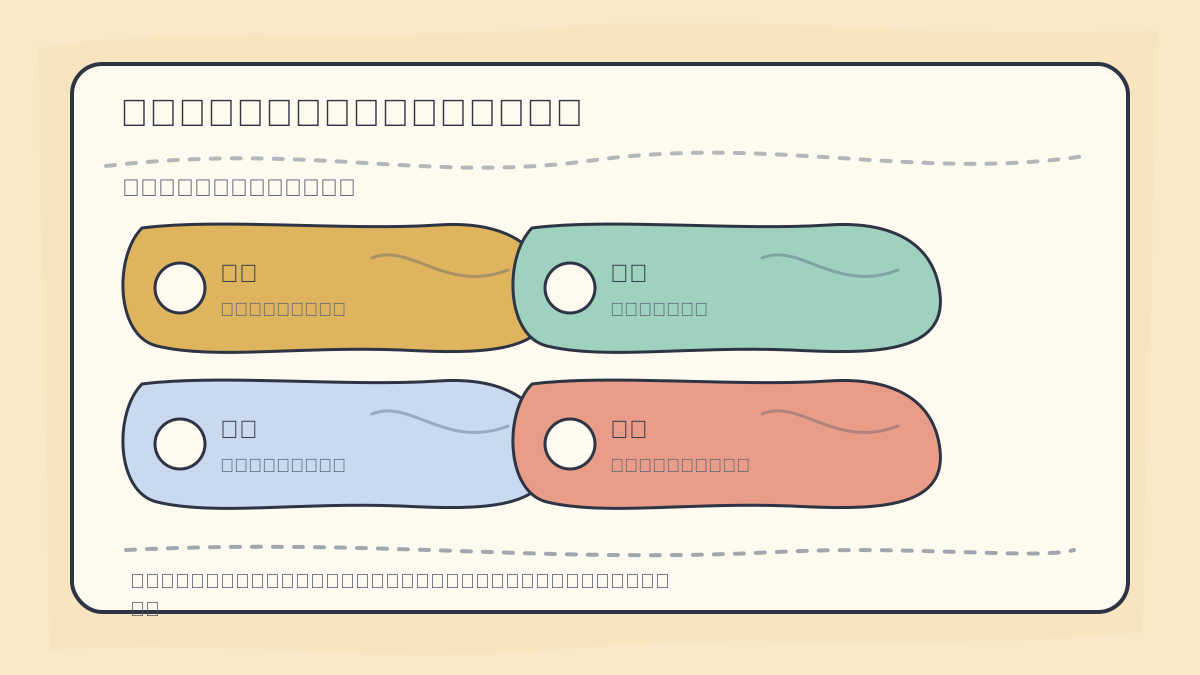
When interpreting the integration–area relationship, first examine:
- the integration interval,
- the sign of the function over subintervals,
- the approximation method (e.g., Riemann sums),
- the distinction between net (signed) area and geometric (absolute) area.
Example: Area Between Two Curves
Suppose we wish to compute the area between and .
First, find their points of intersection by solving:
This yields and . So the region of interest lies over . Since on this interval, the area between the curves is:
Evaluating as before:
Hence, the area between and is .
Summary
In this article, we learned how the definite integral relates to area, and practiced using it to compute planar areas. Mastering this conceptual link is vital for confidently tackling further definite integral computations and applications. In the next article, we’ll begin exploring basic techniques for evaluating definite integrals and their applications, continuing our learning journey.
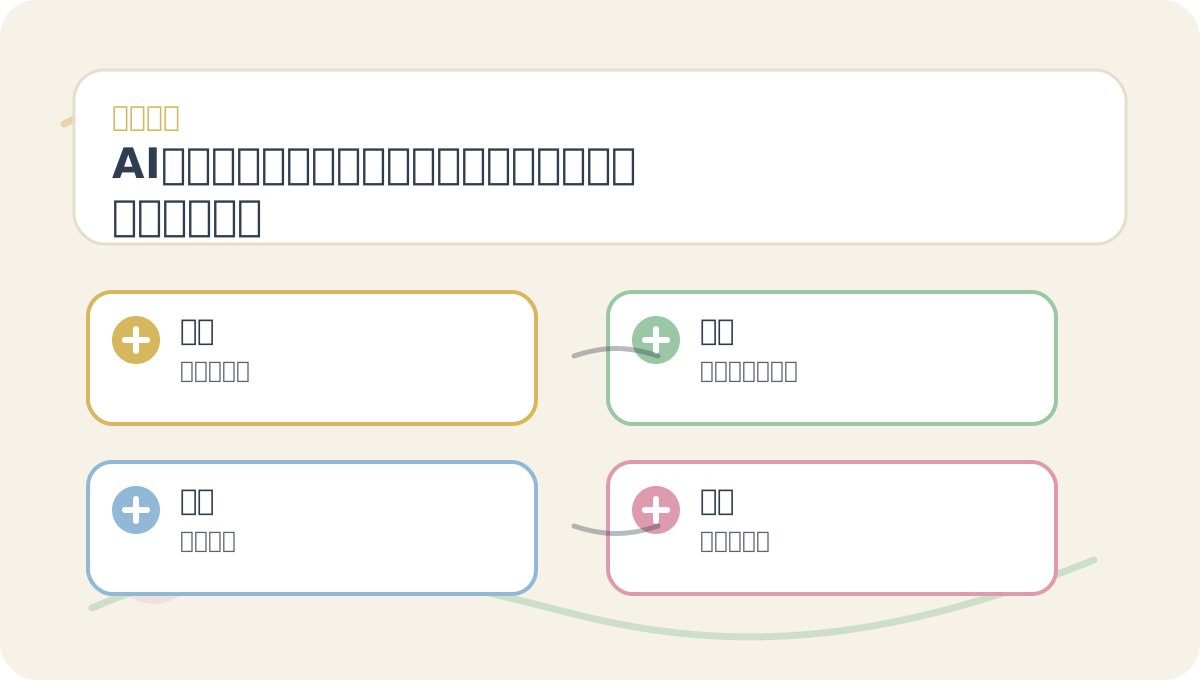
While reading “AI-Calculus Crash Course: Definite Integrals & Applications — Integration–Area Relationship”, first align the diagram’s questions, key terms, operations, and acceptance criteria with the text—this makes reading the main content significantly more efficient. After finishing, try re-explaining the material using your own project as context.
Apply This Lesson
Turn this article into AI software, model, API, and security decisions.
English Article FAQ
Use this article as evidence before choosing AI tools
How should I use this AI Tutorials article?
Use it as the implementation or learning layer, then connect the idea to AI software buyer guides, tool comparisons, benchmarks, API choices, and security checks before making a production decision.
Is this English article different from the Chinese original?
The English edition is localized for global AI readers while preserving the original diagrams, screenshots, prompts, code examples, and source context from the Chinese article.
What should I read after Define the function?
Continue with AI Software Buyer Guides, AI Tools Workbench, Best AI Coding Agents, AI Model Benchmarks, OpenAI vs Anthropic API, or LLM Security Tools depending on the decision you need to make.
Can this article alone choose an AI product or model?
No. Treat the article as evidence and context, then validate fit with pricing, privacy requirements, integration effort, benchmark results, workflow tests, and fallback planning.
Continue