English translation
15. Computing and Applying Basic Definite Integrals
AI Article Decision Snapshot
Turn the lesson into workflow, model, budget, and security checks before choosing tools.
Use this quick snapshot before leaving the article. It keeps the next search tied to practical AI software, model/API, cost, privacy, and implementation questions.
Workflow fit
Identify the real job behind the article: coding, research, document review, support, analytics, content, or internal automation.
Model or tool decision
Decide whether the next step is a software shortlist, an AI tool comparison, an API platform choice, or a model benchmark.
Budget and usage signal
Estimate seats, API calls, prompt volume, retries, review time, and fallback work before assuming the workflow is cheap.
Security and privacy review
Check whether source code, customer data, private documents, prompts, logs, or embeddings will enter the AI workflow.

The key to applying definite integrals lies in modeling. First, clarify what is being accumulated—area, distance, probability, or total cost—then write the corresponding function and interval.

I always assign units to integral results. If the units don’t make sense, it usually means the function or interval was set up incorrectly.
In the previous article, we explored the relationship between definite integrals and area, learning that definite integrals can compute the area under a curve. In this article, we delve deeper into the computation and applications of basic definite integrals to better understand their significance in real-world problems.
1. Definition of the Basic Definite Integral
A definite integral computes the cumulative quantity of a function over a given interval. For a continuous function defined on the closed interval , its definite integral is defined as:

When computing a definite integral: first find an antiderivative; then substitute the upper and lower limits; next check the sign of the function over the interval; finally interpret the result as area, accumulated quantity, or average value.
where and is any point in the -th subinterval.
2. Computing Basic Definite Integrals
In this section, we compute several basic definite integrals through illustrative examples.
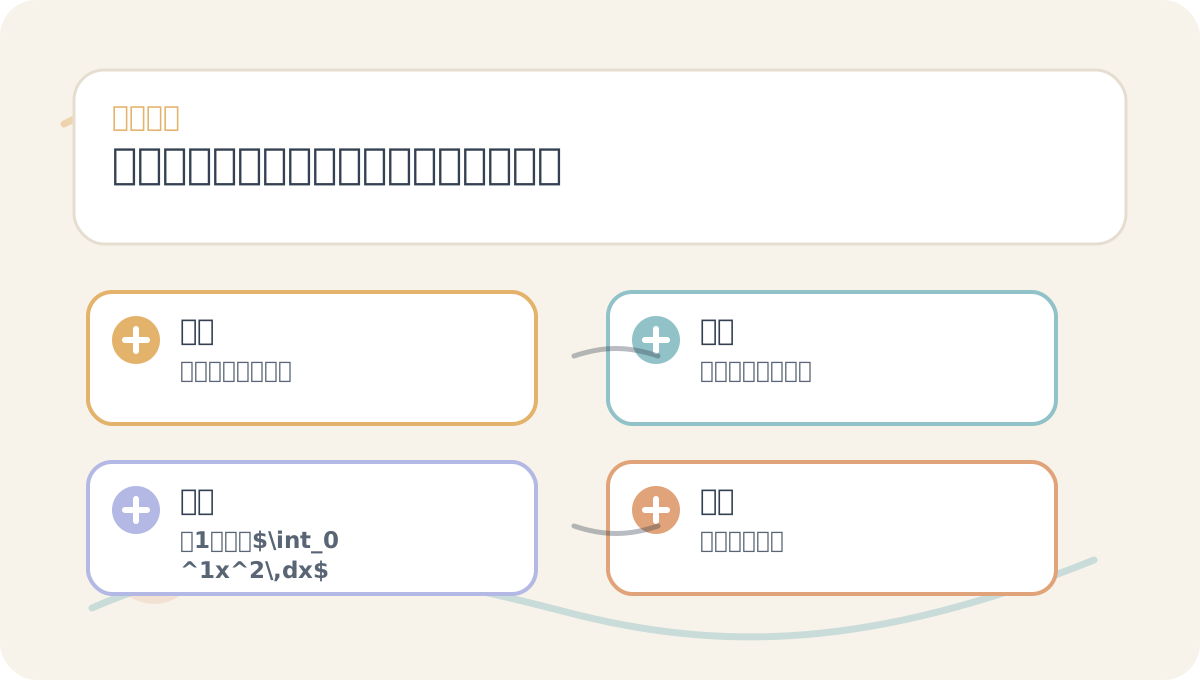
Before reading “Definite Integrals and Applications: Basic Computation and Applications”, preview the visual path from problem to result shown in this diagram. After reading, revisit the main text to verify whether you can reproduce each step independently.
Example 1: Compute
Compute the definite integral of over :
The result is , representing the area between the curve and the -axis over .
Example 2: Compute
Compute the definite integral of over :
Evaluating:
The result is , representing the net signed area between and the -axis over .
3. Applications of Definite Integrals
Definite integrals are not merely tools for computing area—they appear widely across physics, engineering, and other disciplines. Examples include:
Example 3: Computing Displacement Over Time
Suppose an object’s velocity is modeled by . To find its displacement over the time interval , integrate velocity:
Computing:
Thus, the object’s displacement over is units.
Example 4: Computing Area of an Irregular Region
We can also use definite integrals to compute areas of irregular regions. For instance, find the area bounded by and over :
Computing:
This region has area .

If you haven’t fully internalized “Definite Integrals and Applications: Basic Computation and Applications”, revisit this card and walk through its four steps again.

When reviewing “Definite Integrals and Applications: Basic Computation and Applications”, avoid tackling large projects at once. Instead, start with one simple example to confirm whether the core logic is clear.
4. Summary
In this article, we learned how to compute basic definite integrals and demonstrated their practical applications through concrete examples. Definite integrals serve not only to calculate geometric area but also to model physical quantities—such as displacement—and solve problems across science and engineering.
In the next article, we will introduce multivariable calculus, focusing on multivariable functions and partial derivatives. We encourage you to continue following along and deepen your understanding of this essential topic.
Apply This Lesson
Turn this article into AI software, model, API, and security decisions.
English Article FAQ
Use this article as evidence before choosing AI tools
How should I use this AI Tutorials article?
Use it as the implementation or learning layer, then connect the idea to AI software buyer guides, tool comparisons, benchmarks, API choices, and security checks before making a production decision.
Is this English article different from the Chinese original?
The English edition is localized for global AI readers while preserving the original diagrams, screenshots, prompts, code examples, and source context from the Chinese article.
What should I read after 15. Computing and Applying Basic Definite Integrals?
Continue with AI Software Buyer Guides, AI Tools Workbench, Best AI Coding Agents, AI Model Benchmarks, OpenAI vs Anthropic API, or LLM Security Tools depending on the decision you need to make.
Can this article alone choose an AI product or model?
No. Treat the article as evidence and context, then validate fit with pricing, privacy requirements, integration effort, benchmark results, workflow tests, and fallback planning.
Continue