English translation
Define symbolic variables
AI Article Decision Snapshot
Turn the lesson into workflow, model, budget, and security checks before choosing tools.
Use this quick snapshot before leaving the article. It keeps the next search tied to practical AI software, model/API, cost, privacy, and implementation questions.
Workflow fit
Identify the real job behind the article: coding, research, document review, support, analytics, content, or internal automation.
Model or tool decision
Decide whether the next step is a software shortlist, an AI tool comparison, an API platform choice, or a model benchmark.
Budget and usage signal
Estimate seats, API calls, prompt volume, retries, review time, and fallback work before assuming the workflow is cheap.
Security and privacy review
Check whether source code, customer data, private documents, prompts, logs, or embeddings will enter the AI workflow.

A partial derivative measures how the output changes with respect to one input variable while holding all other variables constant. Collectively, all first-order partial derivatives form the gradient vector.

I explicitly identify which variable is being differentiated—and which variables are temporarily treated as constants. Confusing these roles leads directly to incorrect gradient calculations.
In the previous section, we explored definite integrals and their applications—learning how to compute basic definite integrals and how they apply to real-world problems. In this section, we shift our focus to multivariable calculus, centering on multivariable functions and their partial derivatives. This foundation will prepare us for the upcoming discussion of multiple integrals.
Multivariable Functions
A multivariable function is one whose output depends on two or more independent variables. For a function , where and are independent variables, we can interpret it as a function defined over the plane; graphically, such a function corresponds to a surface in three-dimensional space.
Example
Consider the multivariable function . Here, the function value equals the squared Euclidean distance from point to the origin . Geometrically, this function describes a symmetric, upward-opening paraboloid (a “bowl-shaped” surface), symmetric about both coordinate axes.
Partial Derivatives
A partial derivative of a multivariable function is its derivative with respect to one independent variable, while all other independent variables are held fixed. For , we compute its partial derivatives with respect to and , denoted and , respectively.
Definition
The formal definitions are:
-
Partial derivative with respect to :
-
Partial derivative with respect to :
Example Calculation
Let’s compute the partial derivatives of :
-
Compute :
This means that, with held constant, the instantaneous rate of change of with respect to is .
-
Compute :
This means that, with held constant, the instantaneous rate of change of with respect to is .
Physical Interpretation
Partial derivatives play a vital role in applied contexts. For instance, in heat conduction problems, temperature distribution is modeled by a multivariable function, and partial derivatives quantify how temperature changes along specific spatial directions.
Case Study: Gradient and Extrema
Beyond measuring local rates of change, partial derivatives help locate extrema (maxima and minima) of multivariable functions—via the gradient.

When learning multivariable functions and partial derivatives, always begin by clearly stating:
- Which variables are independent,
- Which variables are held constant,
- With respect to which variable you’re differentiating,
- Then interpret the result as the instantaneous rate of change in that direction.
The gradient vector is defined as
Its direction points toward the steepest ascent of , and its magnitude equals the rate of increase in that direction.
Example: Classifying Critical Points
Consider . To find and classify extrema:
-
Compute partial derivatives:
-
Set both partial derivatives to zero:
So is a critical point.
-
Use the second derivative test (e.g., via the Hessian matrix) to determine the nature of this point.
The analysis confirms that is a local maximum, and the maximum value of is .
Python Implementation
We can compute partial derivatives numerically or symbolically using Python—for example, with the sympy library:
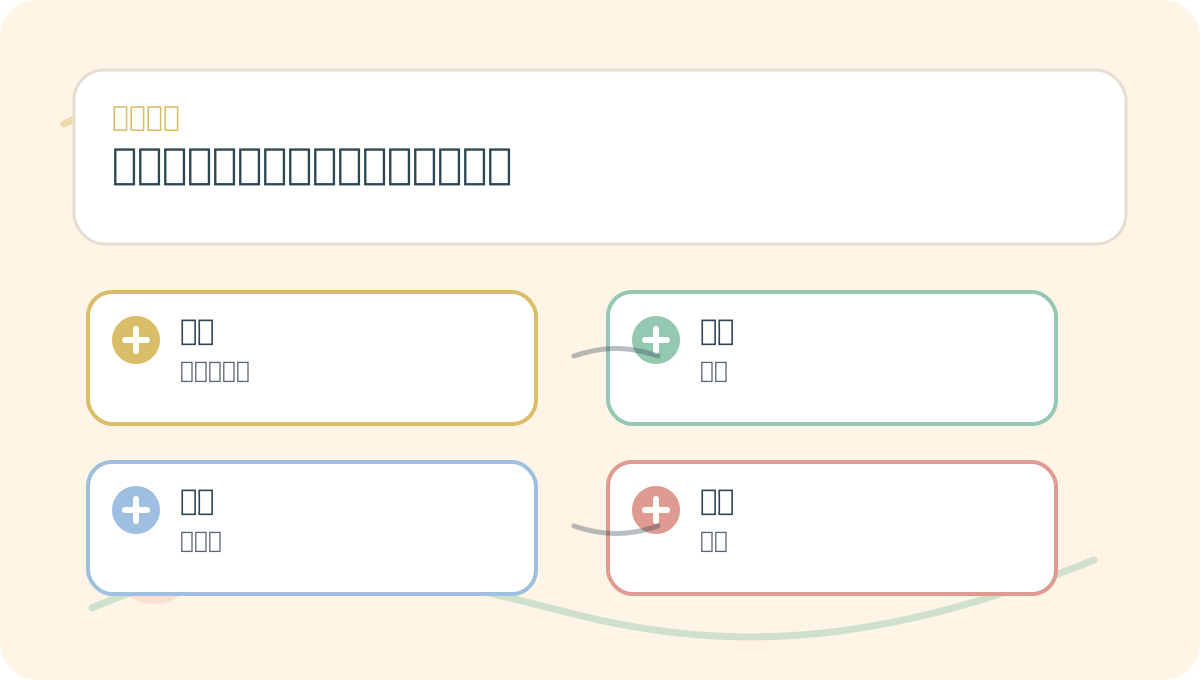
Read “Multivariable Functions and Partial Derivatives” through the lens of Scenario → Concept → Action → Result. First align these four elements, then revisit parameters, code, or procedural steps in the main text.
import sympy as sp

# Define symbolic variables
x, y = sp.symbols('x y')

# Define the function
f = x**2 + y**2

# Compute partial derivatives
f_x = sp.diff(f, x)
f_y = sp.diff(f, y)

print(f'Partial derivative w.r.t. x: {f_x}')
print(f'Partial derivative w.r.t. y: {f_y}')
Running this code yields the symbolic partial derivatives, enabling further analytical or numerical exploration.
Having read this section, consolidate “Multivariable Functions and Partial Derivatives” into a structured recap table: clarify the central narrative first, then validate understanding using a small, concrete task.
After finishing “Multivariable Functions and Partial Derivatives”, pick a simple example and walk through the full workflow end-to-end. Then assess which steps you can now execute independently.
Summary
In this section, we introduced multivariable functions and partial derivatives. We learned how to define and compute partial derivatives, and explored their significance in modeling real-world phenomena. Mastering these concepts lays essential groundwork for the next section: computing and applying multiple integrals. There, we’ll delve deeper into double and triple integrals—their evaluation techniques and diverse applications.
Apply This Lesson
Turn this article into AI software, model, API, and security decisions.
English Article FAQ
Use this article as evidence before choosing AI tools
How should I use this AI Tutorials article?
Use it as the implementation or learning layer, then connect the idea to AI software buyer guides, tool comparisons, benchmarks, API choices, and security checks before making a production decision.
Is this English article different from the Chinese original?
The English edition is localized for global AI readers while preserving the original diagrams, screenshots, prompts, code examples, and source context from the Chinese article.
What should I read after Define symbolic variables?
Continue with AI Software Buyer Guides, AI Tools Workbench, Best AI Coding Agents, AI Model Benchmarks, OpenAI vs Anthropic API, or LLM Security Tools depending on the decision you need to make.
Can this article alone choose an AI product or model?
No. Treat the article as evidence and context, then validate fit with pricing, privacy requirements, integration effort, benchmark results, workflow tests, and fallback planning.
Continue