English translation
AI Product Manager Tutorial Series: Part 1
AI Article Decision Snapshot
Turn the lesson into workflow, model, budget, and security checks before choosing tools.
Use this quick snapshot before leaving the article. It keeps the next search tied to practical AI software, model/API, cost, privacy, and implementation questions.
Workflow fit
Identify the real job behind the article: coding, research, document review, support, analytics, content, or internal automation.
Model or tool decision
Decide whether the next step is a software shortlist, an AI tool comparison, an API platform choice, or a model benchmark.
Budget and usage signal
Estimate seats, API calls, prompt volume, retries, review time, and fallback work before assuming the workflow is cheap.
Security and privacy review
Check whether source code, customer data, private documents, prompts, logs, or embeddings will enter the AI workflow.

This tutorial series is designed to help you first build a working mental map: Product managers don’t need to become algorithm engineers—but they must be able to bring user problems, data constraints, model capabilities, and business goals together onto the same table for discussion.

After reading this overview, write down the product lifecycle stage you currently engage with most frequently: user research, requirements definition, design, launch, or operations. Your subsequent learning focus will revolve around strengthening that specific area.

If you’d like a quick way to assess whether this tutorial series suits your needs, try summarizing your current work in three concise sentences:
- What is the core user problem?
- Where does the data come from?
- Which metric will you track post-launch?
The more concrete these three sentences are, the easier it will be to connect later concepts—models, tools, and case studies—to your own product context.
Course Overview & Learning Objectives
In today’s rapidly evolving technological landscape, artificial intelligence (AI) has become a central driver across industries—especially in product management. As a product manager, mastering practical AI techniques and tools is essential to enhancing product competitiveness and delivering real user value. This tutorial series provides a comprehensive educational framework for AI-powered product management—equipping you to thrive at the frontier of this field.
When practicing with the AI Product Manager Tutorial Series, we recommend documenting each exercise as a unified triplet: input conditions, processing actions, and observable outcomes—making future review faster and more effective.
When reviewing the AI Product Manager Tutorial Series, consolidate key concepts, step-by-step procedures, and observable outcomes onto a single page for efficient re-engagement.
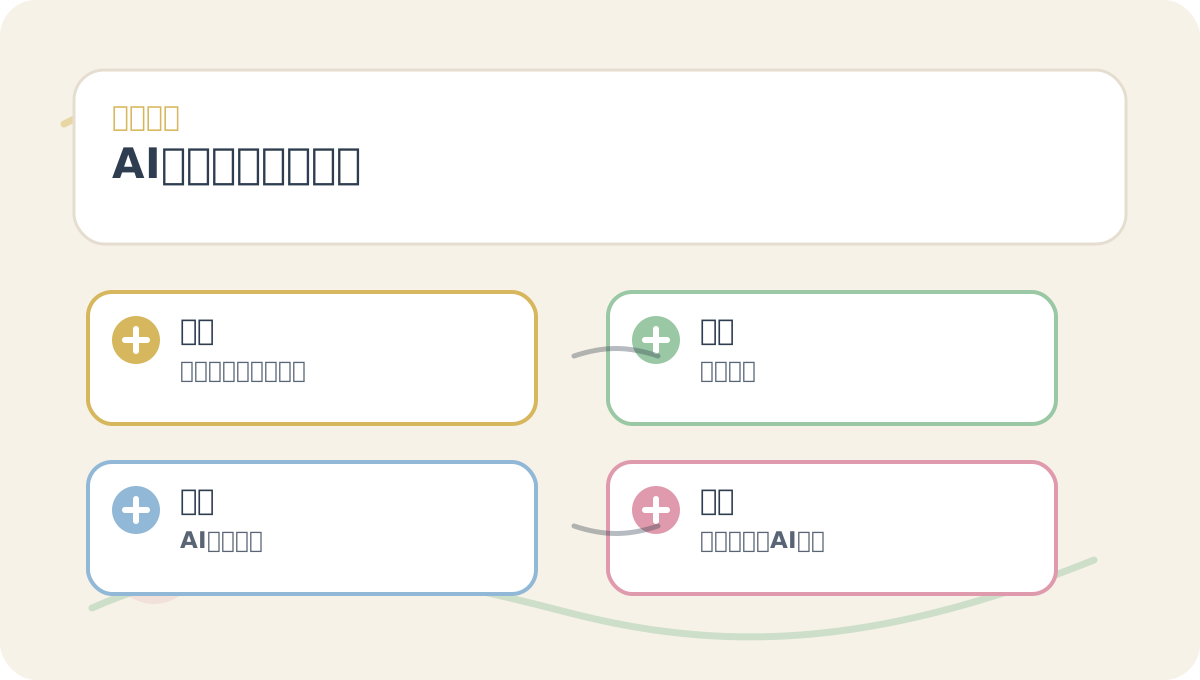
The AI Product Manager Tutorial Series is best studied alongside its visual aids. First confirm the problem statement and evaluation criteria; then read the conceptual explanations and practice steps. This approach helps information cohere into a clear, actionable thread.
This course covers the following key themes:
-
Foundations of AI: Understand core concepts—including AI, machine learning (ML), and deep learning (DL)—to establish a solid theoretical foundation.
-
Integrating AI into Product Management: Explore how AI technologies apply across the full product lifecycle—from discovery and requirements gathering through design, development, launch, and iteration.
-
Practical Tools & Technologies: Learn how to identify and leverage AI tools and platforms suited to your product’s needs—such as automated analytics systems, user behavior prediction models, and more.
-
Real-World Case Studies: Deepen your understanding through hands-on analysis of actual AI-driven products. For example, we’ll examine how successful AI products continuously optimize themselves using data insights and user feedback.
Learning Objectives
By completing this course, you will be able to:
-
Grasp fundamental AI concepts, and understand how these technologies shape product development and management decisions.
-
Identify AI application opportunities across key product management activities—including user research, market analysis, feature prioritization, and performance optimization.
-
Select and apply AI tools effectively, strengthening your ability to make data-informed decisions and execute with greater precision.
-
Analyze real-world AI product cases, extracting success patterns, lessons learned, and common pitfalls to avoid.
-
Develop your own AI product strategy, grounded in market needs and aligned with emerging technical trends—to guide future product initiatives.
For instance, in our Case Study section, we’ll dissect the AI recommendation system of a leading social media platform—examining how it improves content distribution, boosts user engagement, and elevates satisfaction. This isn’t just about algorithms: it’s about how product managers orchestrate cross-functional collaboration to align technology with business impact.
As you progress through this course, our goal is to prepare you to confidently integrate AI into your day-to-day product work—empowering you to lead teams in building more innovative, intelligent, and competitive products. Stay tuned for the next article: “Why AI Matters in Product Management.”
Apply This Lesson
Turn this article into AI software, model, API, and security decisions.
English Article FAQ
Use this article as evidence before choosing AI tools
How should I use this AI Tutorials article?
Use it as the implementation or learning layer, then connect the idea to AI software buyer guides, tool comparisons, benchmarks, API choices, and security checks before making a production decision.
Is this English article different from the Chinese original?
The English edition is localized for global AI readers while preserving the original diagrams, screenshots, prompts, code examples, and source context from the Chinese article.
What should I read after AI Product Manager Tutorial Series: Part 1?
Continue with AI Software Buyer Guides, AI Tools Workbench, Best AI Coding Agents, AI Model Benchmarks, OpenAI vs Anthropic API, or LLM Security Tools depending on the decision you need to make.
Can this article alone choose an AI product or model?
No. Treat the article as evidence and context, then validate fit with pricing, privacy requirements, integration effort, benchmark results, workflow tests, and fallback planning.
Continue