English translation
10 Business Models and Value Propositions
AI Article Decision Snapshot
Turn the lesson into workflow, model, budget, and security checks before choosing tools.
Use this quick snapshot before leaving the article. It keeps the next search tied to practical AI software, model/API, cost, privacy, and implementation questions.
Workflow fit
Identify the real job behind the article: coding, research, document review, support, analytics, content, or internal automation.
Model or tool decision
Decide whether the next step is a software shortlist, an AI tool comparison, an API platform choice, or a model benchmark.
Budget and usage signal
Estimate seats, API calls, prompt volume, retries, review time, and fallback work before assuming the workflow is cheap.
Security and privacy review
Check whether source code, customer data, private documents, prompts, logs, or embeddings will enter the AI workflow.
The business model for an AI product must account for inference costs, data acquisition costs, and human review costs. A feature that looks impressive—but loses money on every use—requires a fundamental redesign of its value proposition.
For each feature, conduct a simple cost-benefit ledger: What is the cost per use? What value does the user perceive? Does it drive retention or monetization? If you can’t quantify these clearly, resist the urge to prematurely package and pitch “selling points.”
In product planning and strategy, a well-defined business model and a crisp value proposition are critical to success. A business model not only determines how a product generates revenue—it also shapes product design and functionality. As an AI Product Manager, deeply understanding—and actively shaping—an effective business model and value proposition is therefore essential. In what follows, we’ll explore this topic in depth through both theory and real-world case studies.
Components of a Business Model
A business model typically comprises the following core elements:
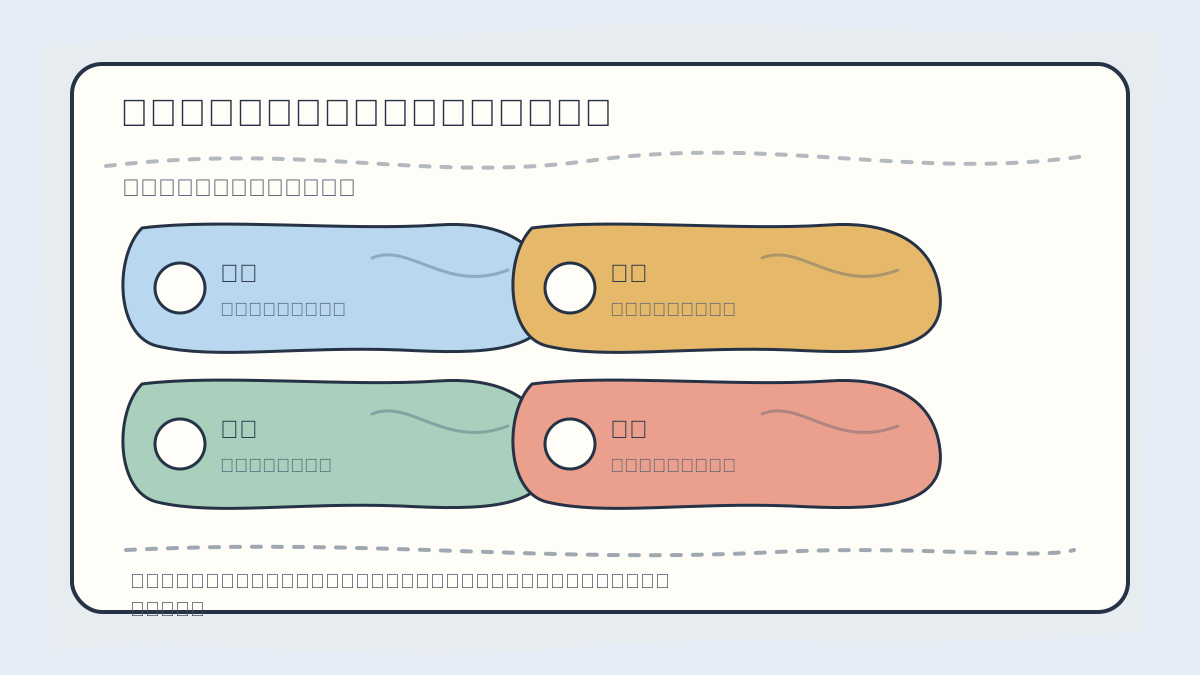
When designing a business model, begin by explicitly articulating:
- Target customers
- Core customer pain points
- Existing alternatives
- Value delivered (benefits)
- Revenue model (pricing & monetization)
- Delivery cost (cost to serve)
- Target Market: Clearly define which user segments your product serves.
- Value Proposition: What value does your product create for users—and which specific problems does it solve?
- Revenue Streams: How does the product generate income? (e.g., subscriptions, one-time purchases, advertising)
- Cost Structure: What are the primary cost drivers? What resources must be invested?
- Key Activities: Which critical actions are required to deliver the value proposition and achieve business goals?
- Key Resources: What assets—technical, human, financial, or intellectual—are needed to support those key activities?
Case Study: Spotify
Spotify’s business model can be summarized as follows:
- Target Market: Music lovers and casual listeners.
- Value Proposition: Unlimited access to a vast music library, with personalized playlist creation and discovery.
- Revenue Streams: A freemium model—ad-supported free tier, plus premium subscription (ad-free, offline playback, higher audio quality).
- Cost Structure: Royalty payments to artists and rights holders, platform infrastructure and maintenance, marketing and user acquisition.
- Key Activities: UX/UI design and continuous optimization, licensing negotiations with record labels and publishers, global marketing campaigns.
- Key Resources: Licensed music catalog, proprietary recommendation algorithms (leveraging user behavior data), scalable cloud infrastructure.
Building a Compelling Value Proposition
The value proposition lies at the heart of product success—it answers the pivotal question: “Why should users choose your product over competitors?” Constructing an effective value proposition involves the following steps:
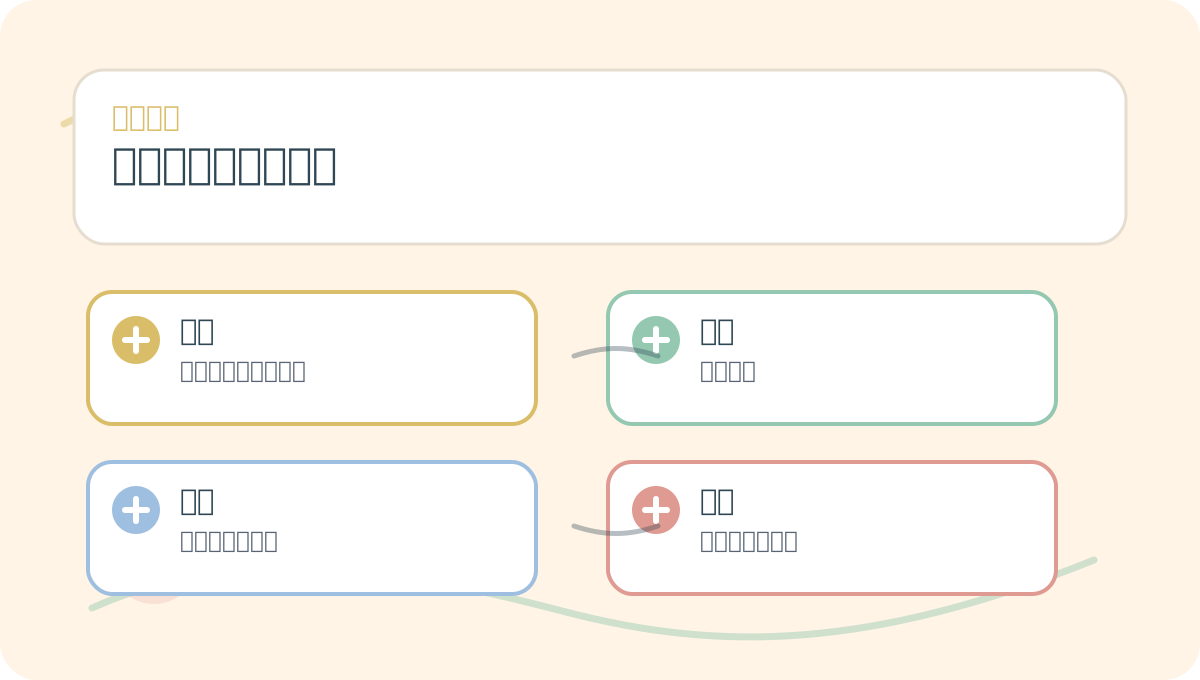
Read “Business Models and Value Propositions” through the lens of Scenario → Concept → Action → Outcome. First align these four dimensions—then return to the details in the main text: parameters, code snippets, or process flows.
- Identify Customer Pain Points: Use user interviews, feedback analysis, and behavioral data to uncover users’ most pressing challenges.
- Describe the Product Solution: Articulate how your product directly addresses those pains—and highlight the core features enabling that resolution.
- Quantify the Value: Where possible, express benefits numerically—for example, “reduces task time by 40%,” “cuts operational costs by $X per month,” or “increases conversion rate by Y%.”
- Differentiate: Benchmark against competitors and emphasize what makes your solution uniquely suited—whether superior accuracy, faster latency, simpler integration, or stronger privacy guarantees.
Case Study: Zoom
Consider Zoom’s video conferencing platform:
- Customer Pain Point: Difficulty coordinating in-person meetings; rising demand for reliable remote collaboration tools.
- Solution: A simple, high-fidelity, low-friction video conferencing platform designed for seamless adoption across teams and geographies.
- Quantified Value: Supports up to 500 participants per meeting—enabling large-scale alignment without compromising clarity or stability.
- Differentiation: Compared to rivals, Zoom prioritizes connection reliability (e.g., adaptive bandwidth management) and intuitive, consistent UX—even for first-time users.
Integrating with the Product Roadmap
In the previous section, we discussed how to build a product roadmap. A roadmap is a vital tool for incrementally realizing your business model and value proposition. Every phase of the roadmap must align with—and reinforce—your stated value proposition and intended business model behaviors. For instance, if your value proposition centers on “enhancing user productivity,” then each release should include mechanisms for gathering user feedback on workflow efficiency—and concrete improvements informed by that input.
After studying “Business Models and Value Propositions,” try applying it to your own context. Pay close attention to whether inputs, processing logic, and outputs logically connect and reinforce one another.
To apply “Business Models and Value Propositions” to your current work, start small: isolate one critical decision point—and rigorously validate just that.
Summary and Outlook
A robust business model and a compelling value proposition form the foundation of effective product planning. As an AI Product Manager, you must continuously analyze market dynamics, evolving user needs, and empirical data—to iteratively refine both your business model and value proposition. In the next section, we’ll dive deeper into how to prioritize product features, a skill that directly informs execution and resource allocation throughout development.
Through this article, we hope to equip you with practical frameworks and mindset shifts—so you can thoughtfully embed business models and value propositions into your product strategy, and ultimately drive successful AI products.
Apply This Lesson
Turn this article into AI software, model, API, and security decisions.
English Article FAQ
Use this article as evidence before choosing AI tools
How should I use this AI Tutorials article?
Use it as the implementation or learning layer, then connect the idea to AI software buyer guides, tool comparisons, benchmarks, API choices, and security checks before making a production decision.
Is this English article different from the Chinese original?
The English edition is localized for global AI readers while preserving the original diagrams, screenshots, prompts, code examples, and source context from the Chinese article.
What should I read after 10 Business Models and Value Propositions?
Continue with AI Software Buyer Guides, AI Tools Workbench, Best AI Coding Agents, AI Model Benchmarks, OpenAI vs Anthropic API, or LLM Security Tools depending on the decision you need to make.
Can this article alone choose an AI product or model?
No. Treat the article as evidence and context, then validate fit with pricing, privacy requirements, integration effort, benchmark results, workflow tests, and fallback planning.
Continue