English translation
How Cross-Functional Teams Collaborate in AI Product Development
AI Article Decision Snapshot
Turn the lesson into workflow, model, budget, and security checks before choosing tools.
Use this quick snapshot before leaving the article. It keeps the next search tied to practical AI software, model/API, cost, privacy, and implementation questions.
Workflow fit
Identify the real job behind the article: coding, research, document review, support, analytics, content, or internal automation.
Model or tool decision
Decide whether the next step is a software shortlist, an AI tool comparison, an API platform choice, or a model benchmark.
Budget and usage signal
Estimate seats, API calls, prompt volume, retries, review time, and fallback work before assuming the workflow is cheap.
Security and privacy review
Check whether source code, customer data, private documents, prompts, logs, or embeddings will enter the AI workflow.
A common challenge in AI product collaboration is that each role speaks a different language: product managers focus on user experience, data scientists prioritize model metrics, engineers emphasize system performance, and operations teams track user complaints. The product manager’s critical role is to translate these distinct perspectives into a shared, unified goal.
During review meetings, avoid focusing solely on live demos. Instead, jointly examine concrete evidence—such as sample set performance, API latency, edge-case failures, and real user feedback—to ground discussions in the same dataset.
In the previous article, we explored Collaboration Tools and Technology Stacks for AI Product Development, highlighting how selecting appropriate tools significantly enhances team communication and operational efficiency. In this article, we delve deeper into Collaboration Methods for Cross-Functional Teams, using practical case studies to illustrate how effective collaboration accelerates AI product development.
Understanding Cross-Functional Teams
A cross-functional team comprises individuals from diverse backgrounds and disciplines who work collectively toward a shared objective. In AI product development, such teams typically include the following roles:
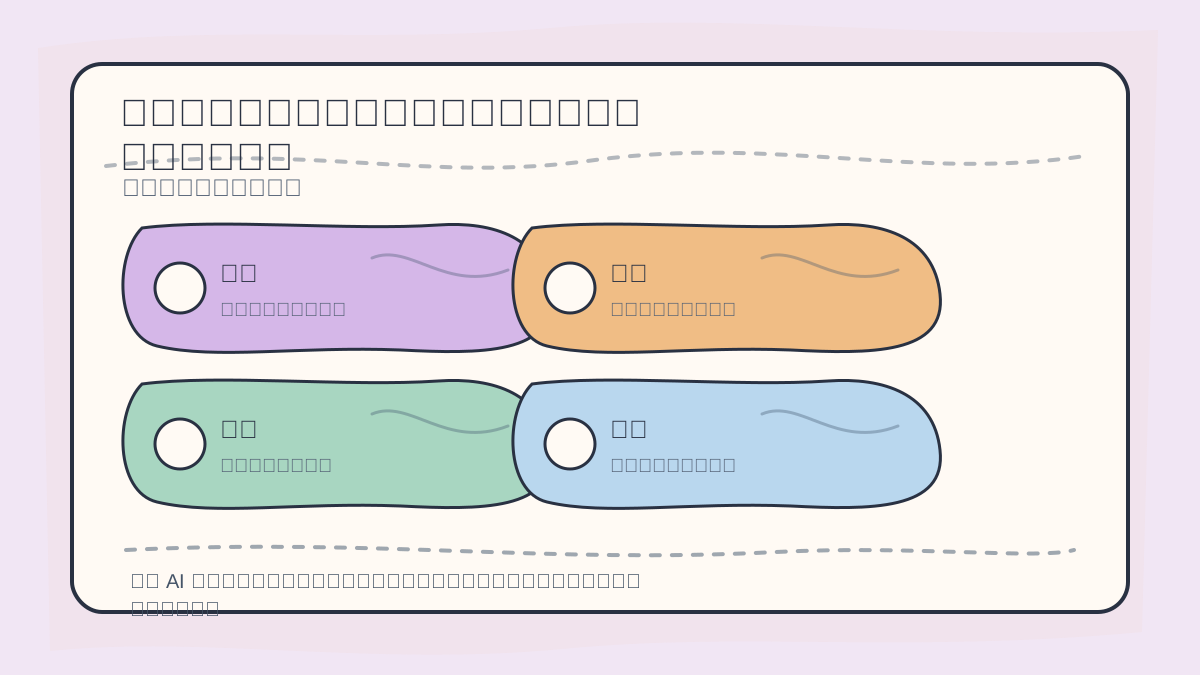
When organizing cross-functional collaboration for AI products, first assess five key dimensions: goal decomposition, role boundaries, delivery cadence, risk synchronization, and feedback closure.
- Product Manager (PM): Responsible for overall product vision, strategy, and roadmap planning.
- Data Scientist: Focuses on data analysis, feature engineering, and building and refining ML models.
- Engineer: Implements technical solutions, develops scalable infrastructure, and integrates models into production systems.
- Designer: Owns user research, interaction design, and UI/UX implementation to ensure intuitive and accessible experiences.
- Marketing Team: Leads go-to-market strategy, positioning, campaign execution, and customer acquisition.
Leveraging team diversity enables organizations to harness complementary expertise across domains—driving innovation, robustness, and competitive differentiation.
Collaboration Methods
Effective cross-functional collaboration can be structured around the following approaches:
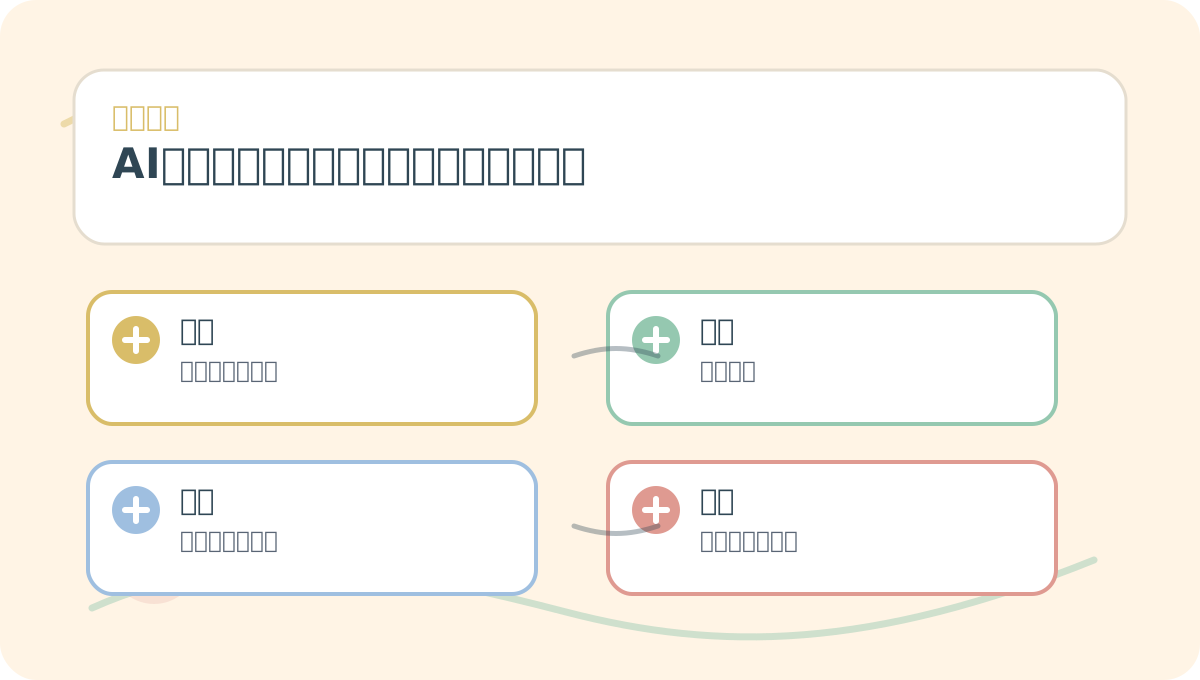
You don’t need to absorb every detail of Collaboration Methods for Cross-Functional Teams in AI Product Development all at once. Start with one small, actionable problem you can test immediately—then use the diagram and accompanying text to fill in conceptual gaps.
1. Regular Cross-Departmental Sync Meetings
Scheduled cross-departmental meetings are essential for maintaining transparent, timely communication. During these sessions, members from each function share progress updates, roadblocks, and proposed solutions—ensuring collective awareness of the project’s status and priorities.
Case Study:
At an AI startup, the team holds a weekly All-Hands Sync. The PM opens with product milestones and upcoming iteration plans; the data scientist presents model evaluation results and training bottlenecks; and engineers highlight integration challenges or infrastructure constraints. This routine has dramatically improved mutual understanding across functions—and accelerated end-to-end delivery.
2. Collaboration Tools & Platforms
As introduced in the previous article, Collaboration Tools and Technology Stacks play a foundational role. When integrated thoughtfully, the following tools strengthen cross-functional alignment:
- Slack: Enables real-time, lightweight communication and rapid feedback loops.
- Trello / Jira: Supports task assignment, sprint planning, and progress tracking across functions.
- Confluence: Serves as a centralized knowledge base for documentation, decision logs, and process guidelines.
- GitHub / GitLab: Provides version control, code review workflows, and CI/CD pipeline visibility.
Practical Application
For example, when a data scientist develops a model in Jupyter Notebook, they commit the notebook directly to GitHub. Other team members—including engineers and PMs—can review logic, suggest improvements, and verify reproducibility. Meanwhile, engineers use Jira to track dependent tasks (e.g., “integrate v2 recommendation model”), ensuring model deployment stays synchronized with backend and frontend development.
3. Agile Development Practices
Agile development is an iterative, incremental approach to software delivery. With sprints typically lasting one to two weeks, teams rapidly incorporate stakeholder feedback, adapt to evolving requirements, and respond to market shifts.
Iteration Example
In developing an AI-powered content moderation tool, the team selects one high-impact capability per sprint—e.g., “detect manipulated media thumbnails.” At each sprint’s conclusion, they hold a retrospective meeting: celebrating wins (e.g., 95% precision on test set), diagnosing blockers (e.g., label noise in training data), and adjusting next steps. This continuous feedback loop empowers the PM to detect emerging user needs early—and pivot strategy accordingly.
4. Design Thinking
Design thinking is a human-centered framework especially valuable in AI product development. It encourages cross-functional teams to co-create solutions grounded in deep user empathy—not technical assumptions.
Implementation Steps
- Empathize: Conduct interviews, contextual inquiries, or diary studies to uncover real user behaviors, pain points, and unmet needs.
- Define: Synthesize findings into a clear, actionable problem statement—co-authored by all functions.
- Ideate: Run inclusive brainstorming sessions where engineers, designers, and data scientists jointly generate solution concepts—no idea is premature.
- Prototype & Test: Build low-fidelity prototypes (e.g., clickable mockups, rule-based simulators) and validate them with target users before investing in full ML pipelines.
After studying Collaboration Methods for Cross-Functional Teams in AI Product Development, try applying it in your own context. Pay special attention to whether inputs, processing logic, and outputs align coherently across roles.
To apply Collaboration Methods for Cross-Functional Teams in AI Product Development to your current task, start small: isolate just one critical decision point—and rigorously test it.
Conclusion
Robust cross-functional collaboration is not optional—it’s foundational to AI product success. By combining regular alignment rituals, purpose-built collaboration tools, agile delivery rhythms, and design-thinking mindsets, teams transform functional silos into integrated innovation engines—delivering higher-quality products, faster.
In the next article, we’ll explore Project Management & Team Collaboration: Product Launch Strategy, examining how AI products transition smoothly from development to launch—and how to orchestrate cross-functional readiness for market impact. Stay tuned!
Apply This Lesson
Turn this article into AI software, model, API, and security decisions.
English Article FAQ
Use this article as evidence before choosing AI tools
How should I use this AI Tutorials article?
Use it as the implementation or learning layer, then connect the idea to AI software buyer guides, tool comparisons, benchmarks, API choices, and security checks before making a production decision.
Is this English article different from the Chinese original?
The English edition is localized for global AI readers while preserving the original diagrams, screenshots, prompts, code examples, and source context from the Chinese article.
What should I read after How Cross-Functional Teams Collaborate in AI Product Development?
Continue with AI Software Buyer Guides, AI Tools Workbench, Best AI Coding Agents, AI Model Benchmarks, OpenAI vs Anthropic API, or LLM Security Tools depending on the decision you need to make.
Can this article alone choose an AI product or model?
No. Treat the article as evidence and context, then validate fit with pricing, privacy requirements, integration effort, benchmark results, workflow tests, and fallback planning.
Continue