English translation
Project Management & Team Collaboration: Operational Metrics and Product Performance Evaluation
AI Article Decision Snapshot
Turn the lesson into workflow, model, budget, and security checks before choosing tools.
Use this quick snapshot before leaving the article. It keeps the next search tied to practical AI software, model/API, cost, privacy, and implementation questions.
Workflow fit
Identify the real job behind the article: coding, research, document review, support, analytics, content, or internal automation.
Model or tool decision
Decide whether the next step is a software shortlist, an AI tool comparison, an API platform choice, or a model benchmark.
Budget and usage signal
Estimate seats, API calls, prompt volume, retries, review time, and fallback work before assuming the workflow is cheap.
Security and privacy review
Check whether source code, customer data, private documents, prompts, logs, or embeddings will enter the AI workflow.
AI product metrics cannot be assessed solely by API call volume. High call volume may indicate success—or it may reflect users repeatedly correcting errors. Instead, we must simultaneously examine task completion rate, human intervention rate, negative feedback, and cost.
Metrics can be organized into three interdependent layers:
- Willingness to use — Do users choose to engage?
- Task completion — Does the system actually succeed at the intended task?
- Cost per completion — How much does each successful outcome cost (in time, compute, labor, or money)?
Only by evaluating all three layers together can we avoid being misled by any single metric.
In the previous section, we explored how to effectively collect and analyze user feedback to improve our AI products. In this section, we turn our attention to operational metrics and product performance evaluation—a critical bridge connecting user feedback to concrete product iteration. It ensures that decisions made during subsequent product launches and ongoing operations are rigorously data-informed.
Operational Metrics
Operational metrics are essential tools for measuring product performance and user behavior—and for objectively assessing whether a product is succeeding. Below are several widely used operational metrics:

When evaluating product performance, first assess activation, retention, conversion, usage frequency, satisfaction, and cost metrics—then identify which stage(s) require optimization.
- Daily Active Users (DAU): The number of unique users who interact with the product on a given day.
- Monthly Active Users (MAU): The number of unique users who interact with the product over a 30-day period.
- Retention Rate: A measure of how many users return after their first interaction—commonly reported as Day-1, Day-7, or Day-30 retention.
- User Conversion Rate: The percentage of visitors who complete a defined desired action (e.g., signing up, upgrading, completing onboarding) within a specified timeframe.
- Average Revenue Per User (ARPU): The average revenue generated per user over a given period (e.g., monthly).
Case Study
Consider an AI-powered chatbot product. During its performance evaluation, the team prioritized key metrics including DAU, retention rate, and conversion rate.
- In the first three months post-launch, DAU stabilized around 2,000, while MAU stood at 5,000. This suggests a reasonably stable user base—but also indicates room for improvement in daily engagement depth and consistency.
- Further analysis revealed a Day-1 retention rate of only 30%. By triangulating this finding with qualitative user feedback, the team identified “inaccurate or unhelpful bot responses” as the primary driver of early drop-off.
Armed with these operational metrics—and grounded in real user insights—the team implemented targeted improvements to boost retention, which in turn supported sustainable DAU growth.
Product Performance Evaluation
Product performance evaluation goes beyond data analysis: it’s the disciplined process of diagnosing root causes hidden in the data—and translating those insights into actionable improvement plans. Below are core steps in conducting such an evaluation:
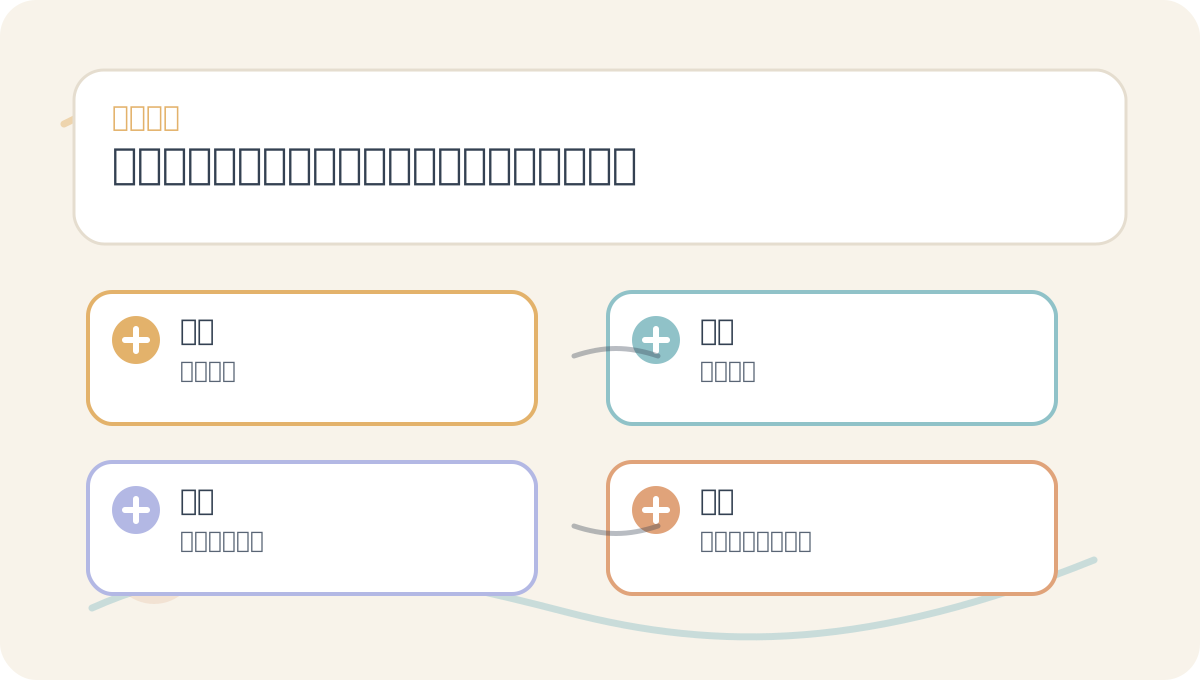
Before reading “Operational Metrics and Product Performance Evaluation in Project Management and Team Collaboration,” use the accompanying diagram to confirm the conceptual flow. After reading, revisit the diagram to identify which steps are immediately actionable—and which require additional resources or background knowledge.
- Define Key Performance Indicators (KPIs): Explicitly select the metrics most critical to your product’s success—for example, DAU, retention rate, and conversion rate.
- Collect Data: Leverage analytics platforms (e.g., Google Analytics, Mixpanel) or custom instrumentation to capture behavioral, transactional, and contextual user data.
- Analyze Data: Use analytical and visualization tools to uncover trends, correlations, anomalies, and cohort-based patterns—making insights accessible and interpretable across teams.
- Report & Discuss: Present findings regularly in cross-functional team meetings. Focus discussions on why metrics shifted—and collaboratively brainstorm hypotheses and testable solutions.
Evaluation in Practice: The Chatbot Case
For the AI chatbot described above, the team executed the following evaluation workflow:
- They established
DAU,Day-1 Retention Rate, andConversion Rateas core KPIs. - Using Mixpanel, they tracked granular user interactions—including session duration, query topics, fallback triggers, and escalation events—and shared weekly analytical summaries in team syncs.
- Analysis revealed that >65% of user queries clustered around a narrow set of common questions—yet response accuracy remained low. In response, the team upgraded the underlying NLP model and introduced a curated, high-precision FAQ module—significantly improving both relevance and user confidence.
When reviewing “Operational Metrics and Product Performance Evaluation in Project Management and Team Collaboration,” consolidate key concepts, concrete steps, and observable outcomes onto a single page for efficient reflection.

When practicing “Operational Metrics and Product Performance Evaluation in Project Management and Team Collaboration,” explicitly document:
- Input conditions (e.g., “DAU plateaued at 2,000; Day-1 retention = 30%”),
- Actions taken (e.g., “retrained NLP model + deployed FAQ module”),
- Observable results (e.g., “Day-1 retention rose to 48% in 4 weeks; DAU increased to 2,650”).
This format enables rapid validation and future replication.
Summary and Outlook
In this section, we examined the strategic importance of operational metrics and product performance evaluation, illustrating—with a real-world case—how these frameworks translate into tangible product improvements. These practices lay the groundwork for the next section: data-driven product iteration, where we’ll explore how to systematically close the loop between insight, experiment, and impact—continuously aligning our AI products with evolving user needs and market expectations.
By embedding robust operational metrics and disciplined evaluation practices into their workflows, AI product managers gain deeper visibility into product health—and build a foundation for confident, evidence-based decisions throughout launch, scaling, and optimization.
Next, we’ll dive into how to execute data-driven product iteration: turning insights into experiments, experiments into validated improvements, and improvements into measurable gains in product quality and user satisfaction.
Apply This Lesson
Turn this article into AI software, model, API, and security decisions.
English Article FAQ
Use this article as evidence before choosing AI tools
How should I use this AI Tutorials article?
Use it as the implementation or learning layer, then connect the idea to AI software buyer guides, tool comparisons, benchmarks, API choices, and security checks before making a production decision.
Is this English article different from the Chinese original?
The English edition is localized for global AI readers while preserving the original diagrams, screenshots, prompts, code examples, and source context from the Chinese article.
What should I read after Project Management & Team Collaboration: Operational Metrics and Product Performance Evaluation?
Continue with AI Software Buyer Guides, AI Tools Workbench, Best AI Coding Agents, AI Model Benchmarks, OpenAI vs Anthropic API, or LLM Security Tools depending on the decision you need to make.
Can this article alone choose an AI product or model?
No. Treat the article as evidence and context, then validate fit with pricing, privacy requirements, integration effort, benchmark results, workflow tests, and fallback planning.
Continue