English translation
Load user interaction logs
AI Article Decision Snapshot
Turn the lesson into workflow, model, budget, and security checks before choosing tools.
Use this quick snapshot before leaving the article. It keeps the next search tied to practical AI software, model/API, cost, privacy, and implementation questions.
Workflow fit
Identify the real job behind the article: coding, research, document review, support, analytics, content, or internal automation.
Model or tool decision
Decide whether the next step is a software shortlist, an AI tool comparison, an API platform choice, or a model benchmark.
Budget and usage signal
Estimate seats, API calls, prompt volume, retries, review time, and fallback work before assuming the workflow is cheap.
Security and privacy review
Check whether source code, customer data, private documents, prompts, logs, or embeddings will enter the AI workflow.
For AI products, user feedback must go beyond sentiment analysis. What’s truly valuable is reconstructing each piece of feedback into concrete inputs, concrete outputs, and specific failure types—enabling the team to refine models, optimize prompts, or improve workflows.
When encountering negative feedback, avoid simply noting “user dissatisfaction.” Instead, systematically record:
- What the user intended to do,
- What the system actually output,
- Where and why it failed,
- Whether the issue is reproducible.
In AI product development, user feedback is an indispensable part of the product manager’s role. It not only helps teams identify product strengths and weaknesses but also guides future development priorities. This article explores how to effectively collect and analyze user feedback to optimize product management and cross-functional collaboration.
I. Why User Feedback Matters
User feedback enables teams to:
- Increase user retention: Promptly addressing user needs and issues boosts satisfaction and loyalty.
- Guide product iteration: Understanding real-world usage uncovers authentic requirements—and reveals where to invest next.
- Strengthen cross-team alignment: When engineers, designers, and data scientists share a grounded understanding of user needs, collaboration becomes more focused and efficient.
II. Methods for Collecting User Feedback
Common approaches include:
1. Online Surveys
Surveys efficiently capture structured insights about user experience and perception. Tools like Google Forms, SurveyMonkey, or Typeform are widely used and effective.
Example:
Suppose our AI assistant app wants to assess user satisfaction with its speech-to-text capability. A sample survey might include:
- How satisfied are you with the accuracy of speech recognition?
(Very dissatisfied / Dissatisfied / Neutral / Satisfied / Very satisfied) - Please describe one issue you encountered while using speech recognition.
2. User Interviews
One-on-one interviews yield rich, contextual insights that surveys often miss.
Case Study:
An AI product company conducted several in-depth user interviews and discovered users strongly preferred “natural conversational tone” over robotic, formulaic responses. This insight directly informed a redesign of the assistant’s text-generation model.
3. Behavioral Analytics Tools
Analyzing in-product behavioral data—such as feature usage patterns, session duration, or drop-off points—uncovers latent needs and friction points.
Sample Code:
Assume we use Python to analyze user interaction logs and identify usage habits:
import pandas as pd

# Load user interaction logs
data = pd.read_csv('user_logs.csv')

# Count frequency of each feature used
usage_frequency = data['feature'].value_counts()

print(usage_frequency)
III. Analyzing User Feedback
Once collected, feedback requires systematic analysis:
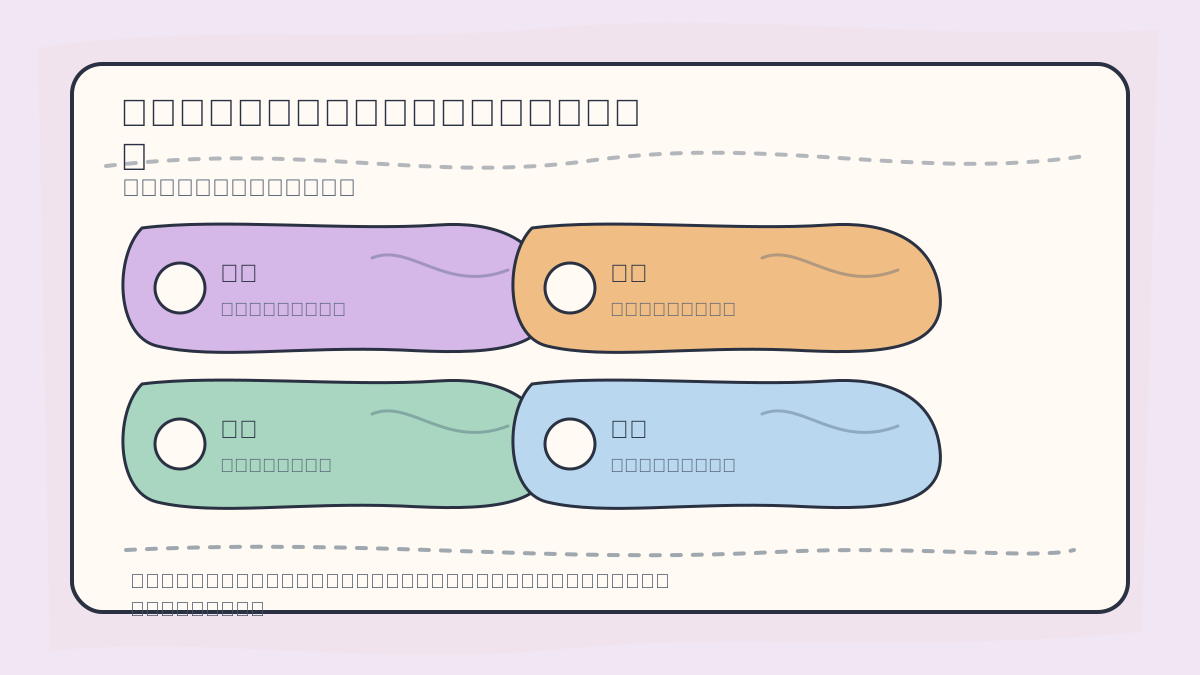
Analysis begins by categorizing feedback by problem type, then prioritizing based on user segment, recurrence frequency, impact scope, and remediation cost.
1. Quantitative Analysis
Apply statistical methods—such as regression analysis or factor analysis—to survey data to uncover dominant trends and correlations.
Case Study:
If 70% of survey respondents flag speech recognition as needing improvement, the product manager should treat this as a high-priority enhancement opportunity.
2. Qualitative Analysis
Code and thematically analyze open-ended responses (e.g., from interviews or free-text survey fields) to surface recurring themes and sentiment patterns.
Example:
Transcribe interview notes into thematic categories—e.g., “Speech Recognition Accuracy,” “Conversational Flow,” “Response Latency”—then tag each instance with frequency and sentiment polarity (positive/negative/neutral).
3. User Persona Construction
Leverage aggregated feedback to build detailed user personas—segmented by behavior, goals, pain points, and preferences. These personas inform both product design and go-to-market strategy.
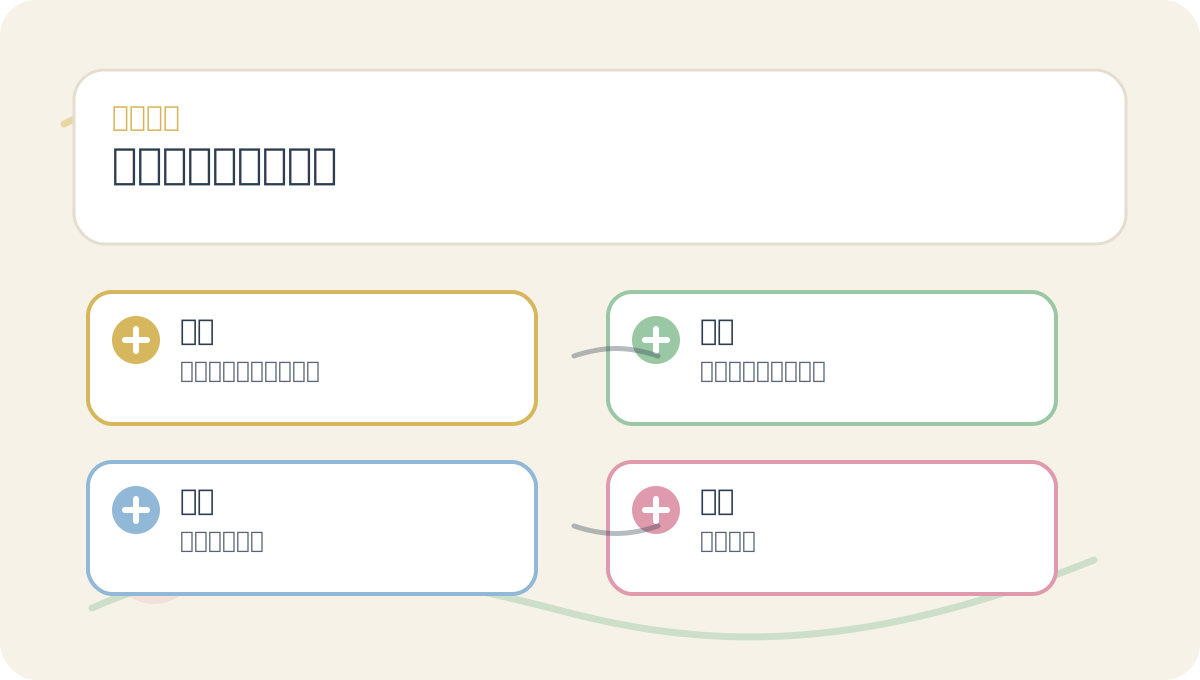
While reading User Feedback Collection and Analysis, start with the visual “Reading Map”: scan the embedded tasks, core concepts, hands-on exercises, and decision checkpoints—then return to the main text to fill in details. This approach helps you quickly assess which real-world scenarios this content applies to.
import matplotlib.pyplot as plt

# Assume we already have user attribute data
user_data = {'age': [22, 25, 47, 35, 29], 'satisfaction_score': [3, 4, 5, 2, 4]}
df = pd.DataFrame(user_data)

# Plot relationship between age and satisfaction score
plt.scatter(df['age'], df['satisfaction_score'])
plt.title('User Satisfaction vs. Age Distribution')
plt.xlabel('Age')
plt.ylabel('Satisfaction Score (1–5)')
plt.show()
IV. Applying Feedback Effectively
- Prioritize rigorously: Rank all feedback items by urgency, severity, user impact, and effort-to-fix—using frameworks like RICE (Reach, Impact, Confidence, Effort) or MoSCoW (Must-have, Should-have, Could-have, Won’t-have).
- Define clear action plans: Translate analysis outcomes into specific, time-bound product initiatives—with clear ownership, success metrics, and dependencies.
- Close the loop continuously: After deploying changes, re-collect feedback to validate impact and sustain iterative learning.
After reading User Feedback Collection and Analysis, distill it into a concise retrospective sheet: first articulate the core workflow, then test it with one small, concrete task to verify understanding and readiness.
Upon finishing User Feedback Collection and Analysis, pick one small, realistic example and walk through the full process end-to-end. Then assess which steps you can now execute independently—and which still require support or practice.
Summary
User feedback is foundational to effective product management and cross-functional teamwork. When collected thoughtfully and analyzed rigorously, it transforms subjective opinions into objective signals—guiding model improvements, prompt engineering, UX refinements, and strategic roadmaps. In the next article, we’ll explore how operational metrics can be used to evaluate product performance—and further accelerate AI product success.
Apply This Lesson
Turn this article into AI software, model, API, and security decisions.
English Article FAQ
Use this article as evidence before choosing AI tools
How should I use this AI Tutorials article?
Use it as the implementation or learning layer, then connect the idea to AI software buyer guides, tool comparisons, benchmarks, API choices, and security checks before making a production decision.
Is this English article different from the Chinese original?
The English edition is localized for global AI readers while preserving the original diagrams, screenshots, prompts, code examples, and source context from the Chinese article.
What should I read after Load user interaction logs?
Continue with AI Software Buyer Guides, AI Tools Workbench, Best AI Coding Agents, AI Model Benchmarks, OpenAI vs Anthropic API, or LLM Security Tools depending on the decision you need to make.
Can this article alone choose an AI product or model?
No. Treat the article as evidence and context, then validate fit with pricing, privacy requirements, integration effort, benchmark results, workflow tests, and fallback planning.
Continue