English translation
Load user behavior data
AI Article Decision Snapshot
Turn the lesson into workflow, model, budget, and security checks before choosing tools.
Use this quick snapshot before leaving the article. It keeps the next search tied to practical AI software, model/API, cost, privacy, and implementation questions.
Workflow fit
Identify the real job behind the article: coding, research, document review, support, analytics, content, or internal automation.
Model or tool decision
Decide whether the next step is a software shortlist, an AI tool comparison, an API platform choice, or a model benchmark.
Budget and usage signal
Estimate seats, API calls, prompt volume, retries, review time, and fallback work before assuming the workflow is cheap.
Security and privacy review
Check whether source code, customer data, private documents, prompts, logs, or embeddings will enter the AI workflow.
Data-driven iteration isn’t about staring at dashboards—it’s about identifying the stage that most significantly impacts user experience, formulating testable hypotheses, and then validating—through experiments—whether changes truly improve outcomes.
If completion rates drop, first decompose the funnel: Are users failing to start? Encountering input errors? Dissatisfied with outputs? Or finding results unusable? Once you isolate the specific bottleneck, targeted improvements become far more efficient.
In the previous article, we explored the importance of operational metrics and product performance evaluation in project management and team collaboration. In this article, we dive into a critical phase of product launch and operations: data-driven product iteration. Before proceeding, however, it’s worth emphasizing that no matter how sophisticated a product may be, its ultimate goal is to meet user needs and enhance user experience—and data-driven iteration is precisely what empowers us to achieve that.
What Is Data-Driven Product Iteration?
Data-driven product iteration is the process of optimizing and improving a product by analyzing user behavior, usage data, and other key performance indicators (KPIs). Through this process, product managers gain deeper insight into user needs and market dynamics—enabling the product to continuously meet and exceed user expectations.
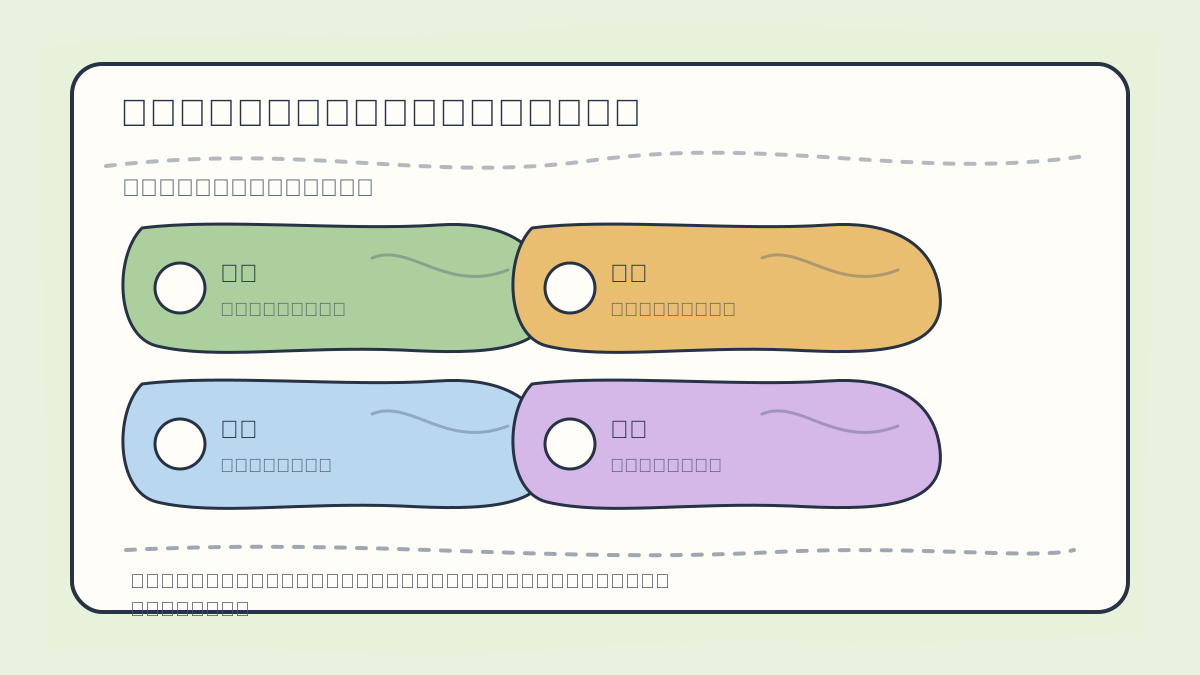
When advancing data-driven iteration, begin by reviewing: core metrics, user segmentation, experiment design, feedback sample quality, iteration hypotheses, and post-mortem results.
Why Adopt Data-Driven Product Iteration?
- Evolving User Needs: User needs and preferences constantly shift; data helps us capture those changes in real time.
- Improved Efficiency: Data analysis reveals pain points and bottlenecks, allowing teams to prioritize features with the greatest impact on users.
- Reduced Risk: Grounding decisions in empirical evidence—not intuition—minimizes the risk of subjective or misinformed choices.
Core Steps
Below are the essential steps involved in executing data-driven product iteration:
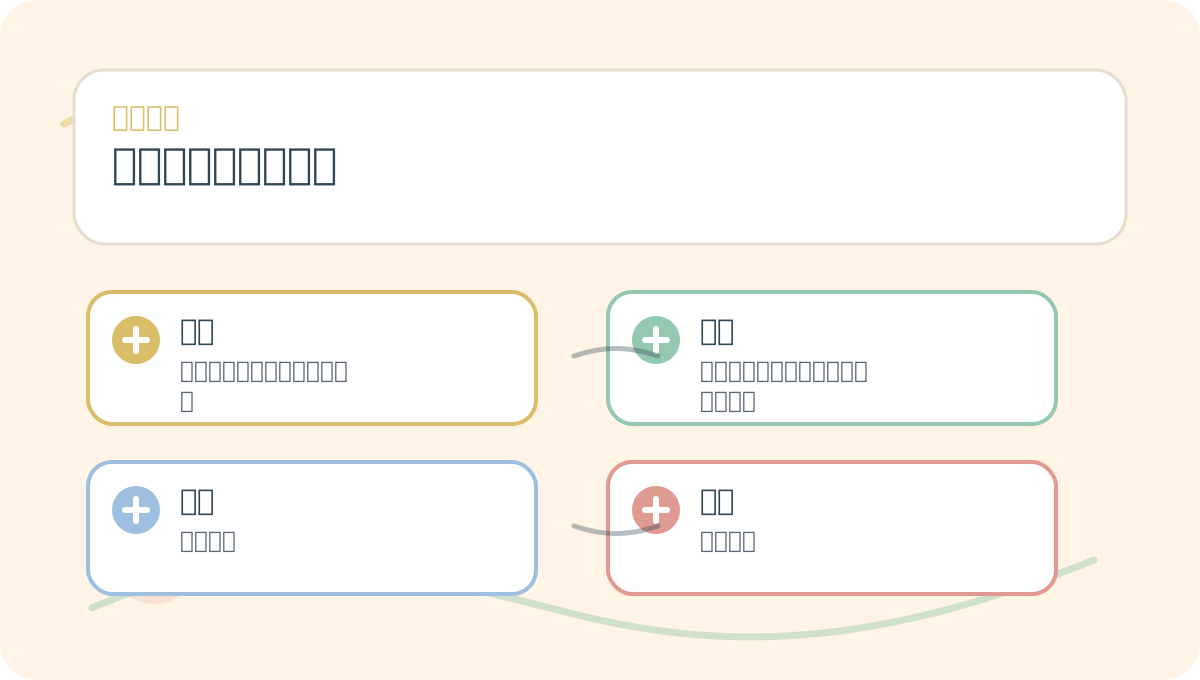
You don’t need to absorb every detail of Data-Driven Product Iteration all at once. Start with one small, actionable problem you can test hands-on—then use the diagram and text to fill in conceptual gaps.
1. Data Collection
First, the product team must collect and export relevant product data—including:
- User Behavior Data: e.g., click-through rates, session duration, daily/weekly active users.
- User Feedback: gathered via surveys, interviews, support tickets, or app store reviews.
- Market Data: such as competitor benchmarks and industry trends.
Case Study:
Suppose we have a mobile fitness coaching app. Using Google Analytics, we observe high drop-off during registration. Our immediate task is to diagnose why users abandon registration—and then optimize accordingly.
2. Data Analysis
Analyze collected data to extract actionable insights. Tools like Python or R enable deep, scalable analysis. For example, using Pandas for data cleaning and summary statistics:
import pandas as pd

# Load user behavior data
data = pd.read_csv('user_data.csv')

# Calculate Daily Active Users (DAU)
daily_active_users = data['user_id'].nunique()

print(f'Daily Active Users: {daily_active_users}')
Analysis may reveal not only where users drop off—but also underused features or unexpected behavioral patterns.
3. Formulating Optimization Strategies
Based on analytical findings, define concrete, hypothesis-driven improvement strategies. For instance, if analysis shows users abandon registration due to overly complex forms, simplifying that flow becomes a top priority.
Example Optimization Strategy:
Suppose data indicates frequent abandonment when users select weight units (kg vs. lbs). To verify causality, conduct targeted user surveys. If confirmed, consider:
- Streamlining Registration: Merge unit selection into a single step with sensible defaults.
- Adding Contextual Guidance: Clarify why unit selection matters—reducing confusion and friction.
4. Implementation & Testing
After deploying optimizations, run A/B tests to quantify impact. By comparing experimental and control groups, you objectively assess whether the change delivered the intended improvement.
A/B Test Example:
# Assume 'group' column identifies experiment/control assignment
experiment_data = data[data['date'] == '2023-10-10']  # Filter data for a specific day

# Compute registration success rate by group
experiment_summary = experiment_data.groupby('group')['registration_success'].mean()
print(experiment_summary)
5. Continuous Iteration
Data-driven iteration is inherently cyclical. After launching an optimization, re-collect and analyze new data to validate impact—and decide whether to scale, refine, pivot, or halt the initiative.
After studying Data-Driven Product Iteration, try applying it to your own context. Pay special attention to whether inputs, processing logic, and outputs align coherently.
To apply Data-Driven Product Iteration to your own work, start narrow: focus on validating just one critical decision point.
Conclusion
Within product launch and operations, data-driven product iteration is indispensable. Through systematic collection, analysis, optimization, and testing, we ensure our product not only satisfies current user needs—but also adapts proactively to future market shifts. In upcoming articles, we’ll explore how advanced user behavior analytics can further strengthen and refine our iteration strategy.
Through consistent practice, product managers gain greater mastery over the product lifecycle—continuously elevating user experience while delivering measurable business value. Cultivating strong data literacy and analytical rigor is therefore not optional—it’s a core competency for every modern product leader.
Apply This Lesson
Turn this article into AI software, model, API, and security decisions.
English Article FAQ
Use this article as evidence before choosing AI tools
How should I use this AI Tutorials article?
Use it as the implementation or learning layer, then connect the idea to AI software buyer guides, tool comparisons, benchmarks, API choices, and security checks before making a production decision.
Is this English article different from the Chinese original?
The English edition is localized for global AI readers while preserving the original diagrams, screenshots, prompts, code examples, and source context from the Chinese article.
What should I read after Load user behavior data?
Continue with AI Software Buyer Guides, AI Tools Workbench, Best AI Coding Agents, AI Model Benchmarks, OpenAI vs Anthropic API, or LLM Security Tools depending on the decision you need to make.
Can this article alone choose an AI product or model?
No. Treat the article as evidence and context, then validate fit with pricing, privacy requirements, integration effort, benchmark results, workflow tests, and fallback planning.
Continue