English translation
Competitor Analysis and Market Positioning for AI Products
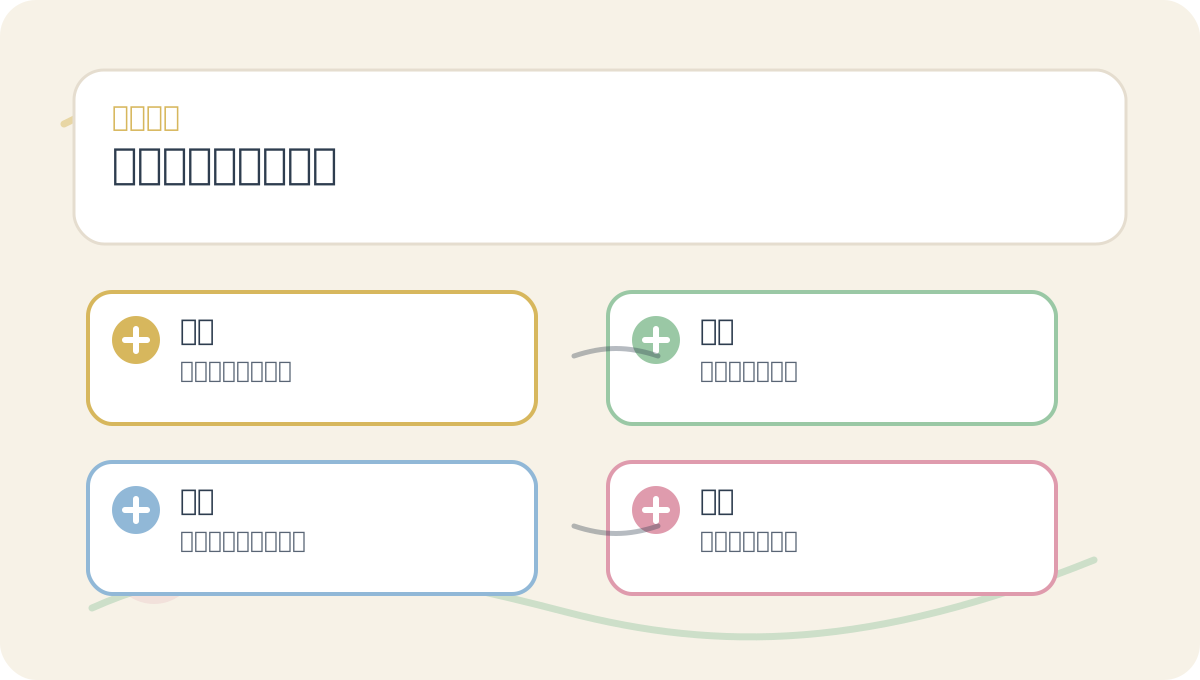
AI Article Decision Snapshot
Turn the lesson into workflow, model, budget, and security checks before choosing tools.
Use this quick snapshot before leaving the article. It keeps the next search tied to practical AI software, model/API, cost, privacy, and implementation questions.
Workflow fit
Identify the real job behind the article: coding, research, document review, support, analytics, content, or internal automation.
Model or tool decision
Decide whether the next step is a software shortlist, an AI tool comparison, an API platform choice, or a model benchmark.
Budget and usage signal
Estimate seats, API calls, prompt volume, retries, review time, and fallback work before assuming the workflow is cheap.
Security and privacy review
Check whether source code, customer data, private documents, prompts, logs, or embeddings will enter the AI workflow.

AI competitive analysis must go beyond asking “Who integrated which model?” What matters more is:
- Who is the product serving?
- Which real-world scenarios does it solve?
- Where does it hide unstable outputs?
- How does it build user trust?

When dissecting competitors, run a fixed set of tasks across all products—and systematically record inputs, outputs, latency, error types, and pricing. This yields positioning grounded in empirical evidence.
In the previous chapter, we discussed how to identify user needs—a foundational step for product development. Understanding users’ genuine needs is essential to launching any successful AI product. Yet user needs alone are insufficient. To ensure your product stands out in a fiercely competitive market, you need rigorous competitive analysis and market positioning. This chapter dives deep into effective market research and competitive analysis—equipping you to deliver greater value to your users.
What Is Competitive Analysis?
Competitive analysis is an in-depth study of existing products in the market. By collecting and analyzing data on competitors’ features, user experience, pricing, and go-to-market strategies, you determine where your product fits—and how it should be positioned.

When conducting competitive analysis, start by comparing: target users, core use cases, functional boundaries, business models, and switching costs. Positioning emerges from deliberate trade-offs.
Steps in Competitive Analysis
-
Identify Competitors
Identify both direct and indirect competitors—using search engines, social media, app stores, and industry reports. Ensure coverage across company sizes and market stages. -
Aggregate Competitor Attributes
Document key attributes: features, UI/UX, pricing, user reviews, support channels, and technical architecture. A tabular summary helps:Competitor Core Features Pricing Avg. Rating Strengths Weaknesses Competitor A AI-powered analytics $29/mo 4.5/5 Robust data analysis capabilities Complex, steep learning curve Competitor B Automated reporting $19/mo 4.0/5 Intuitive interface Limited feature scope Competitor C Natural language processing $49/mo 4.7/5 State-of-the-art NLP models Premium pricing -
Deep-Dive Analysis
Apply SWOT analysis (Strengths, Weaknesses, Opportunities, Threats) to assess each competitor’s strategic posture and market performance. -
Analyze User Feedback & Reviews
Mine real user sentiment from app store comments, forums, and review sites. Example Python script for scraping public reviews:import requests from bs4 import BeautifulSoup url = 'https://example.com/product-reviews' response = requests.get(url) soup = BeautifulSoup(response.text, 'html.parser') reviews = [review.text for review in soup.find_all(class_='review-content')] print(reviews) -
Synthesize Key Insights
Distill success patterns and gaps from your analysis—and translate them into actionable implications for your own product.
How to Conduct Market Positioning?
Market positioning defines where—and how—your product occupies a distinct, valuable place in users’ minds and in the marketplace. It is inseparable from competitive analysis: only by understanding competitors can you define your own differentiated position.
Before reading “Competitive Analysis and Market Positioning”, first align the questions, keywords, actions, and acceptance criteria shown in the diagram. Then read the main text—it’ll be far more efficient. After finishing, try retelling the entire framework using your own project as the example.
Key Elements of Market Positioning
-
Define Your Target Market
Precisely identify your user segment—its demographics, behaviors, pain points, workflows, and purchasing habits. Use market segmentation frameworks (e.g., behavioral, firmographic, or job-to-be-done) to validate assumptions. -
Articulate Your Value Proposition
Clearly state what problem your product solves, and why it’s uniquely better. Your Unique Value Proposition (UVP) should be specific, credible, and customer-centric—for example:- “Our AI cuts data analysis time from hours to minutes.”
- “Real-time feedback loops empower faster, evidence-based decisions.”
-
Build Differentiated Capabilities
Embed features that address unmet or underserved user needs—features competitors overlook or under-deliver on. Examples include:- A radically simplified UI informed by usability testing,
- Personalized workflows driven by user behavior,
- Transparent output confidence scoring to manage expectations.
-
Continuously Monitor Market Signals
Markets evolve rapidly. Track shifts via ongoing user interviews, social listening, support ticket trends, and competitive intelligence—not just quarterly, but continuously.
Case Study
Consider Notion, a successful AI-augmented productivity platform. By analyzing competitors like Evernote and Trello, Notion identified strong demand for unified note-taking and task management—but also recognized fragmentation and workflow friction across tools. Its positioning—“an all-in-one workspace”—deliberately bridged that gap: enabling notes, databases, wikis, and project boards within one coherent system. The result? A clear UVP, broad functionality, and intuitive extensibility—earning widespread adoption and loyalty.
After reading “Competitive Analysis and Market Positioning”, distill it into a retrospective checklist: First clarify the central narrative, then validate it with a small end-to-end task.
Once you’ve finished this chapter, pick one small, concrete example—and walk through the full process end-to-end. Then assess: Which steps can you now execute independently?
Conclusion
Competitive analysis and market positioning are mission-critical for AI product success. By rigorously studying competitors and market dynamics, you gain the insights needed to refine your strategy, prioritize features wisely, and deliver solutions users truly value.
In the next chapter, we’ll explore how to build an effective product roadmap—one that translates your vision and positioning into a coherent, prioritized plan for execution. Stay tuned—we’ll go deeper there.
We hope this chapter has clarified why robust market research and competitive analysis matter—and equipped you with practical methods to apply them confidently in your AI product management journey.
Apply This Lesson
Turn this article into AI software, model, API, and security decisions.
English Article FAQ
Use this article as evidence before choosing AI tools
How should I use this AI Tutorials article?
Use it as the implementation or learning layer, then connect the idea to AI software buyer guides, tool comparisons, benchmarks, API choices, and security checks before making a production decision.
Is this English article different from the Chinese original?
The English edition is localized for global AI readers while preserving the original diagrams, screenshots, prompts, code examples, and source context from the Chinese article.
What should I read after Competitor Analysis and Market Positioning for AI Products?
Continue with AI Software Buyer Guides, AI Tools Workbench, Best AI Coding Agents, AI Model Benchmarks, OpenAI vs Anthropic API, or LLM Security Tools depending on the decision you need to make.
Can this article alone choose an AI product or model?
No. Treat the article as evidence and context, then validate fit with pricing, privacy requirements, integration effort, benchmark results, workflow tests, and fallback planning.
Continue