English translation
10. Privacy Concerns and Legal Frameworks in AI
AI Article Decision Snapshot
Turn the lesson into workflow, model, budget, and security checks before choosing tools.
Use this quick snapshot before leaving the article. It keeps the next search tied to practical AI software, model/API, cost, privacy, and implementation questions.
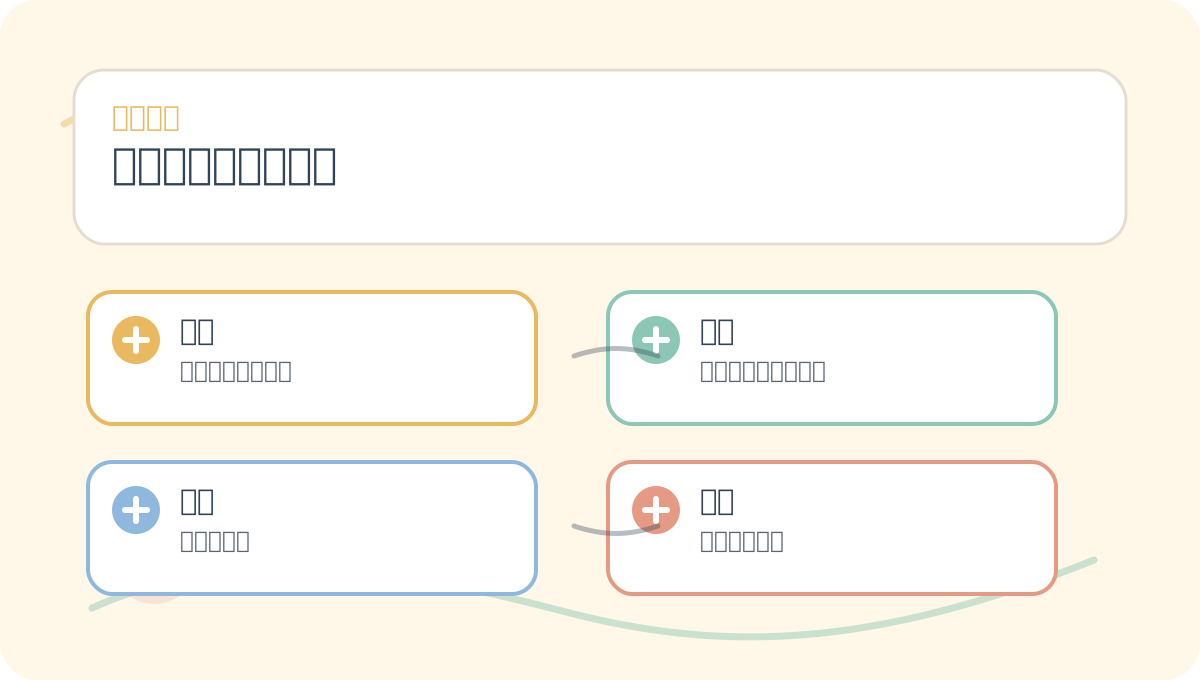
Workflow fit
Identify the real job behind the article: coding, research, document review, support, analytics, content, or internal automation.
Model or tool decision
Decide whether the next step is a software shortlist, an AI tool comparison, an API platform choice, or a model benchmark.
Budget and usage signal
Estimate seats, API calls, prompt volume, retries, review time, and fallback work before assuming the workflow is cheap.
Security and privacy review
Check whether source code, customer data, private documents, prompts, logs, or embeddings will enter the AI workflow.
Framework for Assessing Security Risks

Privacy compliance does not end with posting a policy statement at the bottom of a webpage. AI applications continuously process inputs, logs, feedback, and training data—so privacy risks must be assessed across the full data lifecycle.

For each data category, I write one concise purpose statement: Why is this data collected? How long is it retained? Who has access? Can it be deleted? If you cannot articulate the purpose clearly in a single sentence, the processing objective may be overly broad.

When evaluating privacy and legal frameworks, first examine: data origin, consent mechanism, processing purpose, retention period, user rights, and cross-border data transfers.
After reading Privacy Issues and Legal Frameworks, don’t stop at “I understand.” Instead, select one step and practice it hands-on—then document where you get stuck. This makes subsequent learning more grounded and effective.
Defining Privacy and Its Importance
As artificial intelligence (AI) becomes increasingly pervasive, privacy concerns have emerged as a critical priority. To discuss privacy meaningfully, we must first clarify what “privacy” means. Broadly speaking, privacy refers to an individual’s right to control their personal information—including how it is collected, stored, used, and shared. With the widespread deployment of AI systems—especially data-driven models—personal privacy faces unprecedented challenges.
To apply Privacy Issues and Legal Frameworks to your own work, begin by narrowing the scope: validate just one key decision point.
After completing Privacy Issues and Legal Frameworks, try applying it to a new scenario of your own—focusing specifically on whether inputs, processing steps, and outputs align coherently.
Defining Privacy
According to leading U.S. privacy law scholars, privacy can be categorized into several types:
- Information Privacy: The individual’s control over personal data—including its collection, processing, and storage.
- Spatial Privacy: An individual’s autonomy within physical or digital spaces—such as homes, workplaces, or private online environments.
- Decisional Privacy: The right to make autonomous, uncoerced choices about major life decisions—such as medical treatment or financial planning.
In the context of AI, information privacy is especially critical. AI systems often rely on vast volumes of personal data for training, requiring careful attention to the full data lifecycle—from ingestion through to deletion.
Why Privacy Matters
Privacy safeguards extend beyond individual rights; they underpin societal fairness and justice. Robust privacy protection enables:
- Preserving Individual Freedom: Privacy creates space for autonomous choice and helps prevent abuse of power.
- Building Trust: In the information age, consumer trust is essential to organizational success. Strong privacy practices foster user confidence in both technology and institutions.
- Enabling Innovation: When conducted responsibly—with respect for privacy—data sharing and technical collaboration can catalyze novel business models and technological solutions.
Case Study
Consider a real-world example: A social media company trains its facial recognition algorithm using photos voluntarily uploaded by users—and then leverages inferred behavioral patterns for targeted advertising. Although the company claims the data has been “anonymized,” research shows that even “de-identified” datasets can often be re-identified via advanced data mining techniques. This practice has sparked controversy over privacy violations—highlighting how ambiguous privacy boundaries can become in technical contexts.
Conclusion
As AI advances, privacy issues and legal frameworks are inextricably linked. Individuals must retain meaningful control over their personal information to ensure its security and confidentiality. Strong legal protections—paired with clear, actionable definitions of privacy—will help strike a sustainable balance between technological innovation and fundamental privacy rights.
In the next chapter, we will delve deeper into privacy-related laws and regulations—ensuring responsible, compliant AI development. Understanding today’s legal landscape also provides essential guidance for AI developers and organizations alike.
Apply This Lesson
Turn this article into AI software, model, API, and security decisions.
English Article FAQ
Use this article as evidence before choosing AI tools
How should I use this AI Tutorials article?
Use it as the implementation or learning layer, then connect the idea to AI software buyer guides, tool comparisons, benchmarks, API choices, and security checks before making a production decision.
Is this English article different from the Chinese original?
The English edition is localized for global AI readers while preserving the original diagrams, screenshots, prompts, code examples, and source context from the Chinese article.
What should I read after 10. Privacy Concerns and Legal Frameworks in AI?
Continue with AI Software Buyer Guides, AI Tools Workbench, Best AI Coding Agents, AI Model Benchmarks, OpenAI vs Anthropic API, or LLM Security Tools depending on the decision you need to make.
Can this article alone choose an AI product or model?
No. Treat the article as evidence and context, then validate fit with pricing, privacy requirements, integration effort, benchmark results, workflow tests, and fallback planning.
Continue