English translation
9. Adversarial Attacks
AI Article Decision Snapshot
Turn the lesson into workflow, model, budget, and security checks before choosing tools.
Use this quick snapshot before leaving the article. It keeps the next search tied to practical AI software, model/API, cost, privacy, and implementation questions.
Workflow fit
Identify the real job behind the article: coding, research, document review, support, analytics, content, or internal automation.
Model or tool decision
Decide whether the next step is a software shortlist, an AI tool comparison, an API platform choice, or a model benchmark.
Budget and usage signal
Estimate seats, API calls, prompt volume, retries, review time, and fallback work before assuming the workflow is cheap.
Security and privacy review
Check whether source code, customer data, private documents, prompts, logs, or embeddings will enter the AI workflow.
Security Risk Assessment Framework
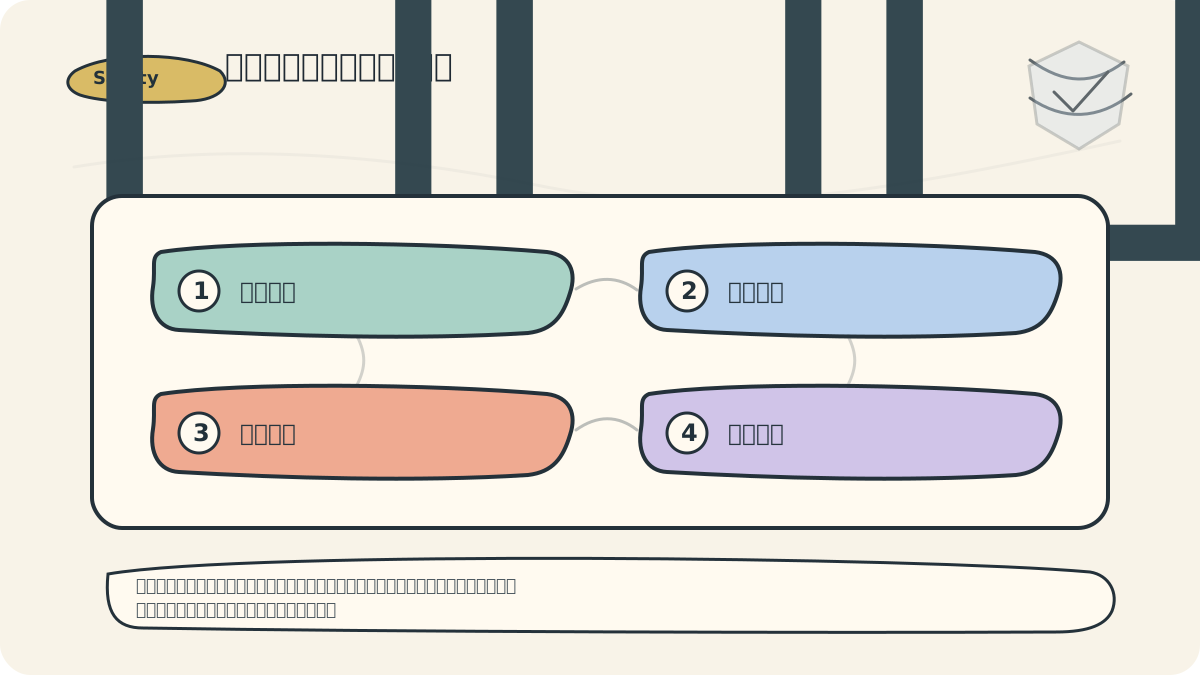
Adversarial attacks remind us that seemingly minor input perturbations can lead to drastically different model predictions. Defense is not about writing a single filtering rule—it’s about continuously collecting boundary samples.
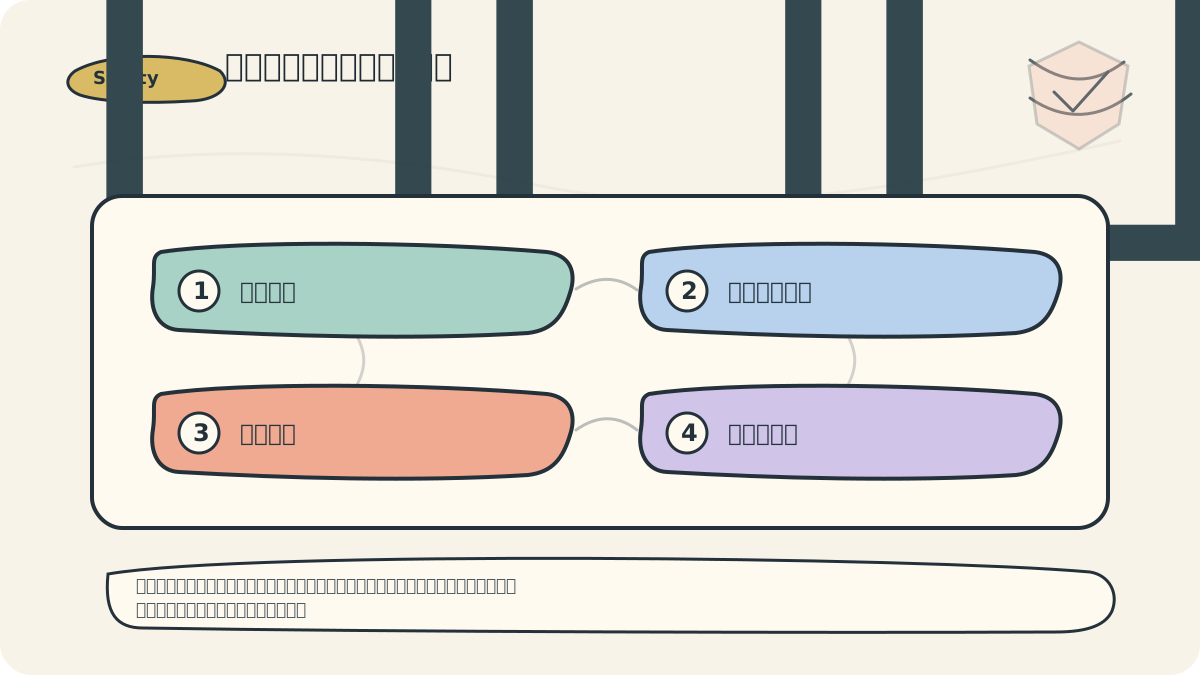
I add every misclassification to my test set—especially samples where only a few words, pixels, or fields were altered. The more boundary samples we have, the less “blind” our model will be upon deployment.
In AI systems, adversarial attacks represent a critical and challenging security risk. Unlike data poisoning or model hijacking, adversarial attacks primarily target already-trained models. Attackers craft carefully designed input samples to induce incorrect predictions or classifications. Such attacks may not only produce erroneous outputs but also cause severe consequences—particularly in high-stakes domains such as autonomous driving, medical diagnosis, and financial transactions.
1. Concept of Adversarial Attacks
The core idea behind adversarial attacks is to disrupt a model’s decision-making process using small, often imperceptible perturbations. For example, in an image classification system, an attacker can slightly modify the original image so that the model misclassifies it as a completely different category. These modifications may be virtually invisible to human observers—yet sufficient to trigger incorrect model behavior.
Mathematically, adversarial sample generation can be expressed as:
where is the original input, is the adversarial example, and is a small perturbation.
Case Study: Adversarial Attacks on Image Classification Systems
In 2014, researchers added subtle noise to an image of a cat, causing a deep learning model to misclassify it as “a long sedan.” This attack illustrated the potential threat of adversarial examples—especially in computer vision systems for autonomous vehicles, where attackers could manipulate road signs or pedestrian images to provoke dangerous vehicle responses.
2. Types of Adversarial Attacks
Adversarial attacks are typically categorized as follows:
- White-box attacks: The attacker has full knowledge of the model’s architecture and parameters, enabling exploitation of internal details to generate adversarial samples.
- Black-box attacks: The attacker has no access to the model’s internals and can only query it via inputs and outputs.
- Transfer attacks: Adversarial samples crafted for one model are used to attack another—often revealing shared vulnerabilities across models.
Example Code: Implementing a White-box Adversarial Attack
Below is a simple Python implementation of a white-box adversarial attack using the Fast Gradient Sign Method (FGSM):
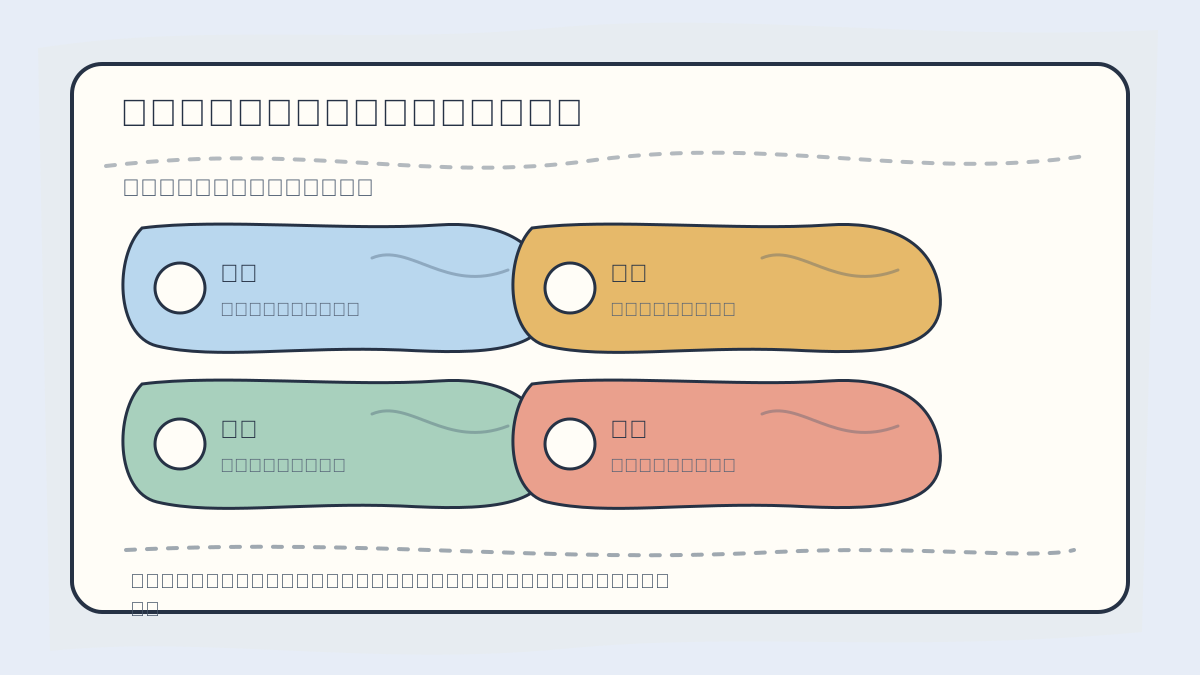
When analyzing adversarial attacks, first examine: perturbation location, perceptibility, target class, attack constraints, and resulting changes in model output.
import numpy as np
import tensorflow as tf

def fgsm_attack(model, images, labels, epsilon):
    # Ensure model is in evaluation mode
    model.trainable = False

    with tf.GradientTape() as tape:
        predictions = model(images)
        loss = tf.keras.losses.sparse_categorical_crossentropy(labels, predictions)

    # Compute gradients
    gradients = tape.gradient(loss, images)
    signed_gradients = tf.sign(gradients)

    # Generate adversarial examples
    adversarial_examples = images + epsilon * signed_gradients
    return tf.clip_by_value(adversarial_examples, 0, 1)  # Normalize to valid pixel range
3. Countermeasures Against Adversarial Attacks
Researchers have proposed several defense strategies against adversarial attacks, including:
- Adversarial training: Incorporating adversarial samples into the training process so the model learns to resist them.
- Model regularization: Applying regularization techniques to improve robustness and reduce sensitivity to minor input variations.
- Input detection: Deploying auxiliary algorithms to detect adversarial features before the input reaches the main model.
Case Study: Application of Adversarial Training
In one study, researchers augmented training data with adversarial examples, significantly improving the robustness of an image classification model against adversarial attacks. Experiments showed that models trained adversarially achieved markedly higher accuracy under both white-box and black-box attack settings compared to conventionally trained models.
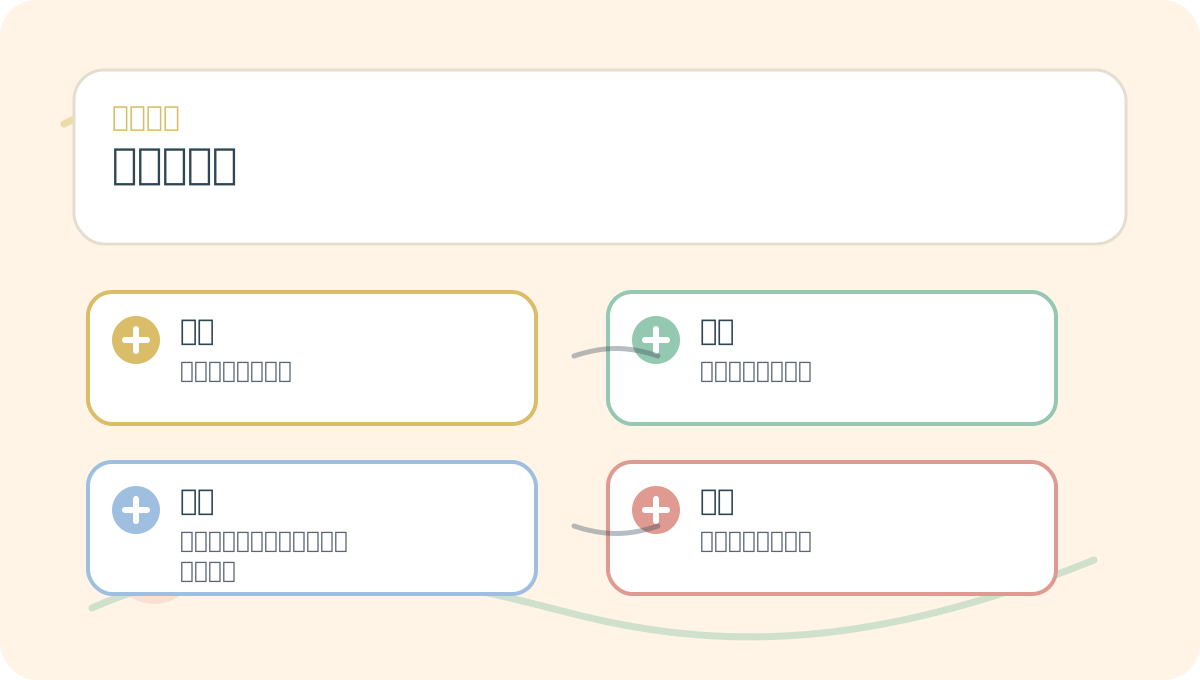
When studying Adversarial Attacks, start by reproducing a small, concrete scenario you understand—then explore related concepts and step-by-step exercises. After reading, re-explain the material using your own example.
When reviewing Adversarial Attacks, consolidate key concepts, procedural steps, and observable outcomes onto a single page for efficient revision.
When practicing Adversarial Attacks, explicitly document input conditions, processing actions, and observable outcomes together—making future review straightforward.
4. Conclusion and Future Outlook
Adversarial attacks constitute a non-negligible security risk in AI systems, with potentially serious real-world implications. As AI becomes increasingly pervasive, developing effective defenses against such attacks will remain a top research priority. Simultaneously, as adversarial techniques evolve, defensive strategies must continually adapt and mature—to enhance system security, reliability, and trustworthiness.
Understanding both the nature of adversarial attacks and their mitigation techniques is essential for building safe and dependable AI systems. In upcoming chapters, we will examine privacy concerns and legal frameworks—further exploring other critical security challenges facing AI systems.
Apply This Lesson
Turn this article into AI software, model, API, and security decisions.
English Article FAQ
Use this article as evidence before choosing AI tools
How should I use this AI Tutorials article?
Use it as the implementation or learning layer, then connect the idea to AI software buyer guides, tool comparisons, benchmarks, API choices, and security checks before making a production decision.
Is this English article different from the Chinese original?
The English edition is localized for global AI readers while preserving the original diagrams, screenshots, prompts, code examples, and source context from the Chinese article.
What should I read after 9. Adversarial Attacks?
Continue with AI Software Buyer Guides, AI Tools Workbench, Best AI Coding Agents, AI Model Benchmarks, OpenAI vs Anthropic API, or LLM Security Tools depending on the decision you need to make.
Can this article alone choose an AI product or model?
No. Treat the article as evidence and context, then validate fit with pricing, privacy requirements, integration effort, benchmark results, workflow tests, and fallback planning.
Continue