English translation
12. Data Subject Rights in AI Privacy and Legal Frameworks
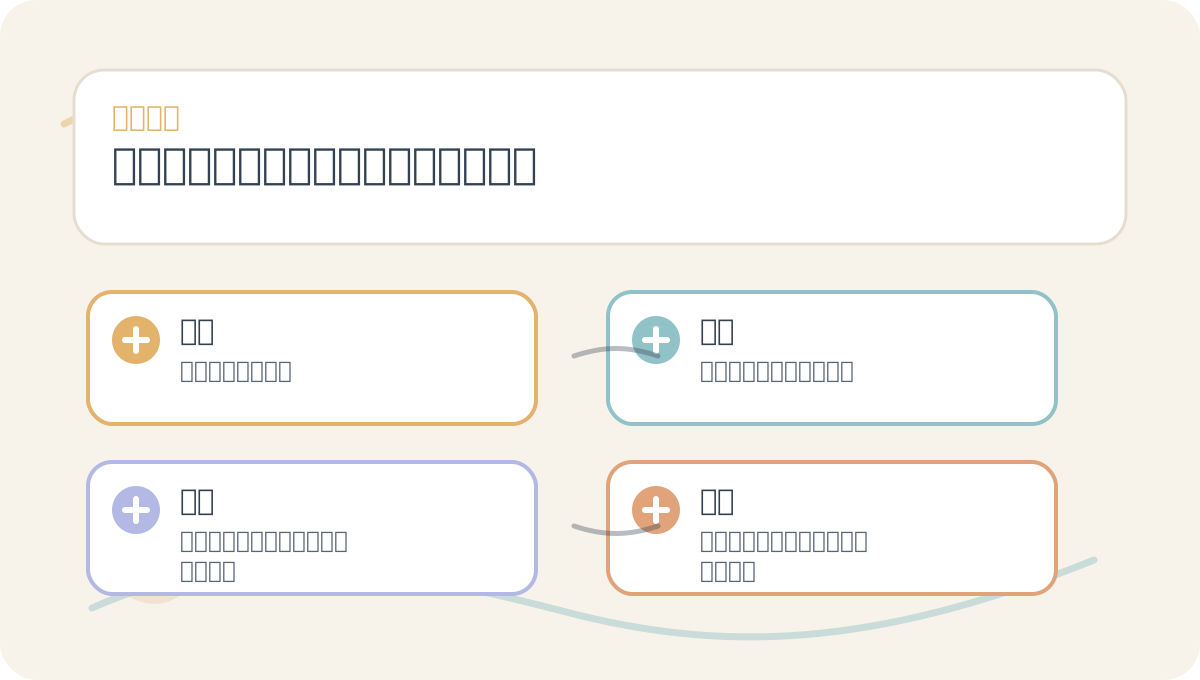
AI Article Decision Snapshot
Turn the lesson into workflow, model, budget, and security checks before choosing tools.
Use this quick snapshot before leaving the article. It keeps the next search tied to practical AI software, model/API, cost, privacy, and implementation questions.
Workflow fit
Identify the real job behind the article: coding, research, document review, support, analytics, content, or internal automation.
Model or tool decision
Decide whether the next step is a software shortlist, an AI tool comparison, an API platform choice, or a model benchmark.
Budget and usage signal
Estimate seats, API calls, prompt volume, retries, review time, and fallback work before assuming the workflow is cheap.
Security and privacy review
Check whether source code, customer data, private documents, prompts, logs, or embeddings will enter the AI workflow.
Security Risk Assessment Framework

In AI applications, enforcing data subject rights presents a key challenge: user data may be scattered across forms, logs, vector databases, and model feedback. A single email-based entry point is often insufficient.

I break down each user request into backend tasks: which tables to query, which indexes to scan, which logs to inspect, who must approve, and by when the task must be completed. Only with such clearly defined workflows does the frontend entry point become meaningful.
When examining the intersection of artificial intelligence and privacy protection, understanding data subject rights is essential. As data protection laws continue to evolve—especially with regulations like the General Data Protection Regulation (GDPR)—data subjects, as holders of personal data, enjoy a suite of critical rights. These rights not only strengthen individual protections but also impose new design and implementation requirements on AI systems.
1. Overview of Fundamental Data Subject Rights
Under the GDPR, core data subject rights include:
- Right to be Informed: Data subjects have the right to know the purposes, methods, and recipients of their personal data processing.
- Right of Access: Data subjects may request access to their personal data and obtain a copy thereof.
- Right to Rectification: Data subjects may request correction of inaccurate personal data.
- Right to Erasure (“Right to Be Forgotten”): Under certain conditions, data subjects may request deletion of their personal data.
- Right to Restrict Processing: Under specific circumstances, data subjects may request restriction of processing activities concerning their data.
- Right to Data Portability: Data subjects may request transfer of their personal data to another data controller.
- Right to Object: Data subjects may object to processing of their personal data—particularly in cases involving automated decision-making and profiling.
2. Application of Data Subject Rights in AI Systems
In AI environments—especially those leveraging big data and machine learning—effectively implementing data subject rights remains highly challenging. For instance, in facial recognition systems, how can individuals exercise their right to be informed or their right to object?
Case Study: The Right to Be Informed in Facial Recognition
Consider an intelligent surveillance company deploying AI-powered facial recognition to enhance public safety. It installs cameras in public spaces and collects facial images of passersby. In this scenario, data subjects have the right to be informed about:
- That their facial images are being collected and stored;
- The purpose of processing—for example, crime prevention or security monitoring;
- The retention period for the data, and their associated rights.
To comply, the company must install clear, visible notices in monitored areas, informing passersby about the collection and use of their biometric data.
Right to Rectification and Right to Restrict Processing
If a passerby’s facial data is misidentified—and subsequently used for inappropriate purposes (e.g., incorrectly flagged as a suspect)—that individual has the right to request correction of the erroneous information. They may also request restriction of further processing of their data until the error is resolved.

When assessing data subject rights, first examine how users initiate requests, how the system verifies identity, how corrections or deletions are executed, and how outcomes are recorded.
3. Right to Object and Automated Decision-Making
In many automated systems—such as credit scoring platforms—data subjects may face algorithmic decisions that directly affect their credit status. These decisions often rely on large-scale data analysis and may lack transparency or explainability.
Code Example: Implementing the Right to Object
Below is a simplified pseudocode example illustrating how a system might implement the data subject’s right to object:
Content like “Data Subject Rights Within Privacy Issues and Legal Frameworks” risks getting lost in detail. First grasp the central thread shown in the diagram, then return to the text to verify context, inputs, outputs, and evaluation criteria.
class DataSubject:
    def __init__(self, id, preferences):
        self.id = id
        self.preferences = preferences
        self.is_opting_out = False

def handle_opt_out_request(subject_id):
    subject = find_data_subject(subject_id)
    if subject:
        subject.is_opting_out = True
        # Halt all processing of this subject’s data
        stop_data_processing(subject_id)

def stop_data_processing(subject_id):
    # Assume we maintain a list of subjects actively undergoing processing
    if subject_id in ongoing_processing:
        ongoing_processing.remove(subject_id)
        print(f"Processing of personal data for data subject {subject_id} has been halted.")
In the above example, upon receiving an objection request, the system marks the data subject as “opted out” and ensures no further processing occurs using their data.
Having read this section, you can consolidate “Privacy Issues and Legal Frameworks — Data Subject Rights” into a retrospective table: first clarify the core workflow, then validate it using a small-scale task.
After reading “Privacy Issues and Legal Frameworks — Data Subject Rights,” begin by walking through a small, concrete example end-to-end—then assess which steps your team can already execute independently.
4. Future Challenges Ahead
As technology advances and legal frameworks evolve, data subject rights will confront increasingly complex challenges—especially amid AI’s rapid expansion into new domains. Ensuring technical transparency and regulatory compliance in data processing remains a cornerstone of data protection.
Going forward, organizations must build comprehensive compliance frameworks capable of promptly responding to data subject requests and effectively managing and safeguarding personal data. Cross-disciplinary collaboration among developers, legal experts, and business leaders will therefore be indispensable.
In the next chapter, we will delve into technical data protection measures—specifically, how encryption and secure storage practices can uphold privacy while enabling responsible AI development.
Apply This Lesson
Turn this article into AI software, model, API, and security decisions.
English Article FAQ
Use this article as evidence before choosing AI tools
How should I use this AI Tutorials article?
Use it as the implementation or learning layer, then connect the idea to AI software buyer guides, tool comparisons, benchmarks, API choices, and security checks before making a production decision.
Is this English article different from the Chinese original?
The English edition is localized for global AI readers while preserving the original diagrams, screenshots, prompts, code examples, and source context from the Chinese article.
What should I read after 12. Data Subject Rights in AI Privacy and Legal Frameworks?
Continue with AI Software Buyer Guides, AI Tools Workbench, Best AI Coding Agents, AI Model Benchmarks, OpenAI vs Anthropic API, or LLM Security Tools depending on the decision you need to make.
Can this article alone choose an AI product or model?
No. Treat the article as evidence and context, then validate fit with pricing, privacy requirements, integration effort, benchmark results, workflow tests, and fallback planning.
Continue