English translation
Generate a cryptographic key
AI Article Decision Snapshot
Turn the lesson into workflow, model, budget, and security checks before choosing tools.
Use this quick snapshot before leaving the article. It keeps the next search tied to practical AI software, model/API, cost, privacy, and implementation questions.
Workflow fit
Identify the real job behind the article: coding, research, document review, support, analytics, content, or internal automation.
Model or tool decision
Decide whether the next step is a software shortlist, an AI tool comparison, an API platform choice, or a model benchmark.
Budget and usage signal
Estimate seats, API calls, prompt volume, retries, review time, and fallback work before assuming the workflow is cheap.
Security and privacy review
Check whether source code, customer data, private documents, prompts, logs, or embeddings will enter the AI workflow.
Security Risk Assessment Framework

Data protection is not simply about encrypting everything. In AI applications, special attention must be paid to logs, prompts, retrieved text snippets, and debugging output—these are the places most likely to leak plaintext.
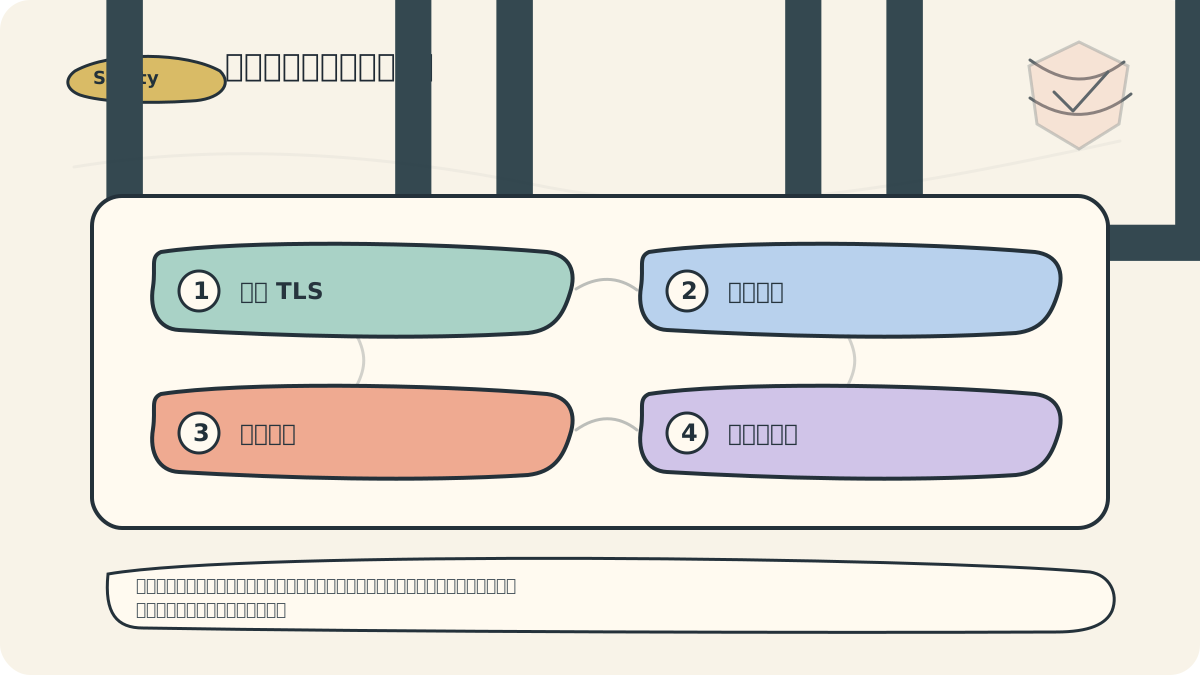
I specifically inspect three categories of locations: whether user input appears in error logs; whether sensitive original text resides in the vector database; and whether full API keys or complete request headers appear in debugging panels.
5.1 Data Encryption and Storage Security
As artificial intelligence (AI) technologies continue to advance, the value of data grows increasingly prominent. However, accompanying this progress are growing concerns regarding data security and privacy protection. To effectively safeguard sensitive information and personal data, encryption techniques and secure storage practices have become core components of data protection.
When practicing Data Protection and Security Measures, write input conditions, processing actions, and observable outcomes together—this makes future review more efficient.
When reviewing Data Protection and Security Measures, place key concepts, procedural steps, and observable outcomes on the same page for consolidated reflection.
5.1.1 Fundamental Concepts of Data Encryption
Data encryption refers to the process of transforming plaintext data into unreadable ciphertext using specific algorithms, rendering it inaccessible and unintelligible without proper authorization. Common types of data encryption include:
- Symmetric Encryption: Uses the same secret key for both encryption and decryption—for example, the Advanced Encryption Standard (AES). Symmetric encryption is fast but poses challenges in key management.
- Asymmetric Encryption: Uses a pair of mathematically linked keys—a public key for encryption and a private key for decryption—for example, the RSA algorithm. Asymmetric encryption offers stronger security guarantees but operates more slowly.
- Hashing: Converts input data into a fixed-length hash value, primarily used to verify data integrity—for example, SHA-256.
Case Study
At a fintech company, users’ bank card details and transaction records constitute highly sensitive data. The company employs AES symmetric encryption. When users submit bank card information, the system first encrypts the data using AES before storing it in the database. Even if the database is compromised, attackers cannot retrieve usable bank card information—because they lack the decryption key.
5.1.2 Importance of Secure Storage
Data protection extends beyond encryption alone—it also depends critically on appropriate storage practices. Encryption only delivers its intended security benefit when data resides in a properly secured environment. Key storage security measures include:
- Physical Security: Ensuring the physical safety of storage servers—for example, by implementing access controls and surveillance systems to prevent unauthorized personnel from entering server rooms.
- Regular Backups: Guaranteeing data durability through periodic backups of encrypted data—an essential layer of defense against hardware failure or accidental loss.
- Secure Configuration: Hardening storage infrastructure by disabling unnecessary services and network ports, thereby minimizing the attack surface.
Case Study
A cloud service provider offers data storage solutions to its customers. During storage, the provider not only encrypts customer data using AES but also replicates encrypted backups across multiple geographically distributed locations—to mitigate risks from server outages or unexpected data loss. Additionally, the provider enforces strict access control policies to ensure that only authorized personnel can access encryption keys and associated data.
5.1.3 Code Example: Implementing Data Encryption
Below is a simple Python example demonstrating data encryption using the cryptography library:

When analyzing data protection and security measures, begin by evaluating access control, encryption, data anonymization (de-identification), log auditing, backup strategies, and incident response.
from cryptography.fernet import Fernet

# Generate a cryptographic key
key = Fernet.generate_key()
cipher = Fernet(key)

# Encrypt data
data = b"Sensitive information."
encrypted_data = cipher.encrypt(data)
print("Encrypted:", encrypted_data)

# Decrypt data
decrypted_data = cipher.decrypt(encrypted_data)
print("Decrypted:", decrypted_data.decode())
In this example, we use the Fernet class from the cryptography library to generate a key and perform encryption and decryption. This straightforward approach enables developers to easily integrate robust data protection into their applications.
5.1.4 Managing Encrypted Data
Encryption itself is not the end goal—and should never be treated as the sole protective measure. Proper management of encrypted data is equally critical:
You don’t need to absorb every detail of Data Protection and Security Measures all at once. Start with one small, hands-on problem you can verify experimentally, then follow the map and main text to fill in conceptual gaps.
- Key Management: Use a secure, dedicated key management system (KMS) to store, rotate, and govern access to encryption keys—ensuring only authorized users and services can retrieve them.
- Periodic Auditing: Conduct regular audits of encrypted data storage—including access logs, encryption workflows, and cryptographic configurations—to verify compliance with internal policies and external regulatory requirements.
- Regulatory Compliance: Adhere strictly to applicable legal frameworks such as the General Data Protection Regulation (GDPR) and the Health Insurance Portability and Accountability Act (HIPAA), ensuring all data protection mechanisms meet mandated standards.
Summary
In today’s information-driven society, data encryption and secure storage are indispensable pillars for protecting both individual privacy and organizational sensitive information. Enterprises and institutions must continuously monitor advancements in encryption technology and proactively implement comprehensive, effective safeguards. As AI applications grow increasingly complex and diverse, building a resilient, well-architected data protection framework is essential—not only to enable innovation, but also to uphold users’ fundamental rights to privacy and data sovereignty.
The next section will explore access control and identity verification mechanisms—further strengthening data protection by ensuring that only authenticated and authorized users gain appropriate levels of data access.
Apply This Lesson
Turn this article into AI software, model, API, and security decisions.
English Article FAQ
Use this article as evidence before choosing AI tools
How should I use this AI Tutorials article?
Use it as the implementation or learning layer, then connect the idea to AI software buyer guides, tool comparisons, benchmarks, API choices, and security checks before making a production decision.
Is this English article different from the Chinese original?
The English edition is localized for global AI readers while preserving the original diagrams, screenshots, prompts, code examples, and source context from the Chinese article.
What should I read after Generate a cryptographic key?
Continue with AI Software Buyer Guides, AI Tools Workbench, Best AI Coding Agents, AI Model Benchmarks, OpenAI vs Anthropic API, or LLM Security Tools depending on the decision you need to make.
Can this article alone choose an AI product or model?
No. Treat the article as evidence and context, then validate fit with pricing, privacy requirements, integration effort, benchmark results, workflow tests, and fallback planning.
Continue