English translation
Generate a simple model and dataset
AI Article Decision Snapshot
Turn the lesson into workflow, model, budget, and security checks before choosing tools.
Use this quick snapshot before leaving the article. It keeps the next search tied to practical AI software, model/API, cost, privacy, and implementation questions.
Workflow fit
Identify the real job behind the article: coding, research, document review, support, analytics, content, or internal automation.
Model or tool decision
Decide whether the next step is a software shortlist, an AI tool comparison, an API platform choice, or a model benchmark.
Budget and usage signal
Estimate seats, API calls, prompt volume, retries, review time, and fallback work before assuming the workflow is cheap.
Security and privacy review
Check whether source code, customer data, private documents, prompts, logs, or embeddings will enter the AI workflow.
Framework for Assessing Security Risks

AI ethics must go beyond abstract slogans like “fairness, transparency, and accountability.” Each principle must map directly to concrete, auditable product actions—and to a clearly designated individual who owns them.

I will add one line to every requirements document: If the model makes an incorrect judgment, who is responsible for explaining it? Who is responsible for fixing it? And through what channel can users appeal? If you cannot answer those questions clearly, do not automate the process.
AI Ethics Principles
The rapid advancement of artificial intelligence (AI) brings tremendous convenience—but also raises a host of ethical concerns. These are especially acute in domains involving decision-making, privacy protection, and broad societal impact, where AI behavior and outputs may conflict with human moral values. Establishing and adhering to a clear set of AI ethics principles is therefore essential—not only to ensure technical safety and reliability, but also to uphold respect for individual and collective rights.
After reading Ethical Issues and Accountability, begin by walking through a small, concrete example end-to-end. Then assess which steps you can already perform independently.
By this point, you should be able to distill Ethical Issues and Accountability into a retrospective summary table: first articulate the core narrative, then validate it using a small task.
1. Fairness
AI systems must embed fairness throughout their design and deployment—ensuring no group suffers disproportionate or unjust treatment. For instance, certain facial recognition systems exhibit markedly uneven performance across racial groups, leading to significantly higher error rates for some populations. A 2018 study revealed that several commercial facial recognition systems misidentified Black individuals and other minority groups at rates far exceeding those for white individuals. To uphold fairness, developers can apply algorithmic auditing tools to systematically detect and mitigate bias—substantially improving equitable performance across diverse user groups.
2. Transparency
Transparency is another cornerstone of AI ethics. The decision-making process of an AI system must be interpretable—enabling users to understand, scrutinize, and trust its behavior. Consider a machine learning model used for loan approvals: applicants should receive meaningful explanations for outcomes—not just binary “approved” or “rejected” verdicts. Achieving transparency often involves adopting explainable AI (XAI) techniques such as LIME (Local Interpretable Model-agnostic Explanations) or SHAP (SHapley Additive exPlanations).
import shap
import numpy as np

# Generate a simple model and dataset
X = np.random.rand(100, 10)
y = (X.sum(axis=1) > 5).astype(int)
model = SomeTrainedModel()  # Assume this is a pre-trained model

# Compute SHAP values
explainer = shap.Explainer(model, X)
shap_values = explainer(X)

# Visualize SHAP values
shap.summary_plot(shap_values, X)
3. Accountability
In AI-driven decision-making contexts, accountability becomes critically important: Who bears responsibility when an AI system fails? Is it the developer, the end user, or the operator deploying the system? Consider autonomous vehicles: when accidents occur, liability may involve complex interdependencies among manufacturers, software engineers, fleet operators, and drivers. A well-defined accountability framework is thus indispensable—ensuring that, when harm arises from AI systems, there is always a clearly identifiable and legally responsible party.

When evaluating ethical issues and accountability, first examine: affected populations, data provenance, bias risks, explainability, human review mechanisms, and defined accountability boundaries.
4. Privacy Protection
AI systems must rigorously uphold privacy protection during data processing. In healthcare, for example, AI applications must comply with regulations such as HIPAA (Health Insurance Portability and Accountability Act) to safeguard patient confidentiality. Data anonymization and encryption are foundational technical safeguards. Moreover, developers must adhere to the principle of data minimization—collecting and retaining only the minimum amount of personal data strictly necessary to fulfill the stated purpose.
from cryptography.fernet import Fernet

# Generate encryption key
key = Fernet.generate_key()
cipher = Fernet(key)

# Encrypt sensitive data
data = b"Sensitive user information"
encrypted_data = cipher.encrypt(data)

# Decrypt data
decrypted_data = cipher.decrypt(encrypted_data)
5. Sustainability
Finally, AI development and deployment must embrace sustainability. This means advancing technology while proactively considering its long-term environmental, social, and economic impacts. Training large-scale AI models, for instance, demands massive computational resources—raising significant energy consumption and carbon footprint concerns. Developers should therefore prioritize energy-efficient algorithms, hardware-aware optimization, and lifecycle-aware design to reduce ecological impact.
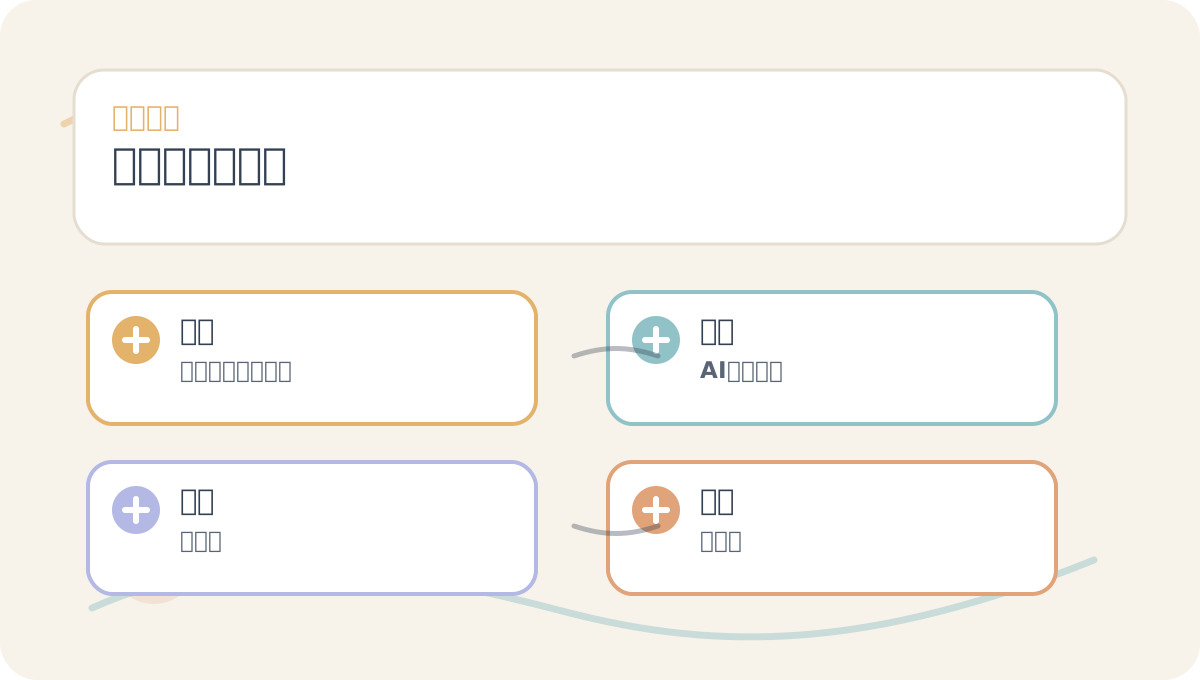
While reading Ethical Issues and Accountability, treat each accompanying illustration as a roadmap card: first grasp the overall sequence; then understand why each step matters; finally, verify boundary conditions and edge cases.
Conclusion
By adhering to these AI ethics principles, organizations developing and deploying AI systems can strengthen public trust—and ensure their products and services align with fundamental societal values. In this rapidly evolving technological landscape, maintaining ethical awareness and a strong sense of responsibility remains vital to the healthy, sustainable advancement of AI.
Next, we will explore The Impact of Automated Decision-Making, delving deeper into the ethical challenges and societal responsibilities arising from AI’s growing role in consequential decisions.
Apply This Lesson
Turn this article into AI software, model, API, and security decisions.
English Article FAQ
Use this article as evidence before choosing AI tools
How should I use this AI Tutorials article?
Use it as the implementation or learning layer, then connect the idea to AI software buyer guides, tool comparisons, benchmarks, API choices, and security checks before making a production decision.
Is this English article different from the Chinese original?
The English edition is localized for global AI readers while preserving the original diagrams, screenshots, prompts, code examples, and source context from the Chinese article.
What should I read after Generate a simple model and dataset?
Continue with AI Software Buyer Guides, AI Tools Workbench, Best AI Coding Agents, AI Model Benchmarks, OpenAI vs Anthropic API, or LLM Security Tools depending on the decision you need to make.
Can this article alone choose an AI product or model?
No. Treat the article as evidence and context, then validate fit with pricing, privacy requirements, integration effort, benchmark results, workflow tests, and fallback planning.
Continue