English translation
Example: Linear regression model using scikit-learn
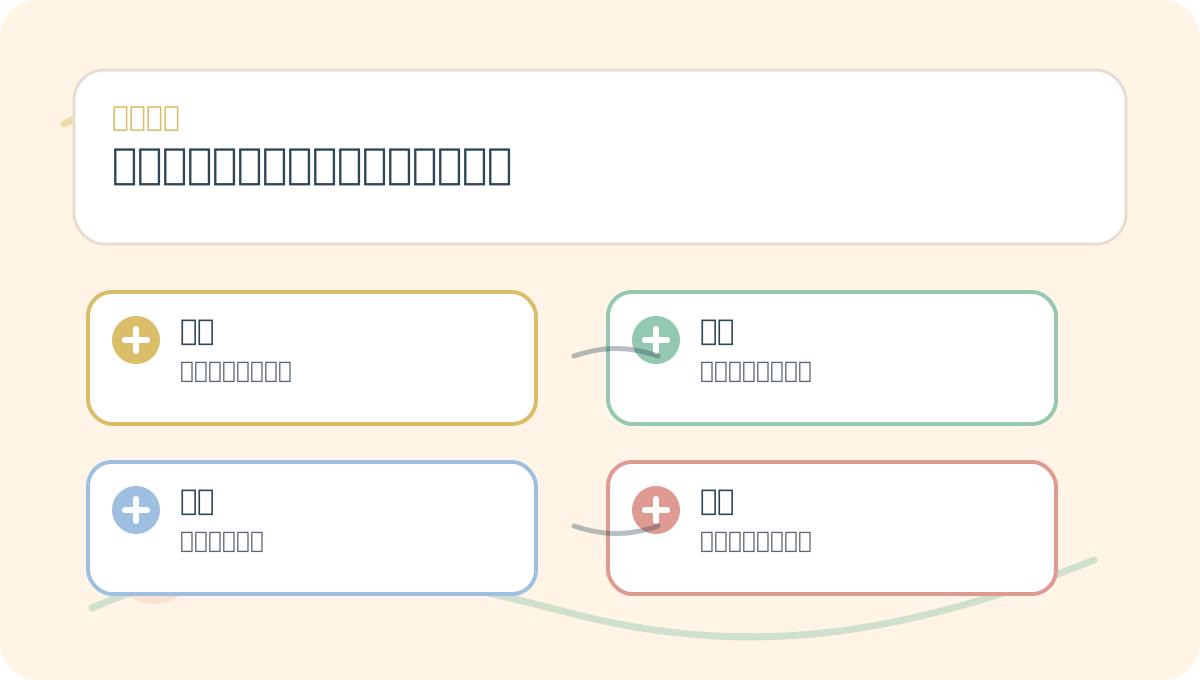
AI Article Decision Snapshot
Turn the lesson into workflow, model, budget, and security checks before choosing tools.
Use this quick snapshot before leaving the article. It keeps the next search tied to practical AI software, model/API, cost, privacy, and implementation questions.
Workflow fit
Identify the real job behind the article: coding, research, document review, support, analytics, content, or internal automation.
Model or tool decision
Decide whether the next step is a software shortlist, an AI tool comparison, an API platform choice, or a model benchmark.
Budget and usage signal
Estimate seats, API calls, prompt volume, retries, review time, and fallback work before assuming the workflow is cheap.
Security and privacy review
Check whether source code, customer data, private documents, prompts, logs, or embeddings will enter the AI workflow.
Security Risk Assessment Framework

The risk of automated decision-making lies not in its apparent efficiency—but in its potential to amplify biases and errors. Human oversight is non-negotiable, especially in high-stakes domains such as hiring, credit approval, healthcare access, and educational opportunity.

I require that every automated conclusion include at least three elements: (1) primary rationale, (2) confidence level, and (3) a clear pathway for human review. Without visibility into these, users cannot effectively identify or correct errors.
In modern society, automated decision-making systems are increasingly pervasive—from bank loan approvals to AI-powered resume screening—across nearly every industry leveraging artificial intelligence (AI) to boost efficiency and accuracy. Yet this trend introduces significant ethical dilemmas and accountability challenges. To ensure fairness and transparency in AI systems, we must rigorously examine their impact on individuals and society.
Challenges of Automated Decision-Making
1. Fairness and Bias
Automated decision-making systems are heavily influenced by their training data. If that data reflects historical biases, the AI may unintentionally reinforce and even exacerbate social inequities. For instance, certain hiring algorithms trained predominantly on past success cases from a narrow demographic may systematically favor candidates from those groups—thereby discriminating against others.
# Example: Linear regression model using scikit-learn
from sklearn.linear_model import LinearRegression
import numpy as np

# Hypothetical hiring data: "success" candidates' features
X = np.array([[5, 10], [6, 12], [5, 8], [4, 5]])  # Features: years of experience, education level
y = np.array([1, 1, 1, 0])  # Labels: success = 1, failure = 0

model = LinearRegression()
model.fit(X, y)

# Predict outcome for a new candidate
new_candidate = np.array([[7, 15]])
print(model.predict(new_candidate))  # Output: predicted result
2. Transparency and Explainability
Automated decision-making systems—especially those based on deep learning—are often treated as “black boxes,” with opaque internal logic. This lack of transparency breeds skepticism and erodes public trust. Worse still, when users suffer adverse outcomes, they frequently cannot trace the root cause—undermining confidence in the system entirely.
3. Accountability
Automated decision-making raises complex questions about responsibility. For example, if a loan application is automatically rejected—causing undue financial hardship—who bears responsibility? The algorithm’s developer? The financial institution deploying it? Or the algorithm itself? Such ambiguity makes redress difficult for affected individuals.
Case Studies

When evaluating the impact of automated decisions, first consider: decision subject, cost of error, sources of bias, explainability, human intervention points, and user appeal mechanisms.
1. Insurance Industry: Automated Premium Setting
Suppose an insurer deploys AI to set premiums based on historical claims data. If the training data draws only from recent successful claims—without accounting for underrepresented or historically disadvantaged groups—the system may inadvertently impose higher premiums on certain demographics.
2. Recruitment: AI-Powered Candidate Screening
After adopting AI to accelerate hiring, a company uses it for initial resume filtering. However, because the system fails to adequately account for gender, race, or other protected attributes, highly qualified candidates are unjustifiably excluded. Such outcomes not only harm job seekers’ livelihoods but may also trigger legal liability.
While studying Ethical Issues and Accountability in Automated Decision-Making, start by identifying a small, reproducible scenario you can simulate yourself. Then map relevant concepts and step-by-step exercises onto it. After reading, re-express the core ideas using your own example.
Mitigation Strategies
Having understood the potential ethical risks of automated decision-making, we can adopt concrete measures to reduce them:
- Diversify Training Data: Ensure AI training datasets represent diverse populations to minimize bias propagation.
- Enhance Transparency: Develop interpretable AI models and provide clear, accessible justifications for decisions—enabling affected individuals to understand how outcomes were reached.
- Clarify Accountability: Before deployment, establish a formal accountability framework specifying roles and responsibilities across developers, deployers, and operators.
- Enable Continuous Monitoring & Feedback: Once live, regularly audit system outputs, collect user feedback, and iteratively refine the model and processes.
When reviewing Ethical Issues and Accountability in Automated Decision-Making, consolidate key concepts, procedural steps, and observable outcomes onto a single page for efficient reflection.

When practicing Ethical Issues and Accountability in Automated Decision-Making, explicitly document input conditions, processing actions, and visible outputs together—facilitating future review and validation.
Conclusion
Automated decision-making delivers undeniable societal benefits—but its associated ethical concerns and accountability gaps demand serious attention. As we integrate AI into critical domains, we must proactively safeguard fairness and transparency—and thoughtfully allocate responsibility across stakeholders. Only through such deliberate, principled design can we harness AI’s power to improve decision-making without compromising individual rights or social equity.
Next, we will delve deeper into Social Responsibility and Transparency.
Apply This Lesson
Turn this article into AI software, model, API, and security decisions.
English Article FAQ
Use this article as evidence before choosing AI tools
How should I use this AI Tutorials article?
Use it as the implementation or learning layer, then connect the idea to AI software buyer guides, tool comparisons, benchmarks, API choices, and security checks before making a production decision.
Is this English article different from the Chinese original?
The English edition is localized for global AI readers while preserving the original diagrams, screenshots, prompts, code examples, and source context from the Chinese article.
What should I read after Example: Linear regression model using scikit-learn?
Continue with AI Software Buyer Guides, AI Tools Workbench, Best AI Coding Agents, AI Model Benchmarks, OpenAI vs Anthropic API, or LLM Security Tools depending on the decision you need to make.
Can this article alone choose an AI product or model?
No. Treat the article as evidence and context, then validate fit with pricing, privacy requirements, integration effort, benchmark results, workflow tests, and fallback planning.
Continue