English translation
Assume a trained model exists
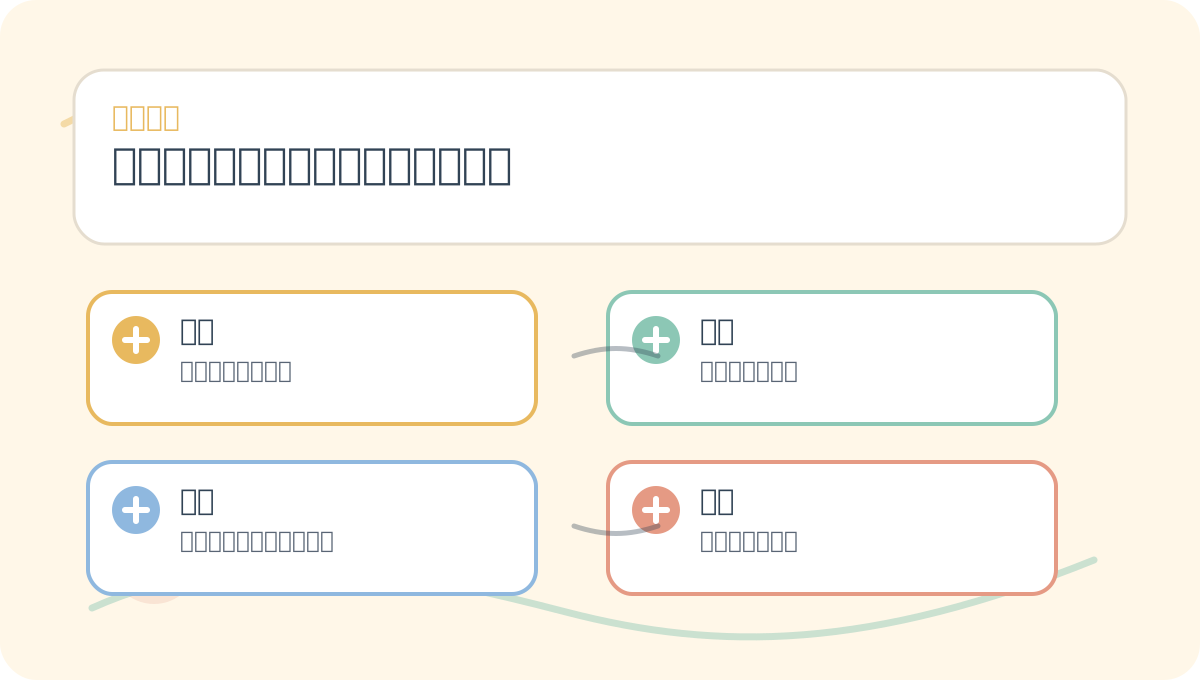
AI Article Decision Snapshot
Turn the lesson into workflow, model, budget, and security checks before choosing tools.
Use this quick snapshot before leaving the article. It keeps the next search tied to practical AI software, model/API, cost, privacy, and implementation questions.
Workflow fit
Identify the real job behind the article: coding, research, document review, support, analytics, content, or internal automation.
Model or tool decision
Decide whether the next step is a software shortlist, an AI tool comparison, an API platform choice, or a model benchmark.
Budget and usage signal
Estimate seats, API calls, prompt volume, retries, review time, and fallback work before assuming the workflow is cheap.
Security and privacy review
Check whether source code, customer data, private documents, prompts, logs, or embeddings will enter the AI workflow.
Framework for Assessing Security Risks

Transparency does not mean publishing all model parameters and internal prompts. Rather, it means clearly informing users when AI is being used, what data or materials inform its outputs, what limitations apply, and who to contact if something goes wrong.

Before launch, I verify that the interface includes four essential statements:
- This is an AI-assisted output, not a final determination;
- This output does not constitute professional advice or a binding decision;
- Data collected is used solely for [specify purpose];
- Users may provide feedback or file an appeal via [clearly specified channel].
In today’s rapidly evolving artificial intelligence (AI) landscape, social responsibility and transparency have become central themes in public and technical discourse. As AI systems penetrate deeper into diverse sectors—from healthcare and finance to education and governance—their potential impacts extend far beyond technical performance, touching on fundamental human values, ethics, and societal well-being. In this section, we delve into the issues of social responsibility and transparency in AI—including their significance, current challenges, and practical pathways forward.
1. Defining Social Responsibility
Social responsibility refers to an organization’s commitment to act in ways that benefit society—encompassing responsibilities toward public welfare, environmental sustainability, and economic fairness. In the context of AI, companies and developers bear responsibility for the real-world consequences of their technologies. This includes ensuring AI systems are fair, non-discriminatory, robust, and safe—and actively mitigating risks of harm to individuals or communities.
Case Study: Facial Recognition Technology
Facial recognition technology has sparked widespread debate about social responsibility. A major tech company deployed a facial recognition system that exhibited significantly higher false-positive rates for minority ethnic groups. This case underscores the ethical obligation of developers to conduct rigorous, representative testing and bias audits before deployment—ensuring systems do not perpetuate or amplify societal inequities.
2. The Importance of Transparency
Transparency means making systems—and the logic behind their decisions—understandable and accessible to all stakeholders. It is especially critical in AI, where many models—particularly deep learning systems—are often treated as “black boxes,” with opaque internal reasoning.
Theoretical Foundation
The importance of transparency in AI is closely tied to explainability. For instance, if an AI system denies a loan application, the applicant has a legitimate right to understand why. Without transparency, such decisions erode trust, reduce user acceptance, and hinder accountability.
Case Study: Credit Scoring System
A fintech company’s credit scoring system came under scrutiny due to its lack of transparency. Applicants discovered their scores were influenced by numerous complex, undisclosed factors—but the company provided no clear, actionable explanations. The resulting wave of legal challenges severely damaged public trust in the system and impeded business growth.

When evaluating social responsibility and transparency, assess:
- How information is communicated to users;
- The stated purpose(s) of data collection and use;
- Explicit documentation of model limitations;
- Identification of affected populations and potential harms;
- Availability and accessibility of redress mechanisms;
- Existence of audit trails and third-party verification records.
3. Strategies to Enhance Transparency
To embed greater transparency throughout the AI lifecycle—from design to deployment—the following strategies are recommended:
3.1 Improving Explainability
Explainability techniques—such as LIME (Local Interpretable Model-agnostic Explanations) or SHAP (SHapley Additive exPlanations)—help developers and users understand how models arrive at specific predictions. Below is a simple example using LIME for local interpretability:
import lime
import lime.lime_tabular

# Assume a trained model exists
explainer = lime.lime_tabular.LimeTabularExplainer(training_data, feature_names=feature_names, class_names=class_names)

# Generate explanation for a specific instance
explanation = explainer.explain_instance(instance, model.predict_proba, num_features=10)
3.2 Open Data and Algorithms
Encouraging open sharing of datasets and algorithmic code supports independent validation, reproducibility, and community scrutiny. For example, several government agencies and academic institutions jointly publish benchmark datasets—strengthening collective understanding and fostering public confidence in AI systems.
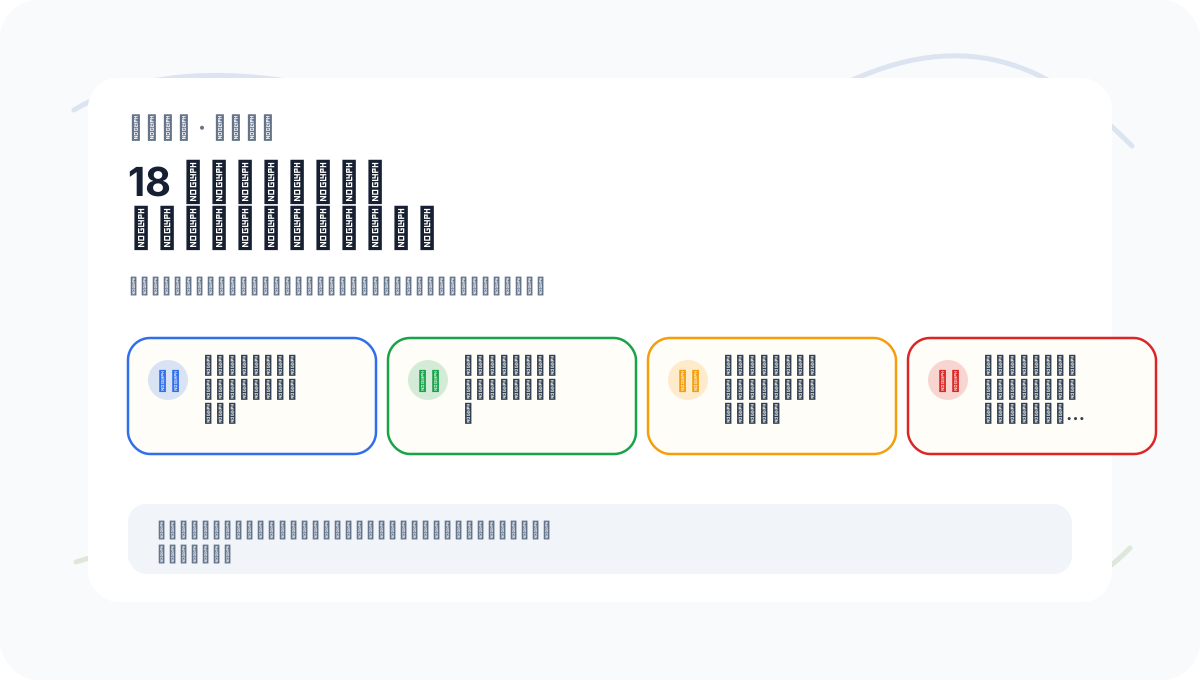
Having completed Ethical Issues and Accountability: Social Responsibility and Transparency, treat the flowchart in this figure as a practical checklist:
- Is the problem clearly defined?
- Are implementation steps concrete and actionable?
- Can the evaluation criteria be reused across contexts?
3.3 Establishing Ethical Review Mechanisms
In high-stakes domains—such as healthcare, autonomous vehicles, or criminal justice—forming dedicated ethics review boards helps proactively identify, assess, and mitigate potential ethical risks. These bodies enhance both transparency (by documenting deliberations) and accountability (by formalizing oversight).
4. The Future of Social Responsibility and Transparency
Looking ahead, AI’s social responsibility and transparency will continue to face complex, evolving challenges. In areas like autonomous weapons systems and mass surveillance, balancing technological advancement with fundamental human rights remains deeply contested. Addressing these challenges demands coordinated action—not only from developers and corporations, but also from policymakers, civil society, and international institutions—to co-develop robust norms, standards, and governance frameworks. Only then can AI advance responsibly, without compromising societal values.

To apply Ethical Issues and Accountability: Social Responsibility and Transparency to your own work, begin by narrowing the scope: focus on validating one critical decision point—e.g., “Does our system disclose when AI is assisting human judgment?”
After studying Ethical Issues and Accountability: Social Responsibility and Transparency, try adapting it to a scenario of your own—paying close attention to whether inputs, processing logic, and outputs align coherently and ethically.
Ultimately, transparency and social responsibility are not optional add-ons to AI development—they are foundational pillars for building trustworthy, equitable, and socially beneficial systems. Only by grounding AI innovation in these principles can we unlock its full potential while generating shared value for people and communities worldwide. Meeting this challenge requires openness, humility, continuous reflection, and unwavering commitment to the common good.
Apply This Lesson
Turn this article into AI software, model, API, and security decisions.
English Article FAQ
Use this article as evidence before choosing AI tools
How should I use this AI Tutorials article?
Use it as the implementation or learning layer, then connect the idea to AI software buyer guides, tool comparisons, benchmarks, API choices, and security checks before making a production decision.
Is this English article different from the Chinese original?
The English edition is localized for global AI readers while preserving the original diagrams, screenshots, prompts, code examples, and source context from the Chinese article.
What should I read after Assume a trained model exists?
Continue with AI Software Buyer Guides, AI Tools Workbench, Best AI Coding Agents, AI Model Benchmarks, OpenAI vs Anthropic API, or LLM Security Tools depending on the decision you need to make.
Can this article alone choose an AI product or model?
No. Treat the article as evidence and context, then validate fit with pricing, privacy requirements, integration effort, benchmark results, workflow tests, and fallback planning.
Continue