English translation
Future Outlook and Best Practices: Government and Industry Roles in AI Security and Privacy
AI Article Decision Snapshot
Turn the lesson into workflow, model, budget, and security checks before choosing tools.
Use this quick snapshot before leaving the article. It keeps the next search tied to practical AI software, model/API, cost, privacy, and implementation questions.
Workflow fit
Identify the real job behind the article: coding, research, document review, support, analytics, content, or internal automation.
Model or tool decision
Decide whether the next step is a software shortlist, an AI tool comparison, an API platform choice, or a model benchmark.
Budget and usage signal
Estimate seats, API calls, prompt volume, retries, review time, and fallback work before assuming the workflow is cheap.
Security and privacy review
Check whether source code, customer data, private documents, prompts, logs, or embeddings will enter the AI workflow.
Security Risk Assessment Framework
The role of government and industry extends beyond issuing high-level principles—it must help organizations understand how to act, how to demonstrate compliance, and how to improve. The more readily standards can be translated into actionable checklists, the more likely they are to be adopted by engineering teams.
When reviewing any new standard, I translate it into three columns:
- What we’re already doing today
- What evidence is currently missing
- What changes are needed in the next iteration
Only then does the standard become embedded in engineering workflows.

To understand the roles of government and industry, begin by examining six dimensions: regulatory requirements, industry standards, corporate responsibilities, audit mechanisms, user rights, and cross-organizational collaboration.
As artificial intelligence (AI) continues to evolve, security and privacy concerns are becoming increasingly prominent. With AI’s widespread deployment across sectors, governments and industry bodies worldwide are actively seeking effective strategies to ensure AI safety and protect user privacy. This section explores the distinct yet complementary roles of government and industry in safeguarding AI security and privacy—highlighting how their coordinated efforts can help build a safer AI future.
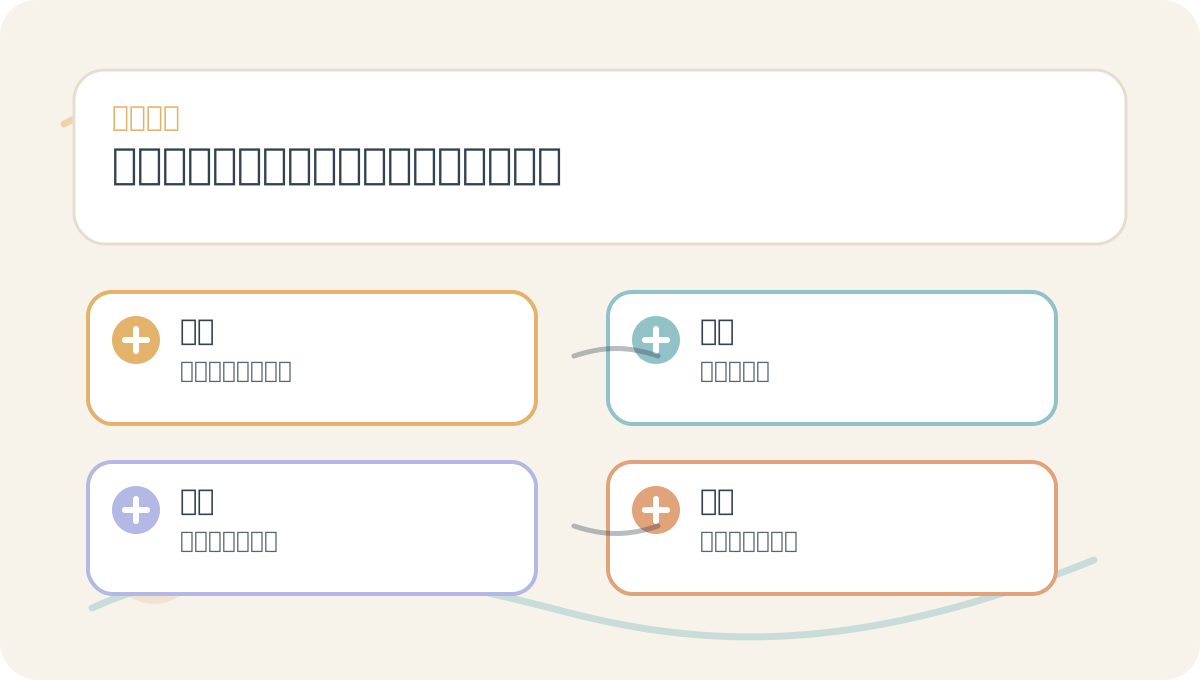
Content like “Future Outlook and Best Practices: The Roles of Government and Industry” risks getting lost in detail. First, grasp the core narrative illustrated in the diagram—then return to the text to verify context, inputs, outputs, and evaluation criteria.
The Role of Government
Policy and Regulatory Development
Governments play a pivotal role in ensuring AI security and privacy by establishing foundational legal frameworks through policy and regulation. For example, the European Union’s General Data Protection Regulation (GDPR) provides concrete legal guidance on personal data handling. Such regulations emphasize transparency and informed user consent, encouraging companies to embed privacy-by-design principles when developing AI systems.
Establishment of Regulatory Agencies
Governments can also create dedicated regulatory agencies to oversee AI development and deployment. These agencies safeguard public interest by evaluating AI systems for fairness, transparency, and accountability. For instance, the U.S. Federal Trade Commission (FTC) has begun assessing AI systems’ transparency and fairness to protect consumer rights.
Funding and Incentive Programs
To accelerate research and development in AI security and privacy, governments can launch targeted funding initiatives and incentive programs. Such measures stimulate innovation across academia and industry. Several countries, for example, have introduced “AI Security Innovation Awards” to recognize and reward breakthroughs that effectively address critical AI security challenges.
The Role of Industry
Development of Industry Standards
Industry associations and enterprises must jointly develop and adopt concrete, actionable standards. These standards guide organizations in designing and deploying AI systems according to best practices—ensuring both data privacy and system integrity. IEEE (Institute of Electrical and Electronics Engineers), for example, has published a suite of standards on AI ethics and safety, explicitly directing developers to integrate privacy and security considerations throughout the AI lifecycle.
Collaboration and Information Sharing
Cross-industry collaboration is essential to strengthening AI security and privacy. Companies can collectively identify emerging threats and privacy risks by sharing threat intelligence, incident reports, and mitigation strategies. Major technology firms, for instance, have formed alliances to exchange real-time information about AI vulnerabilities and adversarial attacks—enhancing collective defense capabilities and improving the sector’s resilience against evolving AI security challenges.
Commitment to Corporate Social Responsibility
Enterprises must uphold strong social responsibility when deploying AI technologies—placing human well-being at the center. When launching AI initiatives, organizations should proactively assess potential societal impacts and implement robust safeguards for user privacy. Some companies, for example, involve end users early in product testing to ensure transparency around user experience and broader social implications—thereby building trust and accountability.
Case Studies
Case Study 1: Implementation of the EU GDPR
The enforcement of the EU GDPR has had far-reaching effects on the global AI industry. Many companies entering the EU market were compelled to fundamentally reevaluate and redesign their data processing pipelines. Beyond boosting user confidence in privacy protections, GDPR’s success has catalyzed data privacy legislation in numerous jurisdictions worldwide.
Case Study 2: USAID’s AI Ethics Framework
The U.S. Agency for International Development (USAID) developed an AI ethics framework emphasizing user privacy protection and the prevention of bias and discrimination. This framework serves as practical guidance for organizations designing and deploying AI systems—helping them align technical development with ethical principles and social impact considerations.
Having read this section, distill “Future Outlook and Best Practices: The Roles of Government and Industry” into a retrospective table: first clarify the central narrative, then validate it using a small-scale task or pilot.
After reading “Future Outlook and Best Practices: The Roles of Government and Industry,” select a small, concrete use case and walk through the full workflow end-to-end—then assess which steps your team can already execute independently.
Summary
Amid rapid AI advancement, close collaboration between government and industry is indispensable. By enacting effective regulations, establishing oversight bodies, advancing industry standards, and fostering transparent information sharing, both stakeholders can co-create a secure, trustworthy AI ecosystem. Looking ahead, as AI technologies grow increasingly complex, intergovernmental and cross-sector cooperation will deepen—enabling more agile, coordinated responses to emerging AI security and privacy challenges.
Within this evolving landscape, addressing AI security and privacy demands sustained research, iterative innovation, and operational rigor. The following chapters will explore how to implement these best practices in practice—maximizing both AI system security and user privacy protection.
Apply This Lesson
Turn this article into AI software, model, API, and security decisions.
English Article FAQ
Use this article as evidence before choosing AI tools
How should I use this AI Tutorials article?
Use it as the implementation or learning layer, then connect the idea to AI software buyer guides, tool comparisons, benchmarks, API choices, and security checks before making a production decision.
Is this English article different from the Chinese original?
The English edition is localized for global AI readers while preserving the original diagrams, screenshots, prompts, code examples, and source context from the Chinese article.
What should I read after Future Outlook and Best Practices: Government and Industry Roles in AI Security and Privacy?
Continue with AI Software Buyer Guides, AI Tools Workbench, Best AI Coding Agents, AI Model Benchmarks, OpenAI vs Anthropic API, or LLM Security Tools depending on the decision you need to make.
Can this article alone choose an AI product or model?
No. Treat the article as evidence and context, then validate fit with pricing, privacy requirements, integration effort, benchmark results, workflow tests, and fallback planning.
Continue