English translation
Assume we have model predictions and ground-truth labels
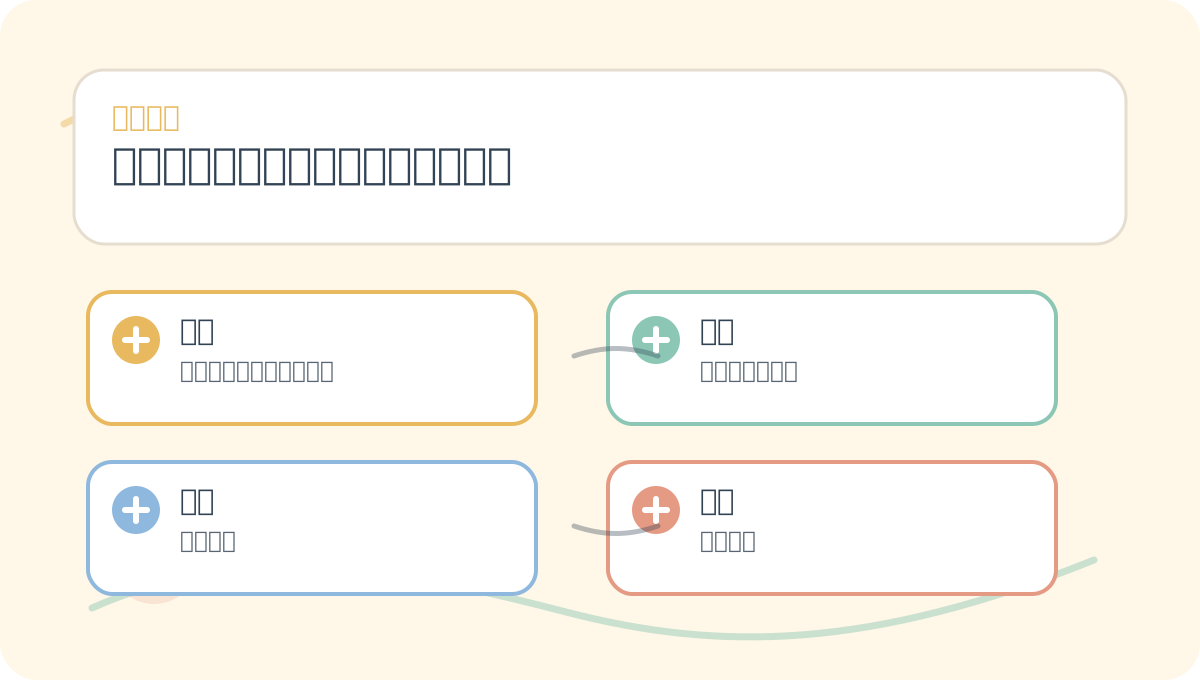
AI Article Decision Snapshot
Turn the lesson into workflow, model, budget, and security checks before choosing tools.
Use this quick snapshot before leaving the article. It keeps the next search tied to practical AI software, model/API, cost, privacy, and implementation questions.
Workflow fit
Identify the real job behind the article: coding, research, document review, support, analytics, content, or internal automation.
Model or tool decision
Decide whether the next step is a software shortlist, an AI tool comparison, an API platform choice, or a model benchmark.
Budget and usage signal
Estimate seats, API calls, prompt volume, retries, review time, and fallback work before assuming the workflow is cheap.
Security and privacy review
Check whether source code, customer data, private documents, prompts, logs, or embeddings will enter the AI workflow.

Metrics determine the AutoML search direction. Choosing the wrong metric causes the system to diligently optimize the wrong objective.

I first ask: Which type of error is most costly? Then I decide whether to optimize for accuracy, recall, F1-score, AUC, or regression error.
In the automated machine learning (AutoML) pipeline, model selection and evaluation are critical steps toward building high-quality models. In the previous article, we explored “Methods for Model Selection,” highlighting various techniques and strategies. In this article, we focus on “The Importance of Evaluation Metrics”—laying the groundwork for the next topic: “How to Perform Cross-Validation.”
Why Evaluation Metrics Matter
Selecting appropriate evaluation metrics is essential when assessing the performance of machine learning models. These metrics not only quantify model performance but also directly influence model selection and refinement directions. Below are several key reasons why evaluation metrics matter:

When setting AutoML evaluation metrics, first consider: business objectives, class imbalance, costs of false positives vs. false negatives, validation set constraints, and production deployment requirements.
-
Assessing Model Accuracy: Different metrics highlight different aspects of model behavior. For example, accuracy is commonly used in classification tasks—but can be misleading under class imbalance.
-
Comparing Models: When evaluating multiple candidate models, evaluation metrics provide objective, quantifiable criteria for selecting the best-performing one.
-
Tuning Models: Monitoring metrics across hyperparameter configurations ensures optimization moves in the right direction—toward improved real-world performance.
-
Understanding Model Limitations: Metrics like recall and precision reveal how well a model performs on specific classes—especially vital for imbalanced datasets.
Common Evaluation Metrics
Evaluation metrics vary by task type. Below are widely used metrics—choose those aligned with your problem context:
After reading “The Importance of Evaluation Metrics in Model Selection and Evaluation,” don’t stop at “I understand.” Go back and implement one step hands-on; note where you get stuck—the next learning steps will feel more grounded.
Classification Metrics
-
Accuracy
Accuracy measures the proportion of correctly classified samples among all samples:where
TP= true positives,TN= true negatives,FP= false positives, andFN= false negatives. -
Precision
Precision measures the proportion of true positive predictions among all samples predicted as positive: -
Recall
Recall measures the proportion of actual positive samples that were correctly identified: -
F1-Score
The F1-score is the harmonic mean of precision and recall—balancing both concerns:
Regression Metrics
-
Mean Squared Error (MSE)
MSE quantifies the average squared difference between predictions and ground truth—lower values indicate better fit: -
Coefficient of Determination (R²)
R² reflects how well the regression model explains variance in the target variable—values closer to 1 indicate stronger fit:
Case Study
Suppose we’re building a binary classifier to predict whether a patient has a certain disease. We can use precision and recall to balance model behavior—especially important when disease prevalence is low.
from sklearn.metrics import confusion_matrix, classification_report

# Assume we have model predictions and ground-truth labels
y_true = [0, 1, 1, 0, 1, 0, 0, 1, 0, 1]
y_pred = [0, 1, 0, 0, 1, 0, 1, 1, 0, 0]

# Compute confusion matrix
cm = confusion_matrix(y_true, y_pred)

# Generate detailed classification report
report = classification_report(y_true, y_pred)
print("Confusion Matrix:\n", cm)
print("Classification Report:\n", report)
Running this code yields detailed performance insights—including numeric values for precision, recall, and F1-score—enabling robust assessment of real-world model behavior.

When reviewing “The Importance of Evaluation Metrics in Model Selection and Evaluation,” place key concepts, procedural steps, and observable outcomes on the same page for efficient reflection.

When practicing “The Importance of Evaluation Metrics in Model Selection and Evaluation,” write input conditions, processing actions, and observable outputs together—making future review faster and more actionable.
Summary
In the AutoML workflow, evaluation metrics are indispensable for interpreting model behavior and guiding performance improvements. By carefully selecting appropriate metrics, we gain a nuanced, task-aligned understanding of a model’s strengths and weaknesses. In the next article, we’ll explore how to perform cross-validation—further strengthening model reliability and generalizability.
Apply This Lesson
Turn this article into AI software, model, API, and security decisions.
English Article FAQ
Use this article as evidence before choosing AI tools
How should I use this AI Tutorials article?
Use it as the implementation or learning layer, then connect the idea to AI software buyer guides, tool comparisons, benchmarks, API choices, and security checks before making a production decision.
Is this English article different from the Chinese original?
The English edition is localized for global AI readers while preserving the original diagrams, screenshots, prompts, code examples, and source context from the Chinese article.
What should I read after Assume we have model predictions and ground-truth labels?
Continue with AI Software Buyer Guides, AI Tools Workbench, Best AI Coding Agents, AI Model Benchmarks, OpenAI vs Anthropic API, or LLM Security Tools depending on the decision you need to make.
Can this article alone choose an AI product or model?
No. Treat the article as evidence and context, then validate fit with pricing, privacy requirements, integration effort, benchmark results, workflow tests, and fallback planning.
Continue