English translation
Load data
AI Article Decision Snapshot
Turn the lesson into workflow, model, budget, and security checks before choosing tools.
Use this quick snapshot before leaving the article. It keeps the next search tied to practical AI software, model/API, cost, privacy, and implementation questions.
Workflow fit
Identify the real job behind the article: coding, research, document review, support, analytics, content, or internal automation.
Model or tool decision
Decide whether the next step is a software shortlist, an AI tool comparison, an API platform choice, or a model benchmark.
Budget and usage signal
Estimate seats, API calls, prompt volume, retries, review time, and fallback work before assuming the workflow is cheap.
Security and privacy review
Check whether source code, customer data, private documents, prompts, logs, or embeddings will enter the AI workflow.

Cross-validation mitigates the impact of random data splits—but it does not solve data leakage. Exercise special caution with time-series and user-level data.

I examine both the mean and variance of cross-validation scores. A high average score coupled with large variance suggests model or data instability.
In the previous article, we discussed the importance of evaluation metrics and learned that selecting appropriate metrics is critical for accurately assessing model performance. In model selection and evaluation, cross-validation serves as a powerful technique to obtain more reliable performance estimates. This article delves into the fundamental concepts of cross-validation, its common variants, and practical implementation strategies.
Core Concepts of Cross-Validation
Cross-validation is a method for partitioning a dataset into multiple subsets, enabling repeated training and validation of a model across different data splits. This approach helps reduce overfitting and yields more robust performance estimates. It also maximizes data utilization—especially valuable when working with limited data—ensuring every sample contributes to both training and validation across iterations.

When performing AutoML cross-validation, first assess: split strategy, number of folds, temporal ordering (if applicable), class distribution balance, risk of data leakage, and the final aggregated metric.
Common Cross-Validation Methods
1. K-Fold Cross-Validation
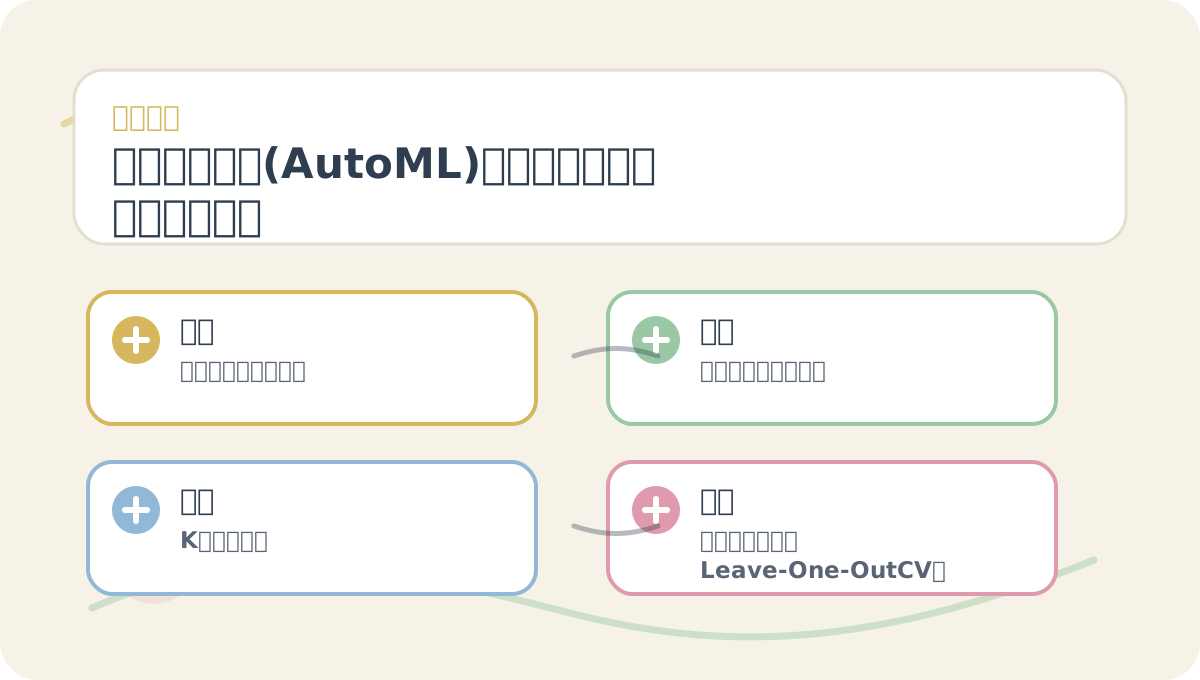
Before diving into the main text of “AutoML Tutorial Series: How to Perform Cross-Validation,” quickly scan the accompanying illustrations: What question is being asked? Which concepts need clear distinction? Which step warrants hands-on practice? And what criteria define successful completion?
The most widely used cross-validation method is K-Fold Cross-Validation, implemented as follows:
- Partition the dataset into K equally sized subsets (called “folds”).
- For each fold, treat it as the validation set while combining the remaining K−1 folds into the training set.
- Repeat this process K times—each fold serving exactly once as the validation set.
- Compute the chosen performance metric (e.g., accuracy, F1-score) on each validation fold, then report their average as the final estimate.
Its primary advantage lies in high data efficiency: every sample participates in both training and validation across the full K-fold cycle.
2. Leave-One-Out Cross-Validation (LOOCV)
Leave-One-Out Cross-Validation (LOOCV) is a special case where K equals the total number of samples—i.e., each iteration holds out exactly one sample for validation. LOOCV is suitable for very small datasets but becomes computationally prohibitive for larger ones.
3. Stratified K-Fold Cross-Validation
For classification tasks, Stratified K-Fold Cross-Validation ensures that each fold preserves the same class proportions as the original dataset. This is especially crucial for imbalanced datasets, guaranteeing consistent label distribution across all folds.
Practical Example
Next, we demonstrate cross-validation in practice using a simple Python code example with scikit-learn’s KFold.
First, import required libraries and prepare the data:
import numpy as np
from sklearn.datasets import load_iris
from sklearn.model_selection import KFold, cross_val_score
from sklearn.ensemble import RandomForestClassifier
Then load the Iris dataset and configure 5-fold cross-validation:
# Load data
data = load_iris()
X, y = data.data, data.target

# Initialize K-Fold cross-validator
kf = KFold(n_splits=5, shuffle=True, random_state=42)
Apply cross-validation using a Random Forest classifier and print per-fold and mean accuracy:
# Initialize model
model = RandomForestClassifier()

# Perform cross-validation
scores = cross_val_score(model, X, y, cv=kf)

# Output per-fold and mean accuracy
print("Accuracy per fold:", scores)
print("Mean accuracy:", np.mean(scores))
In this example, we load the Iris dataset, apply 5-fold cross-validation via KFold, and compute and display both individual fold accuracies and their average.
After completing “AutoML Tutorial Series: How to Perform Cross-Validation,” try adapting it to your own use case—focus specifically on whether inputs, processing steps, and outputs align coherently.
To apply “AutoML Tutorial Series: How to Perform Cross-Validation” to your own task, start by narrowing scope—validate just one critical decision point first.
Conclusion
This article thoroughly introduced the core concepts and common variants of cross-validation, illustrated with a concrete Python implementation of K-fold cross-validation. Cross-validation not only improves the reliability of model performance estimation but also effectively reduces bias introduced by arbitrary train/validation splits. With cross-validation mastered, we will next explore automated feature engineering—specifically, feature selection techniques—to further enhance model performance and interpretability.
In the upcoming article, we will discuss intelligent methods for selecting optimal features from raw data—enabling both stronger predictive power and greater transparency in model behavior.
Apply This Lesson
Turn this article into AI software, model, API, and security decisions.
English Article FAQ
Use this article as evidence before choosing AI tools
How should I use this AI Tutorials article?
Use it as the implementation or learning layer, then connect the idea to AI software buyer guides, tool comparisons, benchmarks, API choices, and security checks before making a production decision.
Is this English article different from the Chinese original?
The English edition is localized for global AI readers while preserving the original diagrams, screenshots, prompts, code examples, and source context from the Chinese article.
What should I read after Load data?
Continue with AI Software Buyer Guides, AI Tools Workbench, Best AI Coding Agents, AI Model Benchmarks, OpenAI vs Anthropic API, or LLM Security Tools depending on the decision you need to make.
Can this article alone choose an AI product or model?
No. Treat the article as evidence and context, then validate fit with pricing, privacy requirements, integration effort, benchmark results, workflow tests, and fallback planning.
Continue