English translation
Load data
AI Article Decision Snapshot
Turn the lesson into workflow, model, budget, and security checks before choosing tools.
Use this quick snapshot before leaving the article. It keeps the next search tied to practical AI software, model/API, cost, privacy, and implementation questions.
Workflow fit
Identify the real job behind the article: coding, research, document review, support, analytics, content, or internal automation.
Model or tool decision
Decide whether the next step is a software shortlist, an AI tool comparison, an API platform choice, or a model benchmark.
Budget and usage signal
Estimate seats, API calls, prompt volume, retries, review time, and fallback work before assuming the workflow is cheap.
Security and privacy review
Check whether source code, customer data, private documents, prompts, logs, or embeddings will enter the AI workflow.

Automated feature selection can reduce noise—but it may also inadvertently remove weak yet business-critical signals. Selected (or discarded) features must therefore be reviewed in conjunction with domain expertise.

I review both the list of removed and retained features—paying special attention to whether any data-leaking features were mistakenly retained.
Feature selection is a critical step in the automated machine learning (AutoML) pipeline. It not only improves model performance but also reduces computational overhead and mitigates overfitting risk. In this tutorial, we’ll delve into several feature selection techniques and demonstrate their practical application through concrete examples and code. In the previous tutorial, we covered cross-validation for optimal model selection; here, we focus specifically on feature selection.
What Is Feature Selection?
The goal of feature selection is to identify the most relevant features to enhance a model’s learning capability and generalization performance. It typically involves three key steps:

When performing automated feature selection, first examine candidate features, potential target leakage, importance scores, cross-validation performance, and the final number of selected features.
- Assess Feature Importance: Evaluate each feature’s influence on the target variable using statistical methods or trained models.
- Select Features: Choose the most informative features based on the assessment results.
- Reconstruct the Dataset: Build a new dataset containing only the selected features, ready for downstream modeling.
Feature Selection Methods
Feature selection methods fall into three main categories:
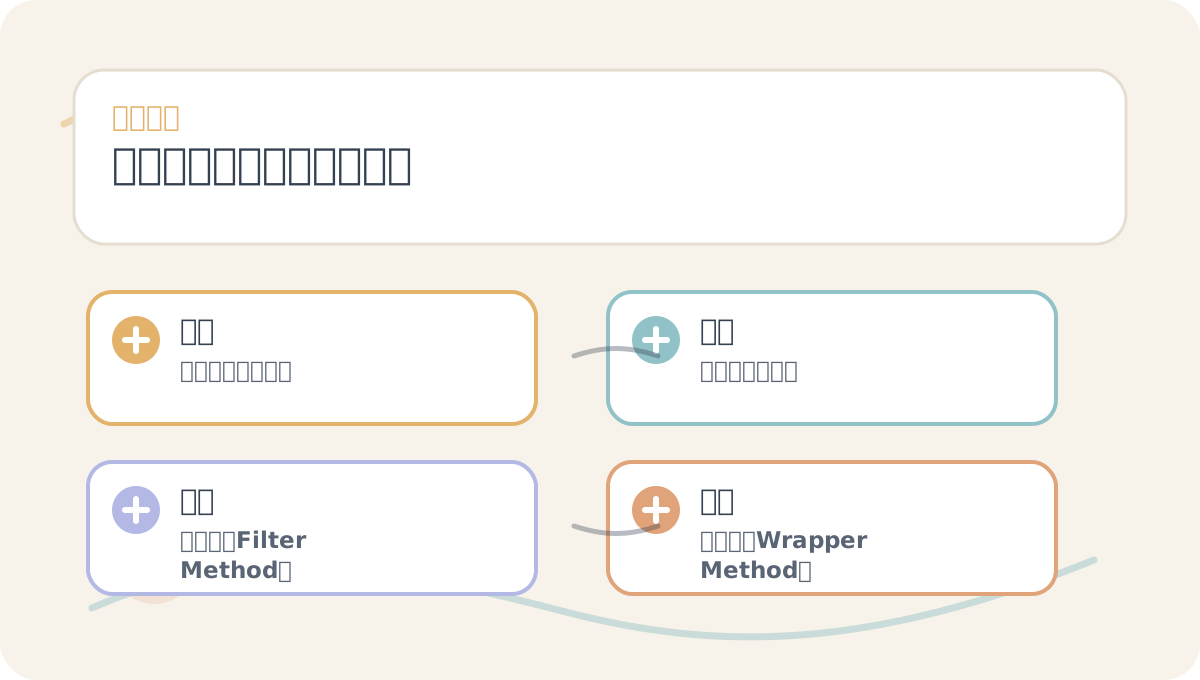
Content like “Automated Feature Engineering: Feature Selection” can easily derail readers with excessive detail. First, grasp the core workflow shown in the diagram—then return to the text to verify environment setup, inputs, outputs, and decision criteria.
1. Filter Methods
Filter methods select features based solely on statistical properties—without relying on any machine learning model. Common techniques include chi-square tests, correlation coefficients, and mutual information.
import pandas as pd
from sklearn.feature_selection import SelectKBest, chi2

# Load data
data = pd.read_csv('data.csv')
X = data.drop(columns='target')
y = data['target']

# Select top K features
selector = SelectKBest(score_func=chi2, k=5)
X_new = selector.fit_transform(X, y)

selected_features = X.columns[selector.get_support()]
print("Selected features:", selected_features)
In the above code, we use the chi-square test to select the five features most statistically associated with the target variable. Note that SelectKBest requires both features and the target to be numeric—or appropriately preprocessed beforehand.
2. Wrapper Methods
Wrapper methods evaluate subsets of features using a specific machine learning model. A widely used example is Recursive Feature Elimination (RFE). Though computationally expensive, wrapper methods often yield superior results.
from sklearn.feature_selection import RFE
from sklearn.linear_model import LogisticRegression

model = LogisticRegression()
rfe = RFE(model, n_features_to_select=5)  # Select 5 features
fit = rfe.fit(X, y)

print("Selected features:", X.columns[fit.support_])
Here, logistic regression serves as the evaluation model, and RFE iteratively eliminates less important features until only the top five remain.
3. Embedded Methods
Embedded methods integrate feature selection directly into the model training process. Popular examples include Lasso regression and tree-based feature importance (e.g., from Random Forests or XGBoost). These methods perform selection implicitly during model fitting.
from sklearn.linear_model import LassoCV

lasso = LassoCV(alphas=[0.1, 0.01, 0.001])
lasso.fit(X, y)

# Retrieve features with non-zero coefficients
selected_features = X.columns[lasso.coef_ != 0]
print("Selected features:", selected_features)
In this example, Lasso regression shrinks irrelevant feature coefficients toward zero—effectively identifying the most predictive features.
Key Considerations in Practice
- Data Preprocessing: Always perform essential preprocessing before feature selection—e.g., handling missing values, scaling, or encoding categorical variables.
- Alignment Between Selection Method and Model: The choice of feature selection technique should align with the downstream model. A feature deemed unimportant for one model may be highly valuable for another.
- Avoiding Overfitting: Feature selection must be performed exclusively on the training set. Validation and test sets must remain untouched until final model evaluation.
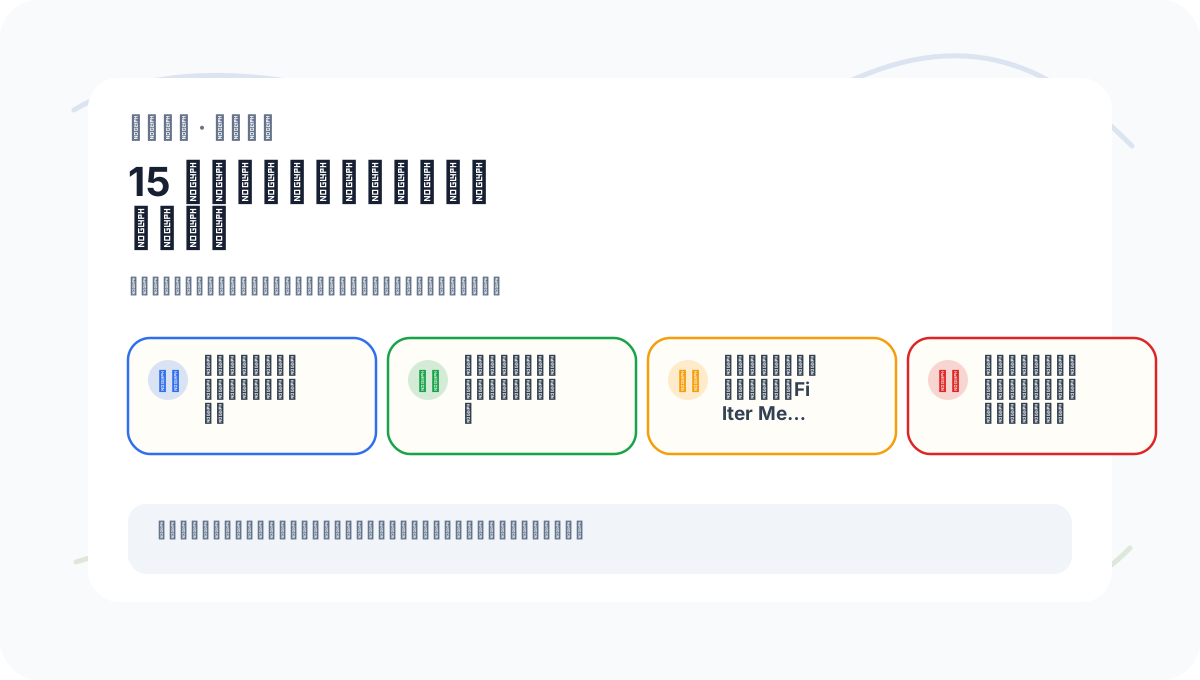
If you haven’t fully internalized “Automated Feature Engineering: Feature Selection”, revisit this card and walk through its four actionable steps.
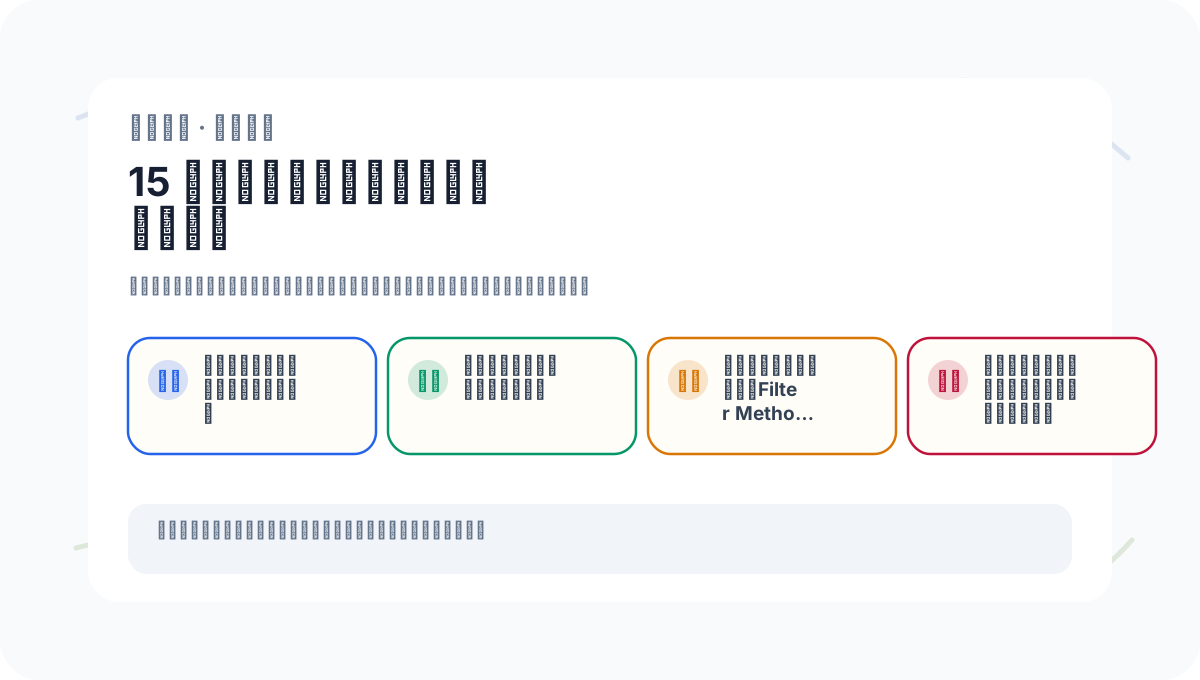
When reviewing “Automated Feature Engineering: Feature Selection”, avoid jumping straight into large-scale projects. Instead, start with a simple, minimal example to confirm your understanding of the core workflow.
Summary
In this tutorial, we introduced feature selection—a foundational component of automated feature engineering—covering filter, wrapper, and embedded methods along with practical implementations. Applying appropriate feature selection techniques helps improve model performance while reducing complexity and computational cost. In the next tutorial, we’ll explore automated feature generation and transformation—so stay tuned for the next challenge!
Apply This Lesson
Turn this article into AI software, model, API, and security decisions.
English Article FAQ
Use this article as evidence before choosing AI tools
How should I use this AI Tutorials article?
Use it as the implementation or learning layer, then connect the idea to AI software buyer guides, tool comparisons, benchmarks, API choices, and security checks before making a production decision.
Is this English article different from the Chinese original?
The English edition is localized for global AI readers while preserving the original diagrams, screenshots, prompts, code examples, and source context from the Chinese article.
What should I read after Load data?
Continue with AI Software Buyer Guides, AI Tools Workbench, Best AI Coding Agents, AI Model Benchmarks, OpenAI vs Anthropic API, or LLM Security Tools depending on the decision you need to make.
Can this article alone choose an AI product or model?
No. Treat the article as evidence and context, then validate fit with pricing, privacy requirements, integration effort, benchmark results, workflow tests, and fallback planning.
Continue