English translation
Automating Feature Engineering: Generation and Transformation
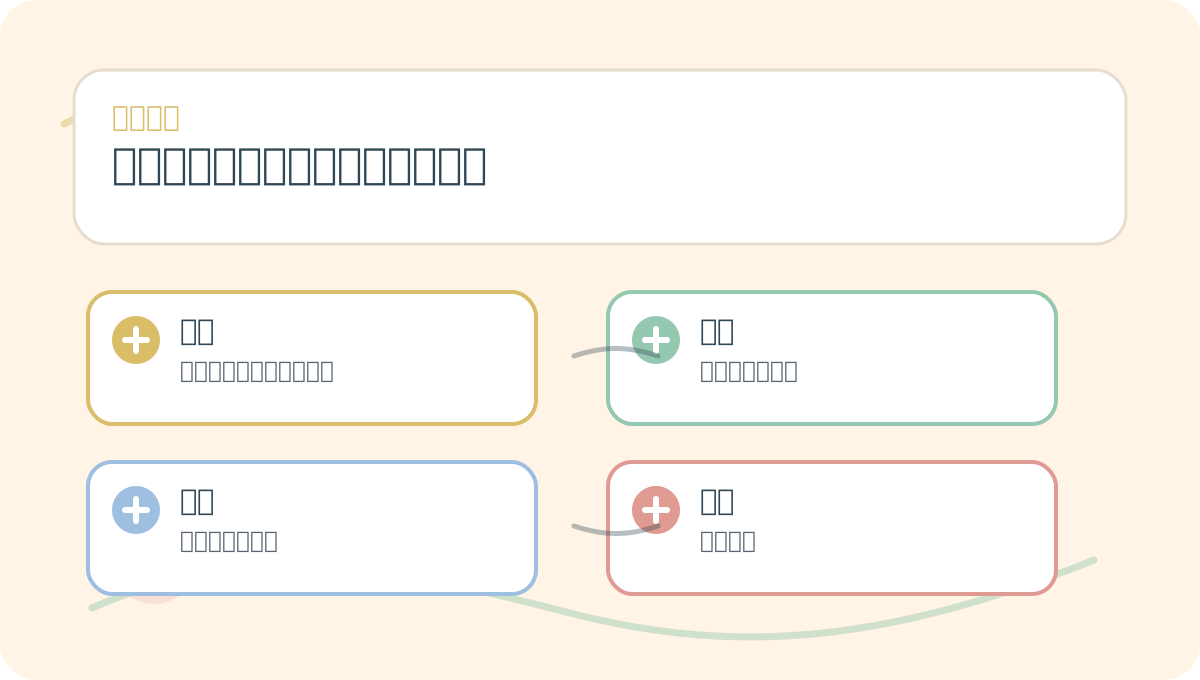
AI Article Decision Snapshot
Turn the lesson into workflow, model, budget, and security checks before choosing tools.
Use this quick snapshot before leaving the article. It keeps the next search tied to practical AI software, model/API, cost, privacy, and implementation questions.
Workflow fit
Identify the real job behind the article: coding, research, document review, support, analytics, content, or internal automation.
Model or tool decision
Decide whether the next step is a software shortlist, an AI tool comparison, an API platform choice, or a model benchmark.
Budget and usage signal
Estimate seats, API calls, prompt volume, retries, review time, and fallback work before assuming the workflow is cheap.
Security and privacy review
Check whether source code, customer data, private documents, prompts, logs, or embeddings will enter the AI workflow.

Automated feature generation expands the search space—but also increases the risk of overfitting and computational cost. The more features you generate, the more critical rigorous validation becomes.

I document the origin of every newly generated feature and verify whether it can be computed in real time when deployed to production.
In the previous article, we explored techniques for feature selection—methods to identify features most relevant to model performance. In this article, we dive into feature generation and transformation, a pivotal step in feature engineering. Thoughtfully designed feature generation and transformation can significantly boost model performance, enabling machine learning algorithms to more effectively uncover latent patterns in the data.
What Are Feature Generation and Transformation?
Feature generation refers to creating new features from raw data—features that help models better capture underlying data structure. Feature transformation, by contrast, involves modifying existing features—either to improve model performance or to meet algorithm-specific requirements.

When performing automated feature generation and transformation, first assess: field semantics, temporal availability, combination rules, encoding schemes, data leakage risks, and validation-set performance.
Methods of Feature Generation
-
Polynomial Features:
Construct new features using polynomial combinations of existing ones. For example, given features and , we may generate , , and .from sklearn.preprocessing import PolynomialFeatures poly = PolynomialFeatures(degree=2) X_poly = poly.fit_transform(X) -
Interaction (Composite) Features:
Combining two or more features can yield meaningful signals. For instance, in house price prediction, dividing “price” by “number of rooms” yields “price per room”—a potentially informative derived feature.df['price_per_room'] = df['price'] / df['num_rooms'] -
Temporal Features:
For time-series or date-stamped data, extracting components such as year, month, day, or weekday enables modeling of cyclical or seasonal patterns.df['year'] = df['date'].dt.year df['month'] = df['date'].dt.month
Methods of Feature Transformation
-
Standardization and Normalization:
Standardization rescales features to zero mean and unit variance—ideal for many ML algorithms (e.g., SVM, linear regression). Normalization scales features to the [0, 1] range.from sklearn.preprocessing import StandardScaler, MinMaxScaler scaler = StandardScaler() X_standardized = scaler.fit_transform(X) min_max_scaler = MinMaxScaler() X_normalized = min_max_scaler.fit_transform(X) -
Logarithmic Transformation:
For right-skewed (positively skewed) features, applying a log transform (e.g., ) often improves normality—benefiting algorithms sensitive to distribution shape.df['log_feature'] = np.log(df['original_feature'] + 1) -
Encoding Categorical Features:
Categorical variables must be converted into numeric representations. Common approaches include one-hot encoding (for low- to medium-cardinality features) and label encoding (with caution—only when ordinal meaning exists).df = pd.get_dummies(df, columns=['categorical_feature'], drop_first=True)
Case Study
Suppose we’re building a house price prediction model, with features including area, number of rooms, and housing type.
First, generate a new feature: price per square foot:
df['price_per_sqft'] = df['price'] / df['area']
Next, apply logarithmic transformation to stabilize the price distribution:
df['log_price'] = np.log(df['price'] + 1)
Finally, encode the categorical feature housing_type using one-hot encoding:
df = pd.get_dummies(df, columns=['housing_type'], drop_first=True)
After these steps, the resulting feature matrix is better suited for model training.

Having read this article, consolidate “Feature Engineering Automation: Feature Generation and Transformation” into a retrospective checklist: clarify the core workflow first, then validate it on a small task.

After reading “Feature Engineering Automation: Feature Generation and Transformation”, start by walking through the full pipeline on a small, concrete example—then assess which steps you can already execute independently.
Summary
Feature generation and transformation are essential components of feature engineering. Selecting appropriate generation and transformation strategies can substantially enhance model performance. In the next article, we’ll explore tools and frameworks for automating feature engineering—further streamlining the end-to-end machine learning workflow.
You don’t need to absorb every detail of “Feature Engineering Automation: Feature Generation and Transformation” all at once. Start with a small, actionable problem you can implement and validate—then use the diagrams and narrative to fill in conceptual gaps.
Apply This Lesson
Turn this article into AI software, model, API, and security decisions.
English Article FAQ
Use this article as evidence before choosing AI tools
How should I use this AI Tutorials article?
Use it as the implementation or learning layer, then connect the idea to AI software buyer guides, tool comparisons, benchmarks, API choices, and security checks before making a production decision.
Is this English article different from the Chinese original?
The English edition is localized for global AI readers while preserving the original diagrams, screenshots, prompts, code examples, and source context from the Chinese article.
What should I read after Automating Feature Engineering: Generation and Transformation?
Continue with AI Software Buyer Guides, AI Tools Workbench, Best AI Coding Agents, AI Model Benchmarks, OpenAI vs Anthropic API, or LLM Security Tools depending on the decision you need to make.
Can this article alone choose an AI product or model?
No. Treat the article as evidence and context, then validate fit with pricing, privacy requirements, integration effort, benchmark results, workflow tests, and fallback planning.
Continue