English translation
Build an image classification model
AI Article Decision Snapshot
Turn the lesson into workflow, model, budget, and security checks before choosing tools.
Use this quick snapshot before leaving the article. It keeps the next search tied to practical AI software, model/API, cost, privacy, and implementation questions.
Workflow fit
Identify the real job behind the article: coding, research, document review, support, analytics, content, or internal automation.
Model or tool decision
Decide whether the next step is a software shortlist, an AI tool comparison, an API platform choice, or a model benchmark.
Budget and usage signal
Estimate seats, API calls, prompt volume, retries, review time, and fallback work before assuming the workflow is cheap.
Security and privacy review
Check whether source code, customer data, private documents, prompts, logs, or embeddings will enter the AI workflow.

AutoML is the automated search over the entire machine learning pipeline—not merely automatic tuning of a single parameter. It typically encompasses data preprocessing, model selection, hyperparameter optimization, and ensemble construction.

I always ask: Which stages does this tool actually automate? Simply labeling something “AutoML” is insufficient—you must explicitly identify whether automation applies to data handling, feature engineering, model selection, hyperparameter tuning, or deployment.
In today’s machine learning landscape, data scientists and developers face complex modeling workflows and labor-intensive parameter-tuning tasks. To address these challenges, Automated Machine Learning (AutoML) emerged. This article delves into the definition and significance of AutoML—laying the conceptual groundwork for the next section, which explores its core components.
What Is AutoML?
Automated Machine Learning (AutoML) is a field integrating diverse techniques and methodologies aimed at automating the end-to-end machine learning workflow. It spans data preprocessing, feature engineering, model selection, and hyperparameter optimization. Put simply, AutoML empowers users—even those without deep machine learning expertise—to build high-performing models efficiently. This capability delivers practical value across numerous domains, including healthcare, financial analytics, and marketing.
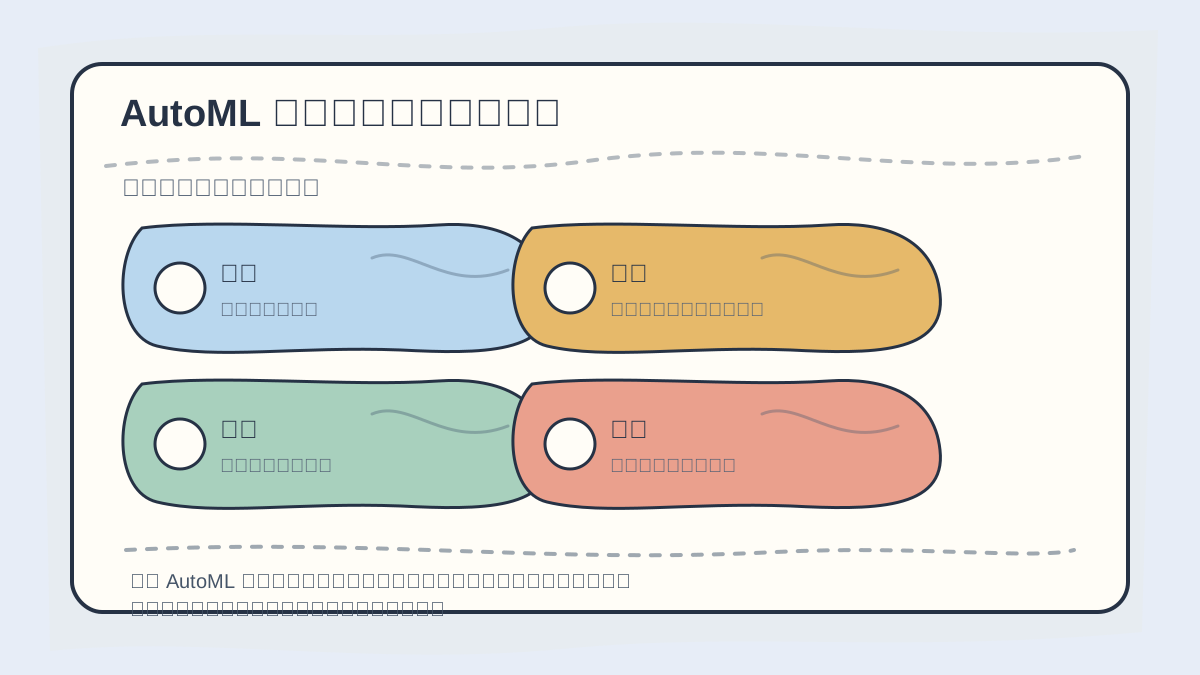
When interpreting the definition of AutoML, first clarify what exactly is being automated: features, models, hyperparameters, evaluation, or deployment. Business objectives and data boundaries still require human definition.
Core Principles of AutoML
The foundational ideas behind AutoML can be summarized as follows:
- Simplifying the Modeling Workflow: By leveraging automation tools, users avoid manually executing intricate ML tasks—reducing both time and cost.
- Enhancing Model Performance: Through automated hyperparameter tuning and model selection, AutoML identifies superior models, achieving higher predictive accuracy.
- Supporting Diverse Users: Whether data scientists or domain experts with limited ML experience, AutoML provides accessible, practical access to machine learning capabilities.
Historical Context of AutoML
AutoML originated from efforts to lower barriers to data science and manage the growing complexity of ML models. As early as the 2000s, researchers began exploring ways to automate individual steps in the ML modeling process. With the rapid advancement of big data technologies and increasing computational power, AutoML evolved into a major research area. Today, leading technology companies and academic institutions have developed and deployed AutoML platforms and tools to meet surging market demand.
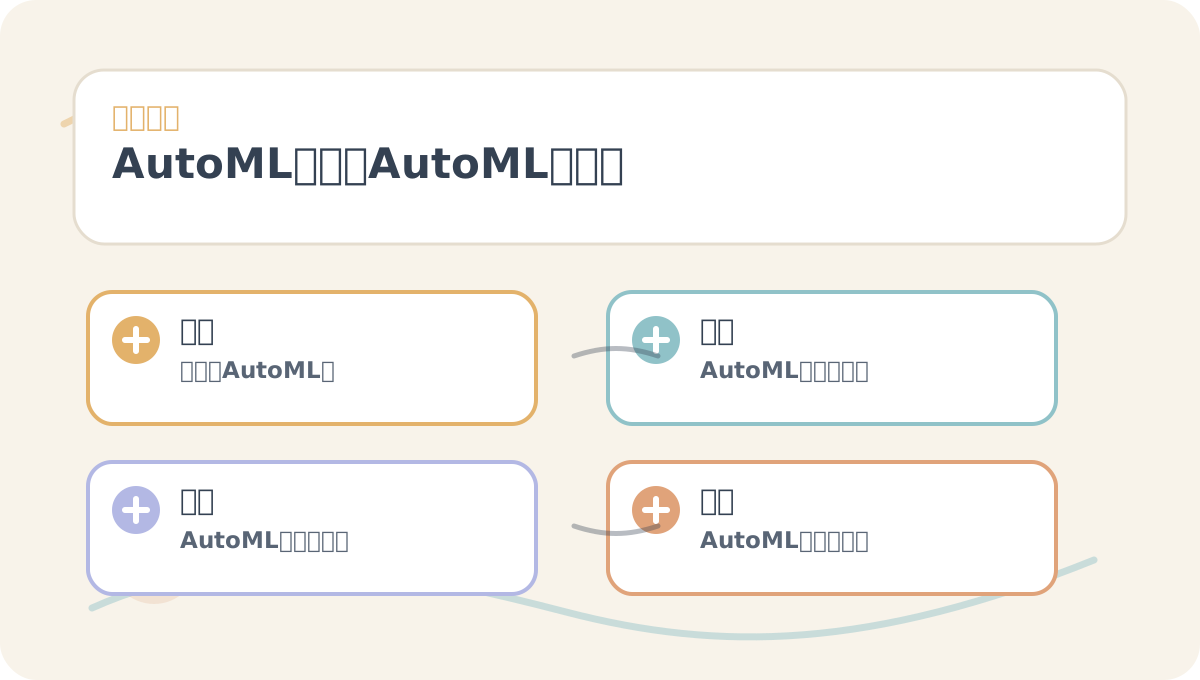
While reading “AutoML Overview: Defining AutoML”, treat each accompanying illustration as a roadmap: First grasp the overall sequence; then examine why each step is performed; finally, verify boundary conditions.
Real-World AutoML Use Cases
Case 1: Medical Image Analysis
In medical imaging, clinicians must interpret vast volumes of image data—a time-consuming and cognitively demanding process. With AutoML, healthcare institutions can rapidly develop diagnostic models. For instance, medical researchers can use AutoML tools to automatically extract discriminative features from thousands of images and select the optimal model—significantly improving both diagnostic accuracy and speed.
Below is a simple code example using AutoKeras, a popular AutoML library, for image classification:
import autokeras as ak

# Build an image classification model
model = ak.ImageClassifier(overwrite=True, max_trials=5)

# Train the model
model.fit(x_train, y_train, epochs=10)

# Evaluate the model
accuracy = model.evaluate(x_test, y_test)
print(f"Model accuracy: {accuracy}")
Case 2: Financial Fraud Detection
In finance, detecting fraudulent transactions is mission-critical. AutoML enables financial institutions to automatically construct fraud-detection models by analyzing historical transaction data and identifying anomalous behavioral patterns. This not only accelerates detection but also reduces reliance on manual labor.
If you haven’t fully internalized “AutoML Overview: Defining AutoML”, revisit this card and walk through its four actions step-by-step.
When reviewing “AutoML Overview: Defining AutoML”, don’t jump straight into large-scale projects. Instead, start with one simple example to confirm whether the core narrative is clear.
Summary
By introducing Automated Machine Learning, users gain a more efficient, scalable approach to model development and optimization. AutoML addresses diverse real-world needs by automating tedious, repetitive tasks—making machine learning more accessible and usable than ever before. In the next article, we will explore AutoML’s key components in depth and examine how they integrate to achieve full automation.
Apply This Lesson
Turn this article into AI software, model, API, and security decisions.
English Article FAQ
Use this article as evidence before choosing AI tools
How should I use this AI Tutorials article?
Use it as the implementation or learning layer, then connect the idea to AI software buyer guides, tool comparisons, benchmarks, API choices, and security checks before making a production decision.
Is this English article different from the Chinese original?
The English edition is localized for global AI readers while preserving the original diagrams, screenshots, prompts, code examples, and source context from the Chinese article.
What should I read after Build an image classification model?
Continue with AI Software Buyer Guides, AI Tools Workbench, Best AI Coding Agents, AI Model Benchmarks, OpenAI vs Anthropic API, or LLM Security Tools depending on the decision you need to make.
Can this article alone choose an AI product or model?
No. Treat the article as evidence and context, then validate fit with pricing, privacy requirements, integration effort, benchmark results, workflow tests, and fallback planning.
Continue