English translation
Cross-validation to select top-performing models
AI Article Decision Snapshot
Turn the lesson into workflow, model, budget, and security checks before choosing tools.
Use this quick snapshot before leaving the article. It keeps the next search tied to practical AI software, model/API, cost, privacy, and implementation questions.
Workflow fit
Identify the real job behind the article: coding, research, document review, support, analytics, content, or internal automation.
Model or tool decision
Decide whether the next step is a software shortlist, an AI tool comparison, an API platform choice, or a model benchmark.
Budget and usage signal
Estimate seats, API calls, prompt volume, retries, review time, and fallback work before assuming the workflow is cheap.
Security and privacy review
Check whether source code, customer data, private documents, prompts, logs, or embeddings will enter the AI workflow.

AutoML isn’t just about chasing the highest metric scores. Training time, inference latency, model size, and maintenance cost must all be considered together.

I’ll present both the best scores and resource consumption in a single table. Relying solely on score metrics risks selecting models that cannot be deployed in production.
In the previous article, we explored how to leverage AutoML to perform model ensembling—thereby improving predictive performance and generalization capability. We learned that ensembling combines strengths across multiple models, reduces overfitting, and enhances adaptability to unseen data. However, as ensembling techniques mature, we must also confront a critical practical challenge: how to balance efficiency and effectiveness in real-world deployment. In this article, we delve into this trade-off—and illustrate it with concrete examples.
Balancing Efficiency and Effectiveness
Efficiency

While reading this article, treat “Balancing Efficiency and Effectiveness → Efficiency → Effectiveness → Strategies for Automated Ensembling” as a verification checklist: first clarify the core theme, logical pathway, and validation points; then revisit the case studies, code snippets, or metrics to verify each step.
In machine learning projects, efficiency typically encompasses the following dimensions:
- Training Time: Training multiple models in an ensemble demands significantly more time—especially with large datasets or highly complex models.
- Computational Resource Consumption: Ensemble training and inference require more memory and compute power, potentially leading to resource waste.
- Model Selection & Tuning Time: Selecting appropriate base models and tuning their hyperparameters is iterative and time-consuming.
Effectiveness
Conversely, effectiveness refers to predictive accuracy and generalization capability:
- Predictive Performance: Final model quality is commonly evaluated on test-set metrics such as
Accuracy,F1 Score, orAUC. - Robustness: Enhanced consistency and stability across diverse datasets—improving resilience against noise and data distribution shifts.
In practice, designing an effective ensembling strategy requires deliberate trade-offs between these two dimensions. Adding more models may improve effectiveness—but at the cost of efficiency. Conversely, restricting model count improves efficiency but may compromise predictive performance.
Strategies for Automated Ensembling
Within AutoML frameworks, several strategies help strike a pragmatic balance between efficiency and effectiveness:
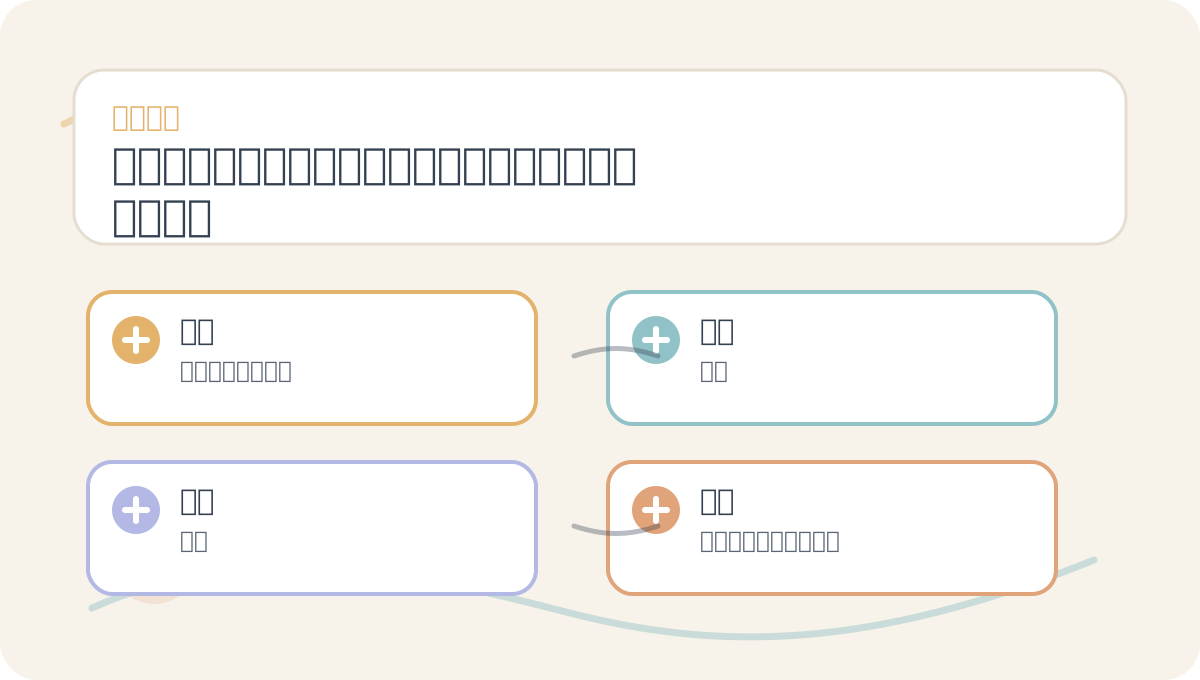
Before reading “Balancing Efficiency and Effectiveness in AutoML Model Ensembling and Automation”, use the accompanying diagram to confirm the article’s central narrative. After reading, revisit the map to identify which steps are immediately actionable—and which require supplemental study.
1. Intelligent Model Selection
During ensembling, adopt intelligent model selection—for example, using cross-validation to evaluate candidate models and retain only top performers. A performance threshold can be set to exclude underperforming models early, reducing training time and resource usage.
from sklearn.model_selection import cross_val_score
from sklearn.ensemble import RandomForestClassifier, GradientBoostingClassifier

models = {
    'RandomForest': RandomForestClassifier(),
    'GradientBoosting': GradientBoostingClassifier()
}

# Cross-validation to select top-performing models
best_models = {}
for name, model in models.items():
    scores = cross_val_score(model, X_train, y_train, cv=5)
    if scores.mean() > 0.8:  # Assume performance threshold = 0.8
        best_models[name] = model
2. Model Simplification
High-performing models need not be complex. Start with lightweight models, then apply techniques like model compression or knowledge distillation to transfer knowledge from high-performing (but costly) models into simpler, faster ones—achieving a favorable trade-off between performance and efficiency.
3. Adaptive Ensembling
Adaptive ensembling dynamically adjusts model composition or weighting based on data stream characteristics. For instance, during training, weights assigned to individual models can be updated in real time based on their recent prediction accuracy—reducing influence from low-performing models.
import numpy as np

def adaptive_weighted_average(predictions, confidences):
    weights = confidences / np.sum(confidences)
    return np.dot(weights, predictions)

# Example: predictions and confidence scores from three models
predictions = np.array([0.6, 0.8, 0.7])
confidences = np.array([0.9, 0.95, 0.85])
final_prediction = adaptive_weighted_average(predictions, confidences)
Case Study
Consider a house price prediction project. First, we train several baseline models—e.g., linear regression, decision trees, and XGBoost—then apply AutoML to automatically conduct cross-validated model selection and retain only the top performers.
After holistic evaluation, XGBoost emerges as the strongest performer (R² = 0.85)—but its training time is prohibitively long. To improve efficiency, we introduce Random Forest as a complementary base model and construct a stacked ensemble.
In this stack, we first train both XGBoost and Random Forest; then feed their predictions as input features into a simple linear regression meta-model for final prediction. This approach synergistically leverages both models’ strengths while mitigating overfitting risk.

If you haven’t fully internalized “Balancing Efficiency and Effectiveness in AutoML Model Ensembling and Automation”, walk through the four actions on this card to reinforce understanding.

When reviewing “Balancing Efficiency and Effectiveness in AutoML Model Ensembling and Automation”, avoid jumping straight into large-scale projects. Instead, start with one simple example to verify whether the core narrative is clear and actionable.
Summary
In AutoML applications, balancing efficiency and effectiveness is indispensable. Techniques—including intelligent model selection, model simplification, and adaptive ensembling—enable us to preserve strong predictive performance while substantially improving training and inference efficiency. In the next article, we’ll deepen this discussion by walking through a full end-to-end case study on real-world data—demonstrating precisely how this balance is achieved in practice.
Apply This Lesson
Turn this article into AI software, model, API, and security decisions.
English Article FAQ
Use this article as evidence before choosing AI tools
How should I use this AI Tutorials article?
Use it as the implementation or learning layer, then connect the idea to AI software buyer guides, tool comparisons, benchmarks, API choices, and security checks before making a production decision.
Is this English article different from the Chinese original?
The English edition is localized for global AI readers while preserving the original diagrams, screenshots, prompts, code examples, and source context from the Chinese article.
What should I read after Cross-validation to select top-performing models?
Continue with AI Software Buyer Guides, AI Tools Workbench, Best AI Coding Agents, AI Model Benchmarks, OpenAI vs Anthropic API, or LLM Security Tools depending on the decision you need to make.
Can this article alone choose an AI product or model?
No. Treat the article as evidence and context, then validate fit with pricing, privacy requirements, integration effort, benchmark results, workflow tests, and fallback planning.
Continue