English translation
Generate synthetic dataset
AI Article Decision Snapshot
Turn the lesson into workflow, model, budget, and security checks before choosing tools.
Use this quick snapshot before leaving the article. It keeps the next search tied to practical AI software, model/API, cost, privacy, and implementation questions.
Workflow fit
Identify the real job behind the article: coding, research, document review, support, analytics, content, or internal automation.
Model or tool decision
Decide whether the next step is a software shortlist, an AI tool comparison, an API platform choice, or a model benchmark.
Budget and usage signal
Estimate seats, API calls, prompt volume, retries, review time, and fallback work before assuming the workflow is cheap.
Security and privacy review
Check whether source code, customer data, private documents, prompts, logs, or embeddings will enter the AI workflow.

AutoML is already highly practical for tabular tasks and routine modeling—but expert involvement remains essential in complex business scenarios, settings with strict constraints, and use cases demanding model interpretability.

I distinguish between “demo-ready” and “production-ready.” Tool maturity must be evaluated across monitoring, rollback capability, explainability, and access control.
In the previous article, we examined lessons learned from real-world case studies, illustrating how to apply AutoML effectively in production environments. This article delves deeper into the current state of AutoML—focusing on technological evolution, application domains, and persistent challenges.
Current Technological Evolution
AutoML emerged to simplify the machine learning workflow, enabling non-experts to leverage ML tools effectively. As the field has matured, modern AutoML systems have evolved far beyond early-stage model selection and hyperparameter tuning—toward more sophisticated, intelligent architectures.
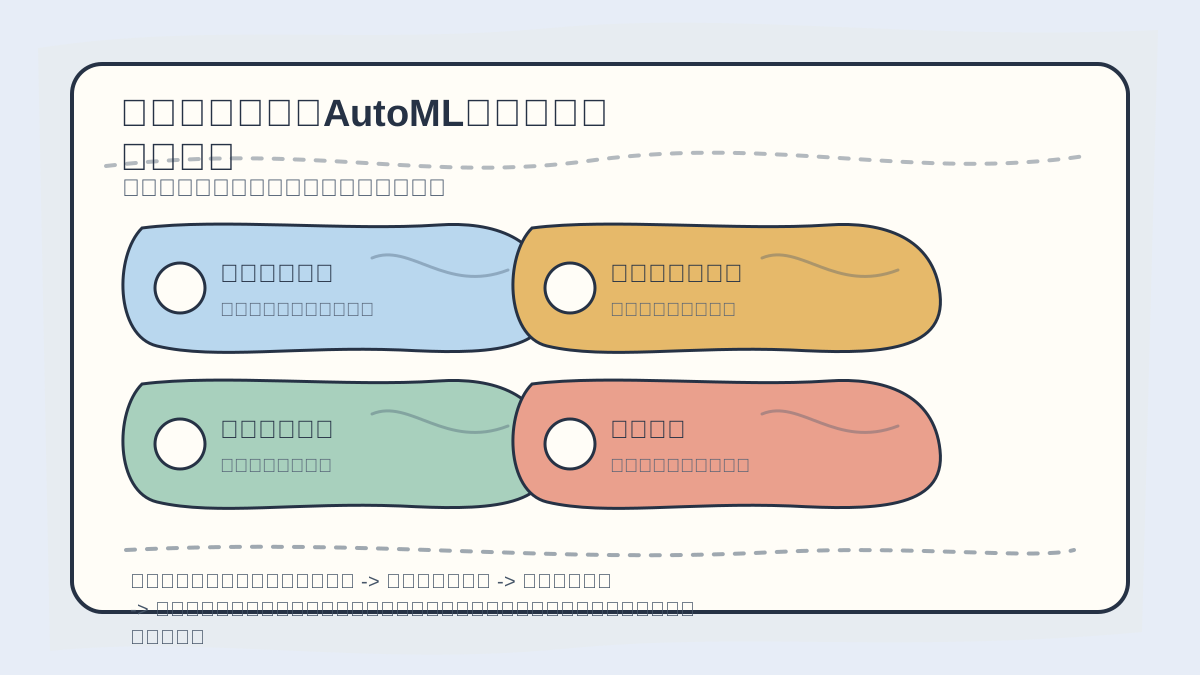
While reading this article, treat the progression “Current Technological Evolution → Model Selection & Tuning → Advanced Feature Engineering → Application Domains” as a diagnostic checklist: first examine the object, path, and evidence; then revisit concrete case studies, code, or metrics to verify understanding.
Model Selection and Hyperparameter Tuning
Since the 2010s, model ensembling has become widely adopted in AutoML. For instance, hybrid models combine strengths from multiple base models to improve prediction accuracy. Ensemble methods allow users to simultaneously harness algorithms such as decision trees and support vector machines—aggregating predictions via weighted averaging or voting mechanisms to boost overall performance.
from sklearn.ensemble import VotingClassifier
from sklearn.tree import DecisionTreeClassifier
from sklearn.svm import SVC
from sklearn.datasets import make_classification
from sklearn.model_selection import train_test_split

# Generate synthetic dataset
X, y = make_classification(n_samples=100, n_features=20)
X_train, X_test, y_train, y_test = train_test_split(X, y, test_size=0.3)

# Instantiate base models
clf1 = DecisionTreeClassifier()
clf2 = SVC(probability=True)

# Build soft-voting ensemble classifier
voting_clf = VotingClassifier(estimators=[('dt', clf1), ('svc', clf2)], voting='soft')
voting_clf.fit(X_train, y_train)
Advanced Feature Engineering
Contemporary AutoML tools place increasing emphasis on automating feature engineering. Modern frameworks routinely automate feature extraction, feature selection, and feature transformation—optimizing data preprocessing to enhance downstream model performance. For example, TPOT employs genetic programming to discover optimal feature combinations and pipeline structures.
from tpot import TPOTClassifier
from sklearn.datasets import make_classification
from sklearn.model_selection import train_test_split

# Generate synthetic dataset
X, y = make_classification(n_samples=100, n_features=20)
X_train, X_test, y_train, y_test = train_test_split(X, y, test_size=0.3)

# Launch TPOT for automated model and pipeline search
tpot = TPOTClassifier(verbosity=2, generations=5, population_size=20)
tpot.fit(X_train, y_train)
Application Domains
AutoML adoption is accelerating—and demonstrating substantial potential across several key domains:
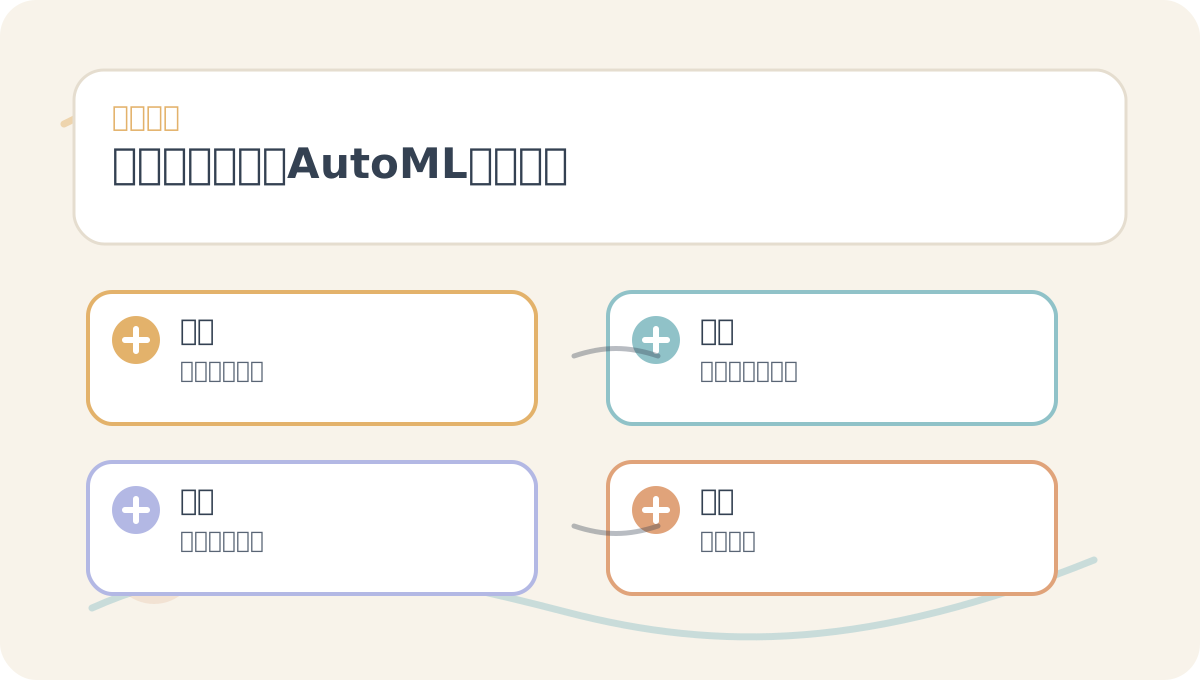
Before reading “The Current State of AutoML,” preview the problem-to-outcome pathway illustrated in this diagram. After reading, cross-check against the main text to confirm whether you can reproduce the core workflow.
-
Healthcare: AutoML enables data scientists to rapidly process electronic health record (EHR) data for disease prediction and diagnosis. For example, AutoML-powered patient screening improves detection rates for conditions like diabetes or cardiovascular disease.
-
Financial Services: In risk management and credit scoring, AutoML is widely used for model development and validation—strengthening decision-making while reducing manual effort.
-
Marketing: AutoML analyzes customer behavioral data to predict churn and generate personalized recommendations—enhancing user experience and driving revenue growth.
Key Challenges
Despite rapid progress, AutoML still faces significant hurdles:
-
Model Interpretability: Many auto-generated models—especially deep learning models—are treated as “black boxes.” Enhancing interpretability so that non-specialists can understand and trust model predictions remains an urgent open problem.
-
Data Quality and Bias: AutoML systems rely heavily on large volumes of high-quality training data. Biased or low-fidelity input data can severely degrade model performance and fairness.
-
Computational Resources: State-of-the-art AutoML tools often demand substantial compute resources—posing accessibility challenges for small organizations with limited infrastructure.
If you haven’t fully internalized “The Current State of AutoML,” use this card’s four-step action sequence to revisit and reinforce core concepts.
When reviewing “The Current State of AutoML,” avoid launching large-scale projects upfront. Instead, start with a single, simple example to validate whether the central narrative and workflow are clear.
Summary
Today’s AutoML landscape reflects steady advancement—encompassing richer model selection strategies, increasingly sophisticated automated feature engineering, and broader application scope. Yet critical challenges persist. In our next article on future directions, we will explore promising frontiers—including enhanced interpretability, heightened attention to data quality, and tighter integration with complementary technologies.
Apply This Lesson
Turn this article into AI software, model, API, and security decisions.
English Article FAQ
Use this article as evidence before choosing AI tools
How should I use this AI Tutorials article?
Use it as the implementation or learning layer, then connect the idea to AI software buyer guides, tool comparisons, benchmarks, API choices, and security checks before making a production decision.
Is this English article different from the Chinese original?
The English edition is localized for global AI readers while preserving the original diagrams, screenshots, prompts, code examples, and source context from the Chinese article.
What should I read after Generate synthetic dataset?
Continue with AI Software Buyer Guides, AI Tools Workbench, Best AI Coding Agents, AI Model Benchmarks, OpenAI vs Anthropic API, or LLM Security Tools depending on the decision you need to make.
Can this article alone choose an AI product or model?
No. Treat the article as evidence and context, then validate fit with pricing, privacy requirements, integration effort, benchmark results, workflow tests, and fallback planning.
Continue