English translation
Load data
AI Article Decision Snapshot
Turn the lesson into workflow, model, budget, and security checks before choosing tools.
Use this quick snapshot before leaving the article. It keeps the next search tied to practical AI software, model/API, cost, privacy, and implementation questions.
Workflow fit
Identify the real job behind the article: coding, research, document review, support, analytics, content, or internal automation.
Model or tool decision
Decide whether the next step is a software shortlist, an AI tool comparison, an API platform choice, or a model benchmark.
Budget and usage signal
Estimate seats, API calls, prompt volume, retries, review time, and fallback work before assuming the workflow is cheap.
Security and privacy review
Check whether source code, customer data, private documents, prompts, logs, or embeddings will enter the AI workflow.

AutoML is not immune to dirty data. Poor data preparation only accelerates the discovery of spurious patterns.

I begin with a data health check: field semantics, missing-value ratios, label provenance, and temporal leakage between training and test sets.
In the previous article, we explored an overview of Automated Machine Learning (AutoML), along with its advantages and challenges. Now, we delve into a critical phase of the AutoML workflow—data preparation. This stage forms the foundation for successful AutoML implementation, as high-quality data significantly enhances model performance and predictive capability.
The Importance of Data Preparation
In machine learning, data determines everything. For AutoML, the data preparation phase influences not only model training but also final outcomes. Constructing an effective dataset requires attention to several key aspects:
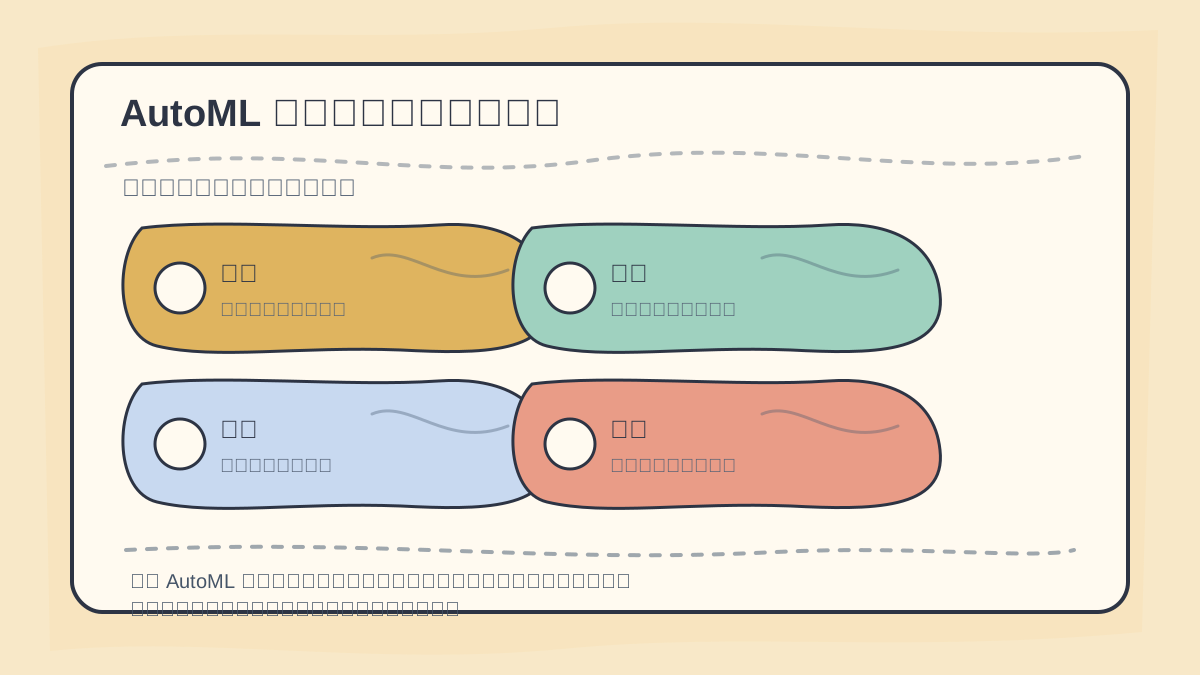
Before entering the AutoML pipeline, verify data provenance, field semantics, label quality, train/validation split strategy, and outlier handling. Data preparation cannot be fully delegated to tools.
- Data Quality: Data must be accurate, complete, and minimally noisy.
- Data Types: Understand feature types—e.g., continuous, discrete—since they directly affect downstream feature engineering steps.
- Target Variable: Clearly define the variable to be predicted and ensure its meaningful relationship with input features.
Core Steps in Data Preparation
Data preparation typically comprises the following essential steps:
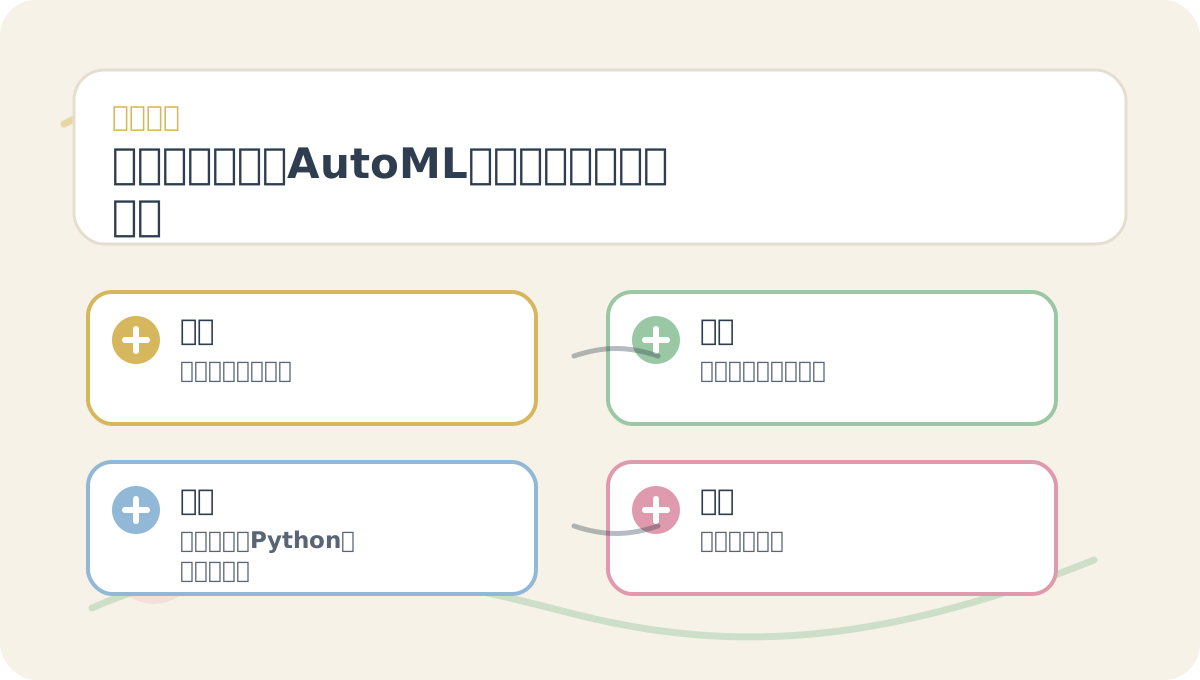
Before diving into the main text of “6. Data Preparation in the AutoML Workflow”, quickly scan the accompanying visuals: What question does each diagram pose? Which concepts need clear distinction? Which step warrants hands-on experimentation? And finally—by what criteria should the outcome be validated?
- Data Collection: Gather data from diverse sources—CSV files, databases, APIs, etc.
- Data Cleaning: Address missing values, duplicates, and outliers—key factors that degrade model performance.
- Data Transformation: Convert data into formats suitable for model training—including type conversion and standardization/normalization.
- Feature Selection & Engineering: Identify predictive features and, when necessary, construct new ones.
- Data Splitting: Partition the dataset into training, validation, and test sets.
Example: Data Preparation in Python
Below, we demonstrate a simple end-to-end data preparation workflow in Python using a hypothetical housing price dataset.
1. Data Loading
import pandas as pd

# Load data
data = pd.read_csv('house_prices.csv')
print(data.head())
2. Data Cleaning
Here, we handle missing values and duplicate records.
# Fill missing values forward (using previous non-null value)
data.fillna(method='ffill', inplace=True)

# Remove duplicate rows
data.drop_duplicates(inplace=True)

# Verify data quality
print(data.isnull().sum())  # Confirm no remaining missing values
3. Data Transformation
Standardize numeric features to improve model convergence and stability.
from sklearn.preprocessing import StandardScaler

# Standardize the 'Square_Feet' feature
scaler = StandardScaler()
data['Square_Feet'] = scaler.fit_transform(data[['Square_Feet']])
4. Feature Selection & Engineering
Select relevant predictors and define the target variable.
# Define features and target
features = data[['Square_Feet', 'Bedrooms', 'Age']]
target = data['Price']
5. Data Splitting
Partition data into train and test subsets.
from sklearn.model_selection import train_test_split

X_train, X_test, y_train, y_test = train_test_split(
    features, target, test_size=0.2, random_state=42
)
Tools for Data Preparation
Selecting appropriate tools is vital for efficient data preparation within the AutoML workflow. Below are several widely adopted Python libraries:
- Pandas: The go-to library for data manipulation and analysis.
- NumPy: Provides powerful support for multi-dimensional arrays and numerical operations.
- Scikit-learn: Offers robust utilities for preprocessing, scaling, encoding, and feature selection.
- Dask: Enables scalable, parallelized processing of large datasets—designed to integrate seamlessly with Pandas.
After studying “6. Data Preparation in the AutoML Workflow”, try applying it to your own use case. Focus especially on whether inputs, transformations, and outputs align coherently.
To adapt “6. Data Preparation in the AutoML Workflow” to your specific task, start small: isolate and rigorously validate just one critical decision point.
Conclusion
In the AutoML workflow, the quality of data preparation directly dictates overall model performance. In this article, we clarified why rigorous data preparation matters, outlined its core steps, and illustrated practical implementation using Python code. Ensuring data completeness, consistency, and fidelity remains the most decisive factor in unlocking AutoML’s full potential.
In the next article, we will explore the model training phase—covering how to effectively train models and tune hyperparameters within AutoML environments. Stay tuned.
Apply This Lesson
Turn this article into AI software, model, API, and security decisions.
English Article FAQ
Use this article as evidence before choosing AI tools
How should I use this AI Tutorials article?
Use it as the implementation or learning layer, then connect the idea to AI software buyer guides, tool comparisons, benchmarks, API choices, and security checks before making a production decision.
Is this English article different from the Chinese original?
The English edition is localized for global AI readers while preserving the original diagrams, screenshots, prompts, code examples, and source context from the Chinese article.
What should I read after Load data?
Continue with AI Software Buyer Guides, AI Tools Workbench, Best AI Coding Agents, AI Model Benchmarks, OpenAI vs Anthropic API, or LLM Security Tools depending on the decision you need to make.
Can this article alone choose an AI product or model?
No. Treat the article as evidence and context, then validate fit with pricing, privacy requirements, integration effort, benchmark results, workflow tests, and fallback planning.
Continue