English translation
Why Deploy Large Language Models Locally?
AI Article Decision Snapshot
Turn the lesson into workflow, model, budget, and security checks before choosing tools.
Use this quick snapshot before leaving the article. It keeps the next search tied to practical AI software, model/API, cost, privacy, and implementation questions.
Workflow fit
Identify the real job behind the article: coding, research, document review, support, analytics, content, or internal automation.
Model or tool decision
Decide whether the next step is a software shortlist, an AI tool comparison, an API platform choice, or a model benchmark.
Budget and usage signal
Estimate seats, API calls, prompt volume, retries, review time, and fallback work before assuming the workflow is cheap.
Security and privacy review
Check whether source code, customer data, private documents, prompts, logs, or embeddings will enter the AI workflow.
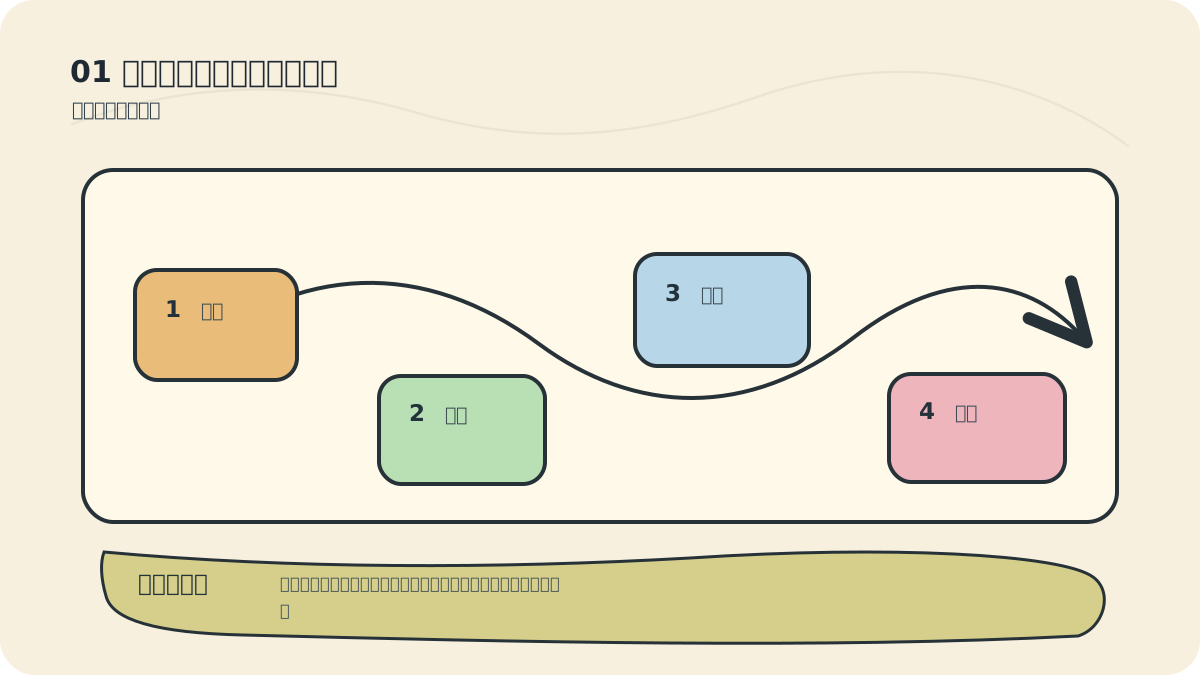
I recommend clarifying why you want to deploy a large language model (LLM) locally before installing one. For individual users, the greatest value isn’t benchmark scores—it’s keeping private documents off the cloud, maintaining functionality even with poor or no internet connectivity, and being able to inspect logs when things go wrong. As soon as you plan to use the model on real files, these practical benefits outweigh chasing “full-performance” models.

Before diving in, ask yourself a quick set of questions: Does your use case involve personal data, corporate documents, offline environments, or iterative trial-and-error? If the answer is yes to any of these, local deployment is worth learning. If you only occasionally ask open-ended questions, an online model may be more convenient. Clarifying your scenario first helps avoid misaligned configuration later. When deploying for the first time, I always start with a small, non-sensitive document—just to verify that the model generates responses, logs are accessible, and failures can be retried—before introducing higher-stakes materials. This approach takes slightly longer but prevents privacy concerns, configuration issues, and debugging challenges from overlapping unnecessarily. Another highly practical use case is learning and debugging: when a local model underperforms, you can swap models, refine prompts, monitor resource usage, and preserve records of every attempt. This hands-on process itself deepens your understanding of LLMs—far beyond what you’d learn from merely interacting with an online chat interface.
Deploying an LLM like DeepSeek locally offers several important advantages:
1 Privacy and Data Security
No data leaves your device: Running the model locally eliminates the need to upload data to remote servers, ensuring sensitive information remains inaccessible to third parties.

When deciding whether to deploy an LLM locally, first list your requirements across four dimensions: privacy constraints, invocation cost, response latency, and maintenance capability. Not every scenario justifies local deployment—but the clearer your constraints, the easier the decision becomes.
2 Customization and Optimization
Fine-tuning support: You can fine-tune the model to align with specific business needs—for example, adapting it to industry-specific terminology or integrating it with internal knowledge bases.
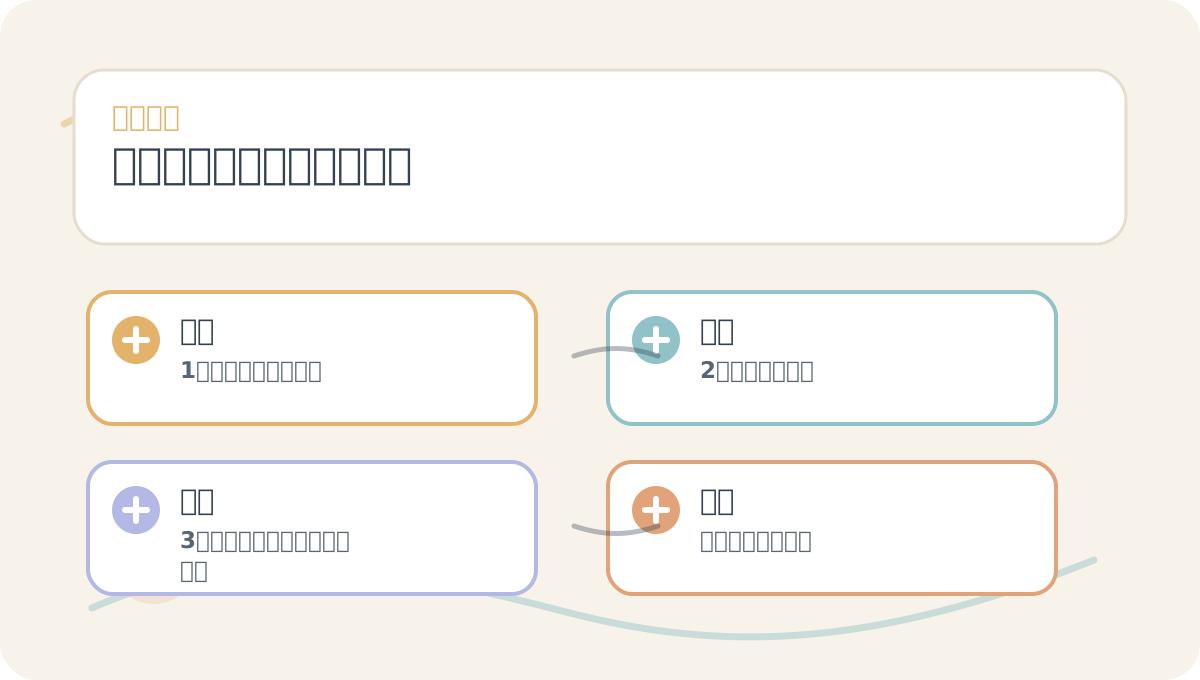
Before reading “Why Deploy Large Language Models Locally?”, use the accompanying visual to orient yourself to the core narrative. After reading, revisit the diagram to identify which steps you can execute immediately—and which ones require supplemental resources.
3 Offline Operation for Network-Constrained Environments
Runs without internet access: Ideal for air-gapped systems or locations with unreliable or restricted connectivity. Improved system resilience: Even if cloud services go down, your local LLM continues operating—unaffected by external outages.
While practicing “Why Deploy Large Language Models Locally?”, write down each input condition, corresponding processing action, and observable outcome together—making future review faster and more reliable.
When reviewing “Why Deploy Large Language Models Locally?”, consolidate key concepts, operational steps, and expected outcomes onto a single page for efficient re-reading.
Practical Benefits of Building DeepSeek Locally (This Tutorial)
Three tangible advantages of setting up DeepSeek locally using this guide:
- This tutorial integrates DeepSeek’s open-source, free-to-use inference model R1, known for its strong performance.
- The setup method described here incurs zero cost—no money required.
- To accommodate the broadest possible audience, the recommended approach minimizes hardware requirements—enabling even ordinary laptops to run DeepSeek smoothly and quickly.
Apply This Lesson
Turn this article into AI software, model, API, and security decisions.
English Article FAQ
Use this article as evidence before choosing AI tools
How should I use this AI Tutorials article?
Use it as the implementation or learning layer, then connect the idea to AI software buyer guides, tool comparisons, benchmarks, API choices, and security checks before making a production decision.
Is this English article different from the Chinese original?
The English edition is localized for global AI readers while preserving the original diagrams, screenshots, prompts, code examples, and source context from the Chinese article.
What should I read after Why Deploy Large Language Models Locally??
Continue with AI Software Buyer Guides, AI Tools Workbench, Best AI Coding Agents, AI Model Benchmarks, OpenAI vs Anthropic API, or LLM Security Tools depending on the decision you need to make.
Can this article alone choose an AI product or model?
No. Treat the article as evidence and context, then validate fit with pricing, privacy requirements, integration effort, benchmark results, workflow tests, and fallback planning.
Continue