English translation
Zero-to-First: Beginner's Learning Path for AI Large Language Models
AI Article Decision Snapshot
Turn the lesson into workflow, model, budget, and security checks before choosing tools.
Use this quick snapshot before leaving the article. It keeps the next search tied to practical AI software, model/API, cost, privacy, and implementation questions.
Workflow fit
Identify the real job behind the article: coding, research, document review, support, analytics, content, or internal automation.
Model or tool decision
Decide whether the next step is a software shortlist, an AI tool comparison, an API platform choice, or a model benchmark.
Budget and usage signal
Estimate seats, API calls, prompt volume, retries, review time, and fallback work before assuming the workflow is cheap.
Security and privacy review
Check whether source code, customer data, private documents, prompts, logs, or embeddings will enter the AI workflow.
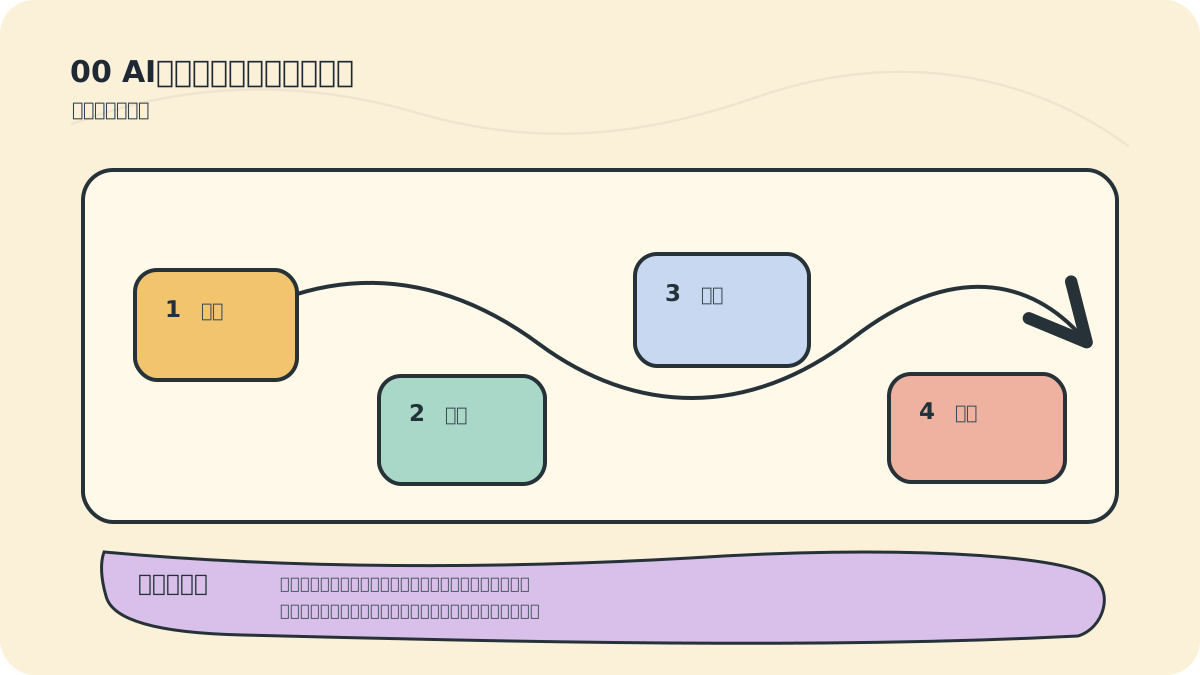
When I revisited this roadmap, the first thing I wanted to add was learning sequence. Many learners jump straight into parameters, leaderboards, and model names—only to get lost in jargon before even getting a local environment up and running. My approach is to start by running a small, locally executable model first—then circle back to learn foundational concepts like Transformers, RAG, and fine-tuning. That way, every concept comes with a concrete, working mental image.
This guide serves best as an index for the full tutorial series. After reading it, write down three things:
- Your computer’s hardware configuration,
- The specific task you most want to solve,
- The amount of time you can realistically commit to learning.
With those clarified, your later decisions—about using Ollama, selecting local models, building knowledge bases, or leveraging remote compute—will be grounded in your context—not just trending tools.
Below is a detailed Zero-Baseline Learning Roadmap for AI Large Models, designed to take you from foundational math and programming all the way through machine learning, deep learning, and finally to core large-model technologies and hands-on projects. The roadmap is structured progressively—balancing theoretical rigor with practical implementation.

1. Foundational Mathematics & Programming
Solid mathematical and programming fundamentals are indispensable for both understanding and implementing large models.
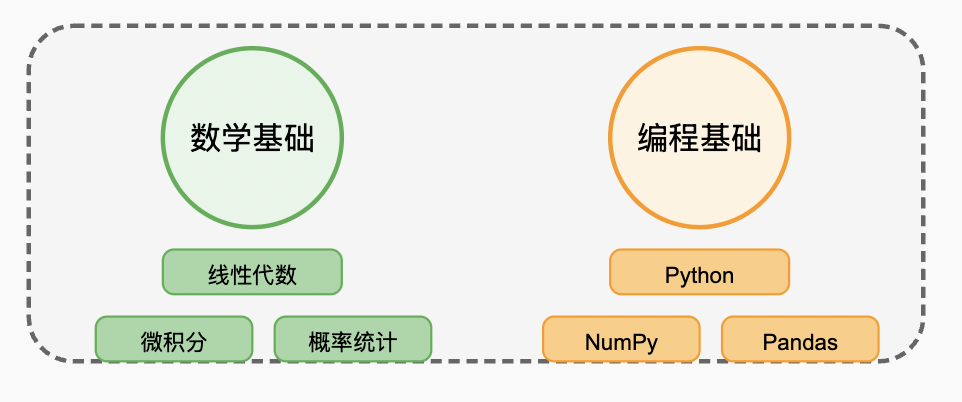
Mathematical Foundations
- Linear Algebra
- Vectors and matrix operations
- Matrix decompositions (eigenvalue decomposition, singular value decomposition)
For a linear algebra primer tailored to AI, see: https://zglg.work/ai-linear-you-need
- Calculus
- Derivatives and integrals
- Chain rule (essential for backpropagation)
For a calculus primer tailored to AI, see: https://zglg.work/ai-math-you-need
- Probability & Statistics
- Basic probability distributions, expectation, variance
- Bayes’ theorem and statistical inference
For a probability & statistics primer tailored to AI, see: https://zglg.work/ai-math-you-need
- Optimization Methods
- Gradient descent and variants (e.g., stochastic gradient descent)
For a gradient descent primer, see: https://zglg.work/ai-math-you-need
Programming Foundations
- Python Programming
- Syntax basics, data types, control flow
- Core data structures (lists, dictionaries, sets, tuples)
Begin your Python journey here: https://zglg.work/python-zero
-
Scientific Computing Libraries
- NumPy: Array operations and linear algebra — https://zglg.work/numpy-zero
- pandas: Data cleaning and manipulation — https://zglg.work/pandas-zero
- matplotlib / seaborn: Data visualization — https://zglg.work/matplotlib-zero
-
Development Tools
- Debugging and version control (Git) — https://zglg.work/git-zero
2. Machine Learning Fundamentals
With solid math and programming foundations, move on to core ML concepts and classic algorithms.
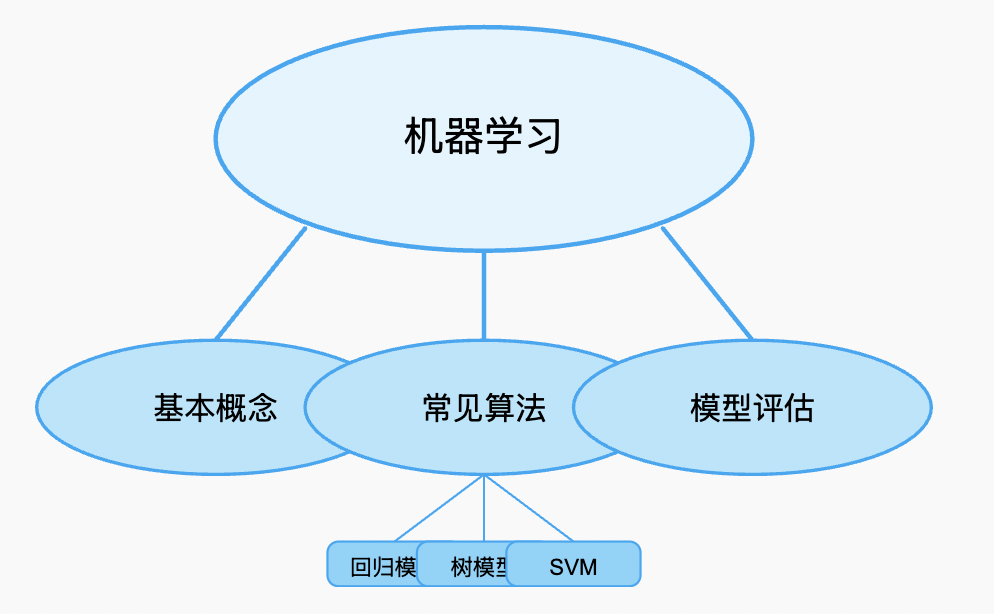
Topics Covered
-
Core Concepts
- What is machine learning? Supervised vs. unsupervised learning
- Model training, validation, and testing
-
Common Algorithms
- Linear regression, logistic regression
- Decision trees, random forests
- Support vector machines (SVM), k-nearest neighbors (KNN)
-
Model Evaluation & Tuning
- Cross-validation, confusion matrices, ROC curves
- Feature engineering and data preprocessing
Comprehensive ML tutorials: https://zglg.work/bayesian-learning-zero https://zglg.work/machine-learning-zero
3. Deep Learning Fundamentals
Dive deeper into neural networks, backpropagation, and foundational architectures—preparing you for large models.
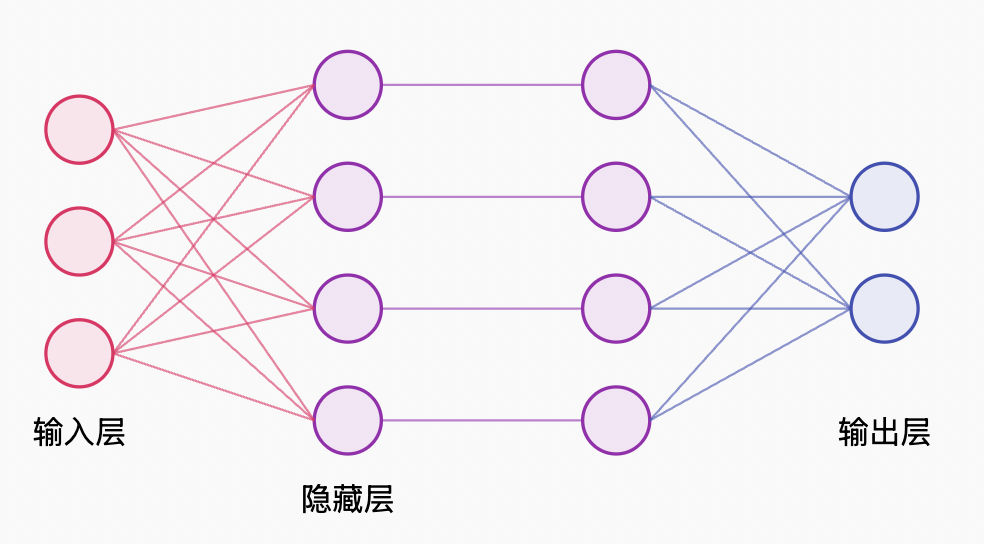
Topics Covered
-
Neural Network Basics
- Neuron structure, activation functions (ReLU, Sigmoid, Tanh)
- Forward and backward propagation
-
Common Architectures
- Multilayer perceptrons (MLP)
- Convolutional neural networks (CNN)
- Recurrent neural networks (RNN) and variants (LSTM, GRU)
-
Deep Learning Frameworks
- Getting started with PyTorch and TensorFlow
- Building, training, and evaluating simple neural networks
Deep learning course: https://zglg.work/deep-learning-zero
4. Modern Neural Architectures & the Transformer
Before entering the large-model domain, master modern architectures—especially attention mechanisms and the Transformer.
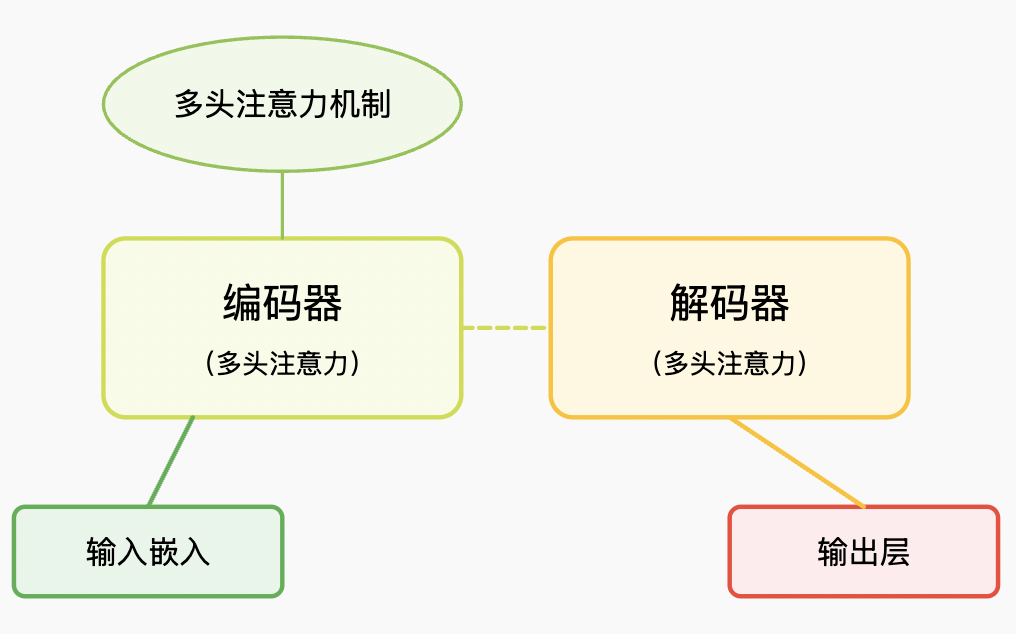
Topics Covered
-
Attention Mechanisms
- Core principles and purpose
- Common attention variants
-
The Transformer Model
- Architecture deep dive: encoder, decoder, multi-head attention
- Advantages and real-world use cases
-
Other Modern Architectures
- Autoencoders
- Generative adversarial networks (GANs)
-
Language Model Fundamentals
- Pretraining and fine-tuning concepts
- Brief introductions to GPT, BERT, T5, etc.
Tutorials covering these topics: https://zglg.work/chatgpt-principle-zero https://zglg.work/ai-30-neural-networks https://zglg.work/ai-dify-tutorial
Recommended Resources
- Paper: “Attention Is All You Need”
- Hugging Face official documentation and tutorials
- OpenAI and Google AI blog posts and technical overviews
5. Principles & Practice of AI Large Models
Now that you understand fundamentals and modern architectures, explore the core principles and training methodologies behind large models.
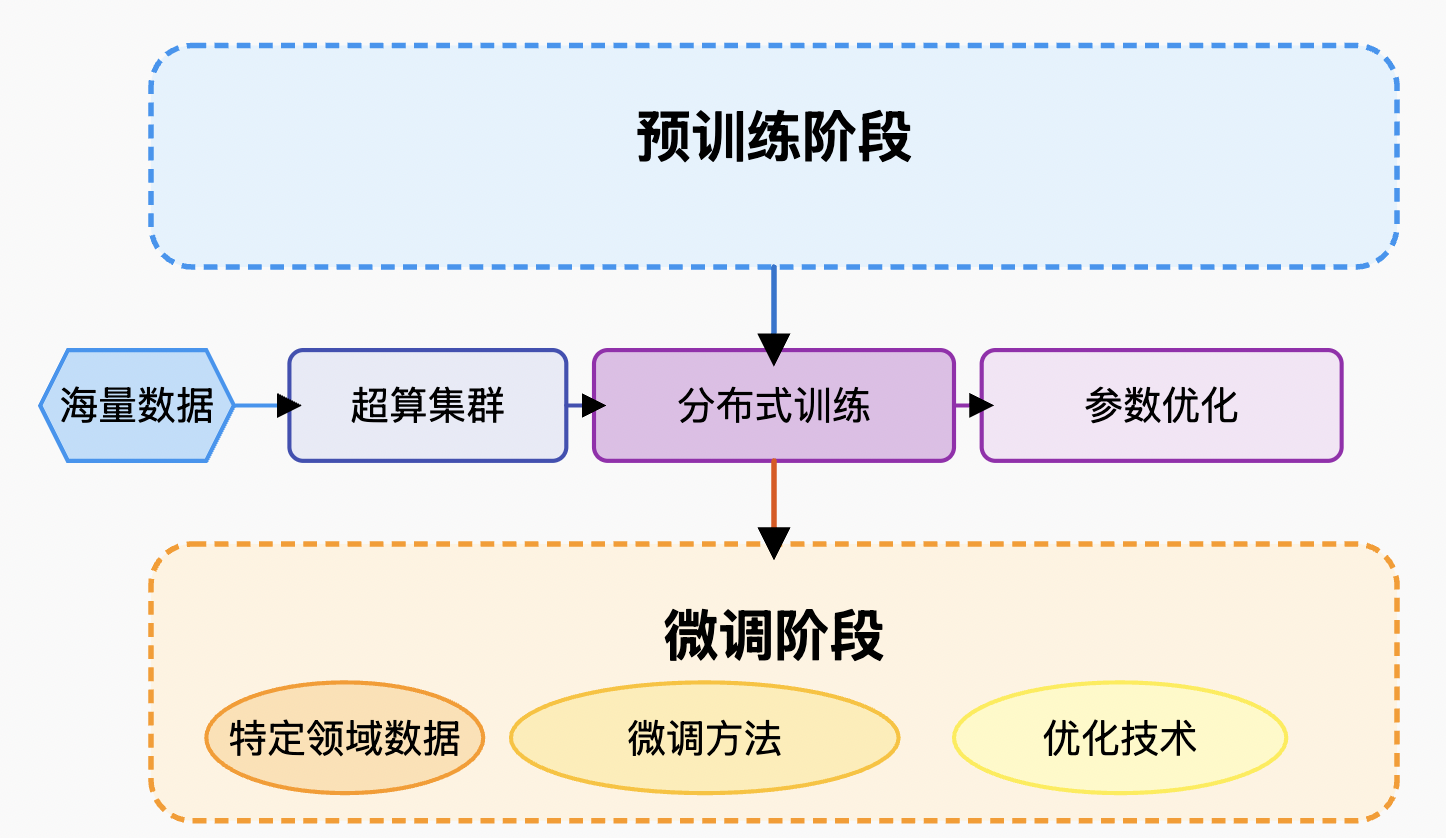
Topics Covered
-
What Are Large Models?
- Definition and rationale for massive parameter counts
- Key advantages—and challenges—in data, compute, robustness, etc.
-
Pretraining & Fine-Tuning Strategies
- Philosophy and methods behind pretraining
- Fine-tuning techniques: transfer learning, few-shot learning, prompt engineering
-
Distributed Training & Resource Optimization
- Multi-GPU/TPU training
- Mixed-precision training, model pruning, quantization
Further study: https://zglg.work/ai-news https://zglg.work/llama3-dev-zero https://zglg.work/llm-fine-tuning-tutorial
Recommended Resources
- Hands-on tutorials using Hugging Face Transformers
- OpenAI technical blogs and research papers
6. Hands-On Projects & Real-World Applications
Consolidate theory through practice—and explore how large models are applied across domains.
Project Directions
-
Natural Language Processing (NLP)
- Text generation (e.g., news articles, creative writing)
- Question-answering systems, sentiment analysis
-
Computer Vision (CV)
- Image classification and object detection
- Image generation and style transfer
-
Multimodal Applications
- Integrated systems combining text, images, and audio
- Domain-specific implementations (healthcare, finance, autonomous driving)
-
Deployment & Integration
- Model compression and edge deployment
- Building APIs and integrating models into production systems
Relevant tutorials: https://zglg.work/cv-network-tutorial https://zglg.work/nlp-zero https://zglg.work/nlp-advanced-one
7. Advanced Reading & Research Directions
Once you’ve mastered fundamentals and built practical experience, explore cutting-edge directions to stay at the forefront.
Research Frontiers
-
Model Safety & Ethics
- Data privacy, bias & fairness
- Model interpretability and robustness
-
Cross-Modal & Meta-Learning
- Unified models handling heterogeneous data types
- Self-supervised learning and meta-learning
-
Cutting-Edge Paper Reading
- Regularly read proceedings from NeurIPS, ICML, ICLR
- Track latest preprints on arXiv
Further study: https://zglg.work/ai-security-privacy-zero https://zglg.work/neuron-network-backdoor-attack https://zglg.work/neuron-network-backdoor-defense
Recommended Resources
- Conference proceedings and online seminars
- Blogs: Distill.pub, OpenAI Blog, Google AI Blog
8. Learning Advice & Summary
Learning Recommendations
-
Prioritize Hands-On Practice
- Start small—then scale up gradually to larger models
- Leverage open-source libraries and tools (e.g., Hugging Face, PyTorch) for real training
-
Stay Updated
- The field evolves rapidly—follow new papers and technical releases
- Join online communities, discussion forums, and tech meetups
-
Progress Step-by-Step
- Master fundamentals before moving forward; consult docs and references when stuck
- Reflect regularly—summarize insights and refine your knowledge map
Summary
This roadmap begins with foundational math and programming, then systematically guides you through machine learning, deep learning, Transformer architecture, and finally to large-model principles and applications. By blending theory with project-based learning, you’ll develop both conceptual clarity and practical fluency—laying a robust foundation for future research or industry work. Persistence, experimentation, and active engagement are your keys to success.
We hope this comprehensive learning roadmap helps clarify your path—and empowers you to advance confidently in the world of AI large models!
Apply This Lesson
Turn this article into AI software, model, API, and security decisions.
English Article FAQ
Use this article as evidence before choosing AI tools
How should I use this AI Tutorials article?
Use it as the implementation or learning layer, then connect the idea to AI software buyer guides, tool comparisons, benchmarks, API choices, and security checks before making a production decision.
Is this English article different from the Chinese original?
The English edition is localized for global AI readers while preserving the original diagrams, screenshots, prompts, code examples, and source context from the Chinese article.
What should I read after Zero-to-First: Beginner's Learning Path for AI Large Language Models?
Continue with AI Software Buyer Guides, AI Tools Workbench, Best AI Coding Agents, AI Model Benchmarks, OpenAI vs Anthropic API, or LLM Security Tools depending on the decision you need to make.
Can this article alone choose an AI product or model?
No. Treat the article as evidence and context, then validate fit with pricing, privacy requirements, integration effort, benchmark results, workflow tests, and fallback planning.
Continue