English translation
Integrating DeepSeek with Manus: Rapid Development That Lives Up to the Hype
AI Article Decision Snapshot
Turn the lesson into workflow, model, budget, and security checks before choosing tools.
Use this quick snapshot before leaving the article. It keeps the next search tied to practical AI software, model/API, cost, privacy, and implementation questions.
Workflow fit
Identify the real job behind the article: coding, research, document review, support, analytics, content, or internal automation.
Model or tool decision
Decide whether the next step is a software shortlist, an AI tool comparison, an API platform choice, or a model benchmark.
Budget and usage signal
Estimate seats, API calls, prompt volume, retries, review time, and fallback work before assuming the workflow is cheap.
Security and privacy review
Check whether source code, customer data, private documents, prompts, logs, or embeddings will enter the AI workflow.
Using DeepSeek with intelligent agents for development carries a common pitfall: mistaking generation speed for delivery quality. My personal workflow is to first ask the agent to draft a plan, then generate code, and finally run tests myself. The ability to auto-generate many files does not mean the output is production-ready—final validation must still rest firmly in human hands.
A great way to practice is to pick a small feature and task the agent with:
- Breaking down the task into sub-steps,
- Listing which files need modification, and
- Proposing concrete test methods.
Only accept changes that are clearly explained—never settle for vague conclusions like “everything looks fixed.”
Recently, several readers asked me about Manus: Is Manus a “better” AI than DeepSeek? Does Manus represent a genuine technical breakthrough?
This article answers these widely shared questions—using a vivid, real-world example to help you grasp what Manus truly is and how it works.
1. The Relationship Between Manus and DeepSeek
Manus is, first and foremost, an Agent—a term borrowed from reinforcement learning, where it refers to an entity capable of perceiving its environment and making intelligent decisions based on those perceptions. In recent years, as large language models (LLMs) like DeepSeek-R1 have matured, integrating them into agents has endowed those agents with far more powerful “brains.”
That’s how Manus came to be.
As shown in the screenshot above, Manus is introduced in one sentence as a general-purpose AI agent. Its relationship with DeepSeek is clear: Manus is an AI application; DeepSeek is the AI core engine. They operate at fundamentally different layers—and thus are not directly comparable.
Since Manus is a general-purpose AI agent, where exactly does its strength lie? Let’s explore this through a compelling case study.
2. Case Study: The “Mijing” (Enigma) Agent
Manus’s most powerful capability is its ability to independently plan, decompose, and execute complex tasks—unlike DeepSeek, which primarily outputs text responses, Manus delivers tangible outcomes. For instance, in interactive fiction creation, have you heard of the Mijing Agent (Enigma Agent)? It’s a highly specialized, Manus-like agent—designed specifically for narrative generation.
Today, we’ll use the Mijing Agent as our illustrative example to unpack core agent technologies. To understand agents, remember this essential truth:
An agent is, at its core, a full-cycle task executor—spanning from thinking to acting. This distinction is critical.
So let’s apply this to interactive fiction creation. A full-cycle production typically involves three fundamental steps:
- Scriptwriting (narrative design),
- Illustration (artists generating character and scene artwork based on the script), and
- Development (programmers implementing interactive logic via code).
Traditionally, completing all three steps takes ~4–6 months.
Now enter the Mijing Agent: it automates all three phases. Let’s walk through how.
To automate Step 1 (scriptwriting), the Mijing Agent integrates DeepSeek-R1. You simply input a theme—and DeepSeek-R1 begins reasoning and drafting the script. Below is a screenshot showing DeepSeek-R1 actively generating a narrative:
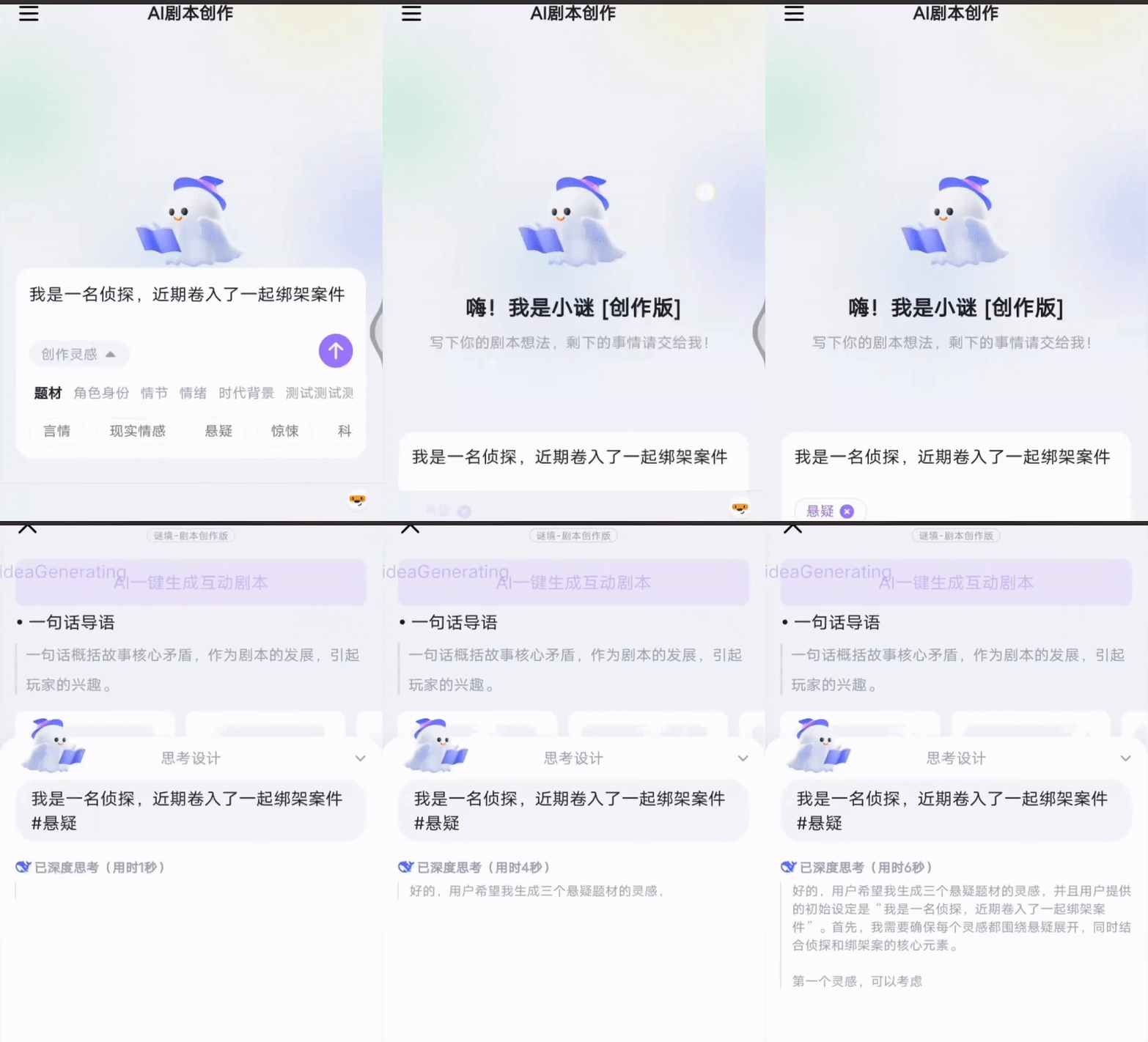
The agent can generate multiple story themes at once—here, predominantly suspense-themed concepts. While the thematic focus is interesting, what matters most is the underlying technical implementation: a typical approach uses prompt engineering, guiding the agent to produce structured output, then rendering it dynamically in the UI using frontend technologies like JavaScript:
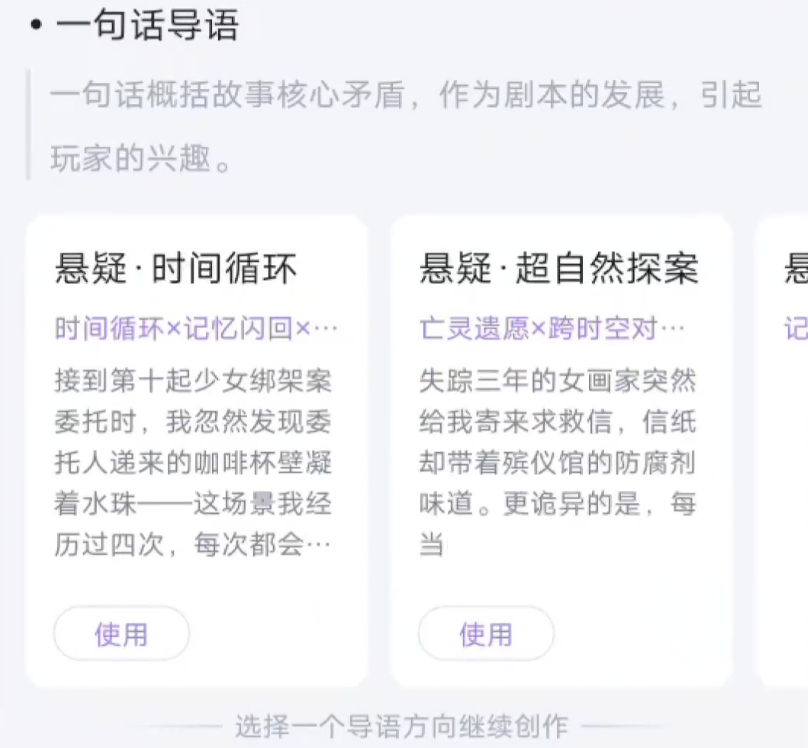
Next, the agent presents you with several opening-line options (“lead-ins”) for foundational story development. Clicking one advances you to the next step—a straightforward interaction. But as a general-purpose AI agent, Mijing learns your preferences over time. With repeated use, even this selection step becomes automated. Eventually, the agent evolves into your personalized, adaptive intelligent assistant.
Then, Mijing proceeds to generate the full story outline—and even an accompanying character relationship diagram. As shown in the GIF below, this entire process takes only minutes:

Before agents existed, crafting such an outline would take days. Now, Step 1—the script phase—is complete.
3. Mijing Agent Automates Step 2: Character & Scene Art Generation
Step 2 involves generating character portraits and scene illustrations aligned with the script. Pre-agent, this required hiring professional illustrators who manually interpreted the script. With Mijing, all coordination, handoff, and manual drawing is eliminated—the agent generates visuals directly from the script.
Below is the first storyboard frame I generated during testing. Notice how the character peers cautiously at something off-screen—immediately evoking suspense:

Next, the camera shifts indoors for character dialogue—then flips to a celebratory frontal shot. Multiple such narrative reversals occur throughout. We won’t dive into every plot detail here—but consider: How do these visual transitions map precisely to the script?
DeepSeek itself possesses strong multimodal capabilities. In late January 2024, DeepSeek released Janus-Pro-7B, a lightweight multimodal model that runs inference on a single 24GB GPU. It supports local deployment and employs a unified understanding–generation autoregressive framework, enabling precise, context-aware image–text co-generation:

Leveraging such multimodal LLMs, the Mijing Agent automatically produces accurate character designs and scene illustrations—achieving impressive fidelity.
4. Mijing Agent Automates Step 3: Interactive Story Logic
DeepSeek-R1 excels at logical reasoning—so the Mijing Agent adds an engaging interactive layer, immersing readers directly in the story.
As shown below, while unfolding the narrative, the agent automatically identifies optimal transition points to insert interactivity—ensuring each interaction remains tightly woven into the plot:

To achieve this, the agent’s design explicitly instructs DeepSeek-R1 to reason about key narrative junctures and embed interactive prompts there. Leveraging its built-in reasoning capacity, DeepSeek-R1 autonomously determines where and how to insert those interactions.
5. Summary
Agents like Manus—and specialized variants like the Mijing Agent—can only make truly intelligent, environment-responsive decisions thanks to a powerful “brain”: DeepSeek-R1.
Here, “environment” means the complex task assigned by humans—e.g., automatically generating an interactive novel, as demonstrated above. Yet automation isn’t possible without robust applications like Manus. Only when smart core models (DeepSeek) meet purpose-built agent frameworks (Manus) can we achieve high-level automation—such as Mijing’s end-to-end capabilities: ✅ Auto-generating scripts, ✅ Auto-defining characters and relationships, ✅ Auto-producing storyboards and interactive logic.
Try it yourself: https://www.ukilive.com/
Think of Manus as the “hand”—executing actions—and DeepSeek as the “brain”—reasoning and planning. Only when hand and brain work in concert can complex tasks be mastered.
Manus is Latin for “Mens et Manus”—literally, “mind and hand.”
Apply This Lesson
Turn this article into AI software, model, API, and security decisions.
English Article FAQ
Use this article as evidence before choosing AI tools
How should I use this AI Tutorials article?
Use it as the implementation or learning layer, then connect the idea to AI software buyer guides, tool comparisons, benchmarks, API choices, and security checks before making a production decision.
Is this English article different from the Chinese original?
The English edition is localized for global AI readers while preserving the original diagrams, screenshots, prompts, code examples, and source context from the Chinese article.
What should I read after Integrating DeepSeek with Manus: Rapid Development That Lives Up to the Hype?
Continue with AI Software Buyer Guides, AI Tools Workbench, Best AI Coding Agents, AI Model Benchmarks, OpenAI vs Anthropic API, or LLM Security Tools depending on the decision you need to make.
Can this article alone choose an AI product or model?
No. Treat the article as evidence and context, then validate fit with pricing, privacy requirements, integration effort, benchmark results, workflow tests, and fallback planning.
Continue