English translation
DeepSeek for Beginners: 3 Essential Concepts to Know
AI Article Decision Snapshot
Turn the lesson into workflow, model, budget, and security checks before choosing tools.
Use this quick snapshot before leaving the article. It keeps the next search tied to practical AI software, model/API, cost, privacy, and implementation questions.
Workflow fit
Identify the real job behind the article: coding, research, document review, support, analytics, content, or internal automation.
Model or tool decision
Decide whether the next step is a software shortlist, an AI tool comparison, an API platform choice, or a model benchmark.
Budget and usage signal
Estimate seats, API calls, prompt volume, retries, review time, and fallback work before assuming the workflow is cheap.
Security and privacy review
Check whether source code, customer data, private documents, prompts, logs, or embeddings will enter the AI workflow.
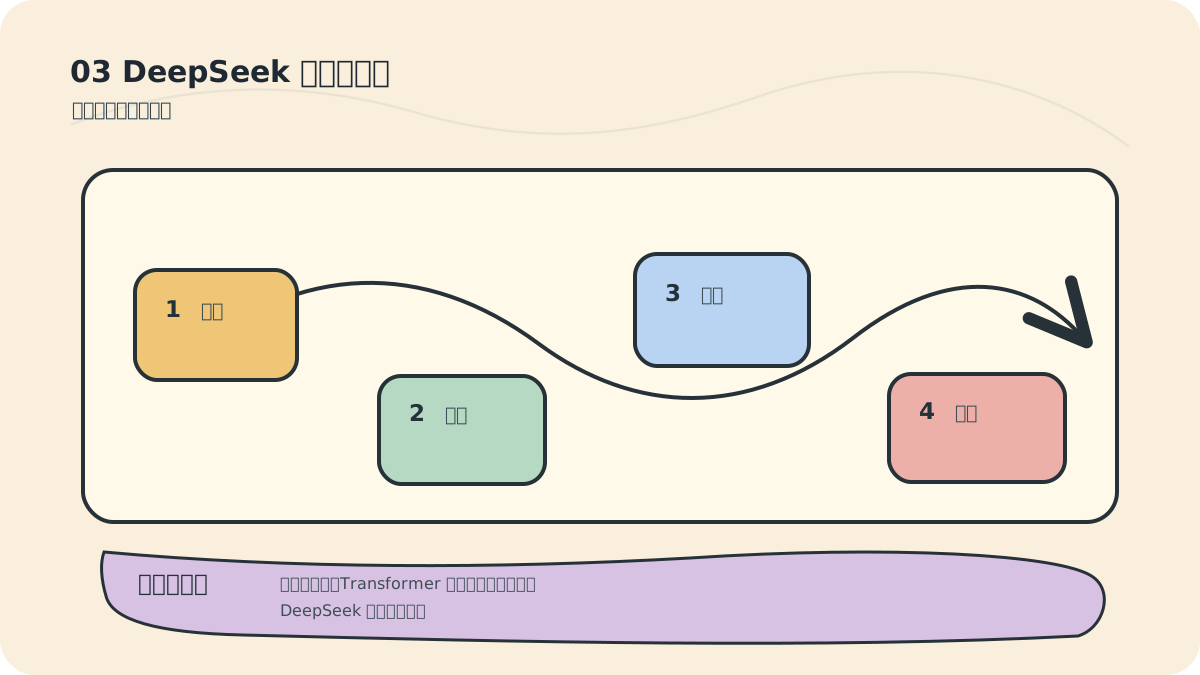
When reading foundational concepts like these, I try to connect them directly to local usage. For example, “1.5B”, “7B”, and “70B” aren’t just arbitrary numbers—they directly affect download size, memory footprint, response speed, and the upper limit of performance. Understanding this helps you choose models based on practical needs—not just names.

Treat this section as a glossary. When you encounter terms like parameters, Transformer, pretraining, SFT, or RLHF, don’t feel pressured to memorize them all at once. Instead, remember what question each one answers:
- How large is the model? → Parameters
- How does it understand context? → Transformer
- How does it learn language? → Pretraining
- How does it become more instruction-following? → SFT & RLHF
To deeply understand DeepSeek-R1, you first need solid grounding in Large Language Model (LLM) fundamentals—including how they work, their architecture, and how they’re trained.
In recent years, rapid advances in artificial intelligence (AI) have driven the rise of Large Language Models (LLMs). LLMs play an increasingly vital role in natural language processing (NLP), powering applications such as intelligent Q&A systems, text generation, code writing, and machine translation. An LLM is a deep learning–based AI model whose core objective is to understand and generate natural language by predicting the next word in a sequence. Training an LLM requires massive amounts of textual data, enabling it to capture complex linguistic patterns and generalize across diverse tasks.
Let’s begin with foundational concepts.
Core LLM Concepts
Model Parameters
You’ll often see identifiers like deepseek-r1:1.5b, qwen:7b, or llama:8b. What do the numbers—1.5b, 7b, 8b—mean? The suffix b stands for billion. So 7b means 7 billion, and 8b means 8 billion. These figures represent the total number of trainable parameters (weights + biases) in the model. Modern LLMs are built upon the Transformer architecture, composed of multiple stacked Transformer layers and fully connected layers—and their parameter counts can range from 7 billion, 8 billion, up to hundreds of billions.
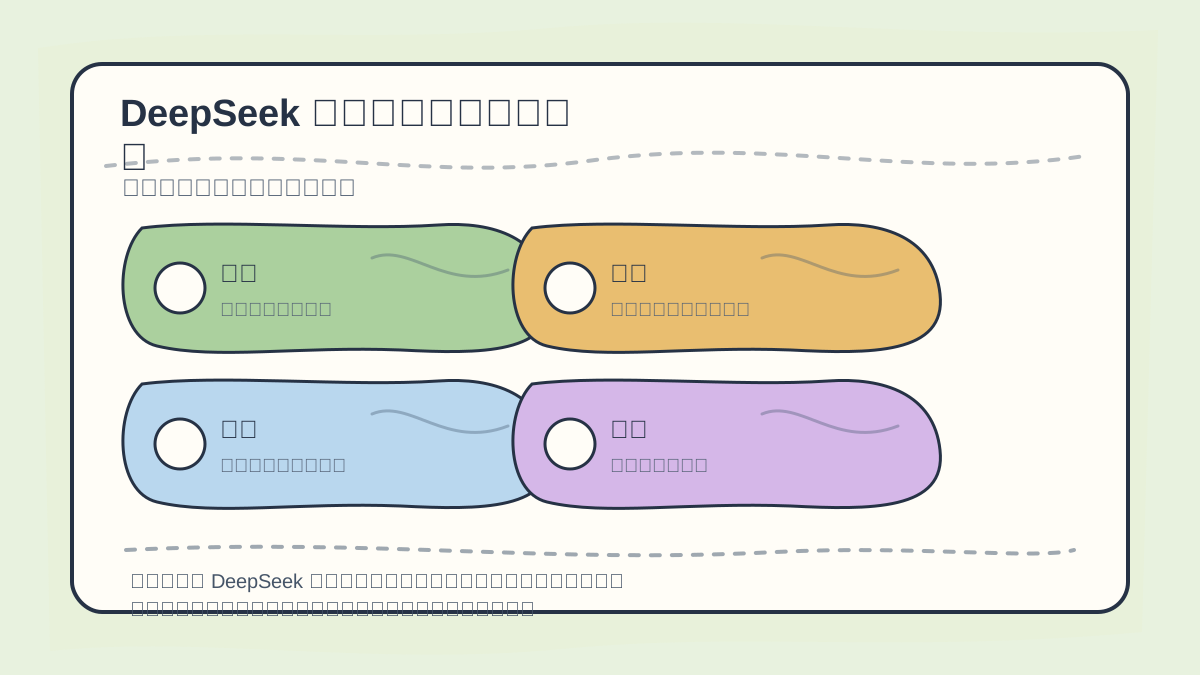
If you’re new to DeepSeek, start by confirming three basics: you can ask questions successfully, understand responses clearly, and save your experimentation notes. Only then gradually progress to local deployment and document processing. A clear learning sequence minimizes rework.
Greater Generality LLMs differ fundamentally from models trained on narrow, domain-specific datasets (e.g., ImageNet or 20Newsgroups). One key distinction is that LLMs are far more general-purpose: they’re trained on vast, heterogeneous corpora spanning countless domains and tasks. This broad exposure endows them with strong knowledge transfer capabilities and multi-task proficiency—giving rise to their hallmark trait: “knowing something about everything.” In contrast, models trained on single-dataset benchmarks tend to be highly specialized, with knowledge confined strictly to that dataset—and thus limited in real-world applicability.
Scaling Laws You’ve likely encountered Scaling Laws frequently. One core reason LLMs succeed—learning effectively from massive, diverse datasets—is precisely because of Scaling Laws and the architectural advantages of modern models. Scaling Laws state: more parameters → stronger learning capacity; larger and more diverse training data → greater generality; even noisy data can yield robust, generalizable knowledge when scaled appropriately. The Transformer architecture is uniquely suited to leverage these laws—it’s the optimal neural structure for scalable, high-performance language modeling.
Transformer Architecture Fundamentals
LLMs rely on the Transformer, introduced by Google in 2017. Compared to traditional RNNs (Recurrent Neural Networks) and LSTMs (Long Short-Term Memory networks), Transformers offer significantly higher training efficiency and superior long-range dependency modeling. Key components include:
- Self-Attention Mechanism: Enables the model to dynamically focus on salient words within a sentence and infer semantic relationships between tokens.
- Multi-Head Attention: Uses multiple parallel attention “heads” to jointly capture distinct types of semantic information—enhancing overall comprehension.
- Feed-Forward Network (FFN): Applies non-linear transformations to boost expressive power.
- Positional Encoding: Injects sequential order information into token representations—critical since Transformers lack inherent recurrence or ordering.
Advantages of the Transformer Architecture
- Highly Parallelizable Computation: Eliminates sequential dependencies, dramatically accelerating training and inference.
- Superior Context Modeling: Attention mechanisms capture long-range dependencies across lengthy texts.
- Excellent Scalability: Designed to scale smoothly—from small models to trillion-parameter systems—boosting AI generalization.
Core LLM Training Methods
Pretraining
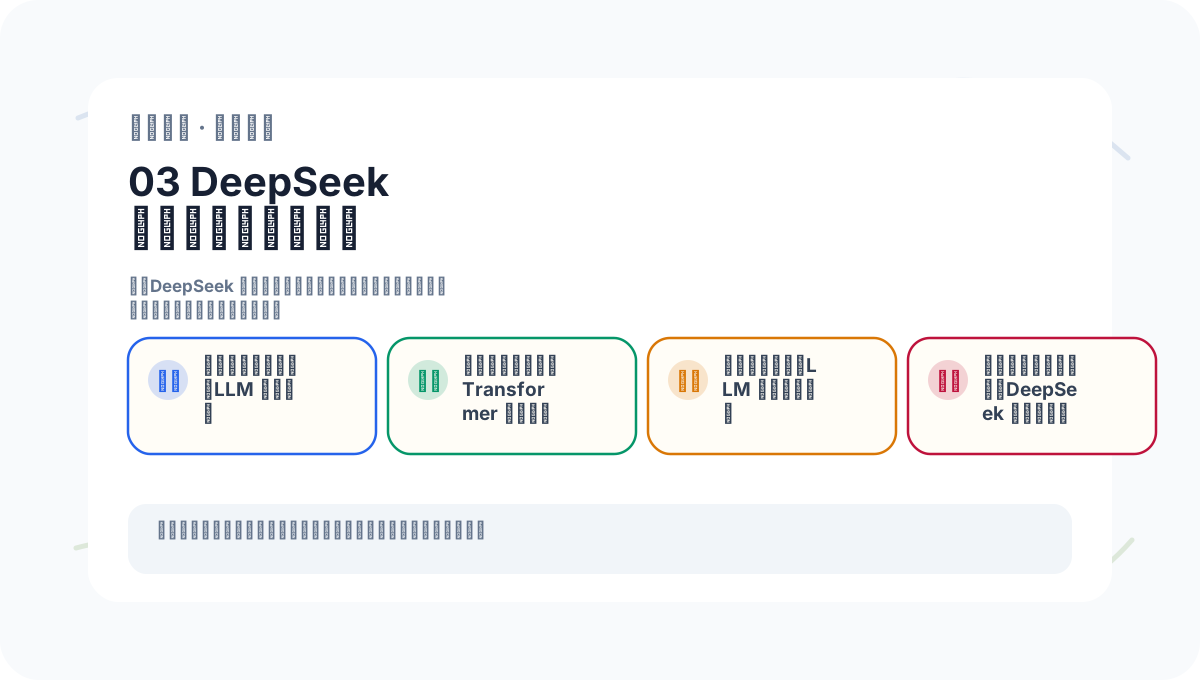
When reviewing DeepSeek: Essential Knowledge for Absolute Beginners, avoid jumping straight into large projects. First, test the core workflow using a simple, concrete example—just to verify clarity of the main thread.
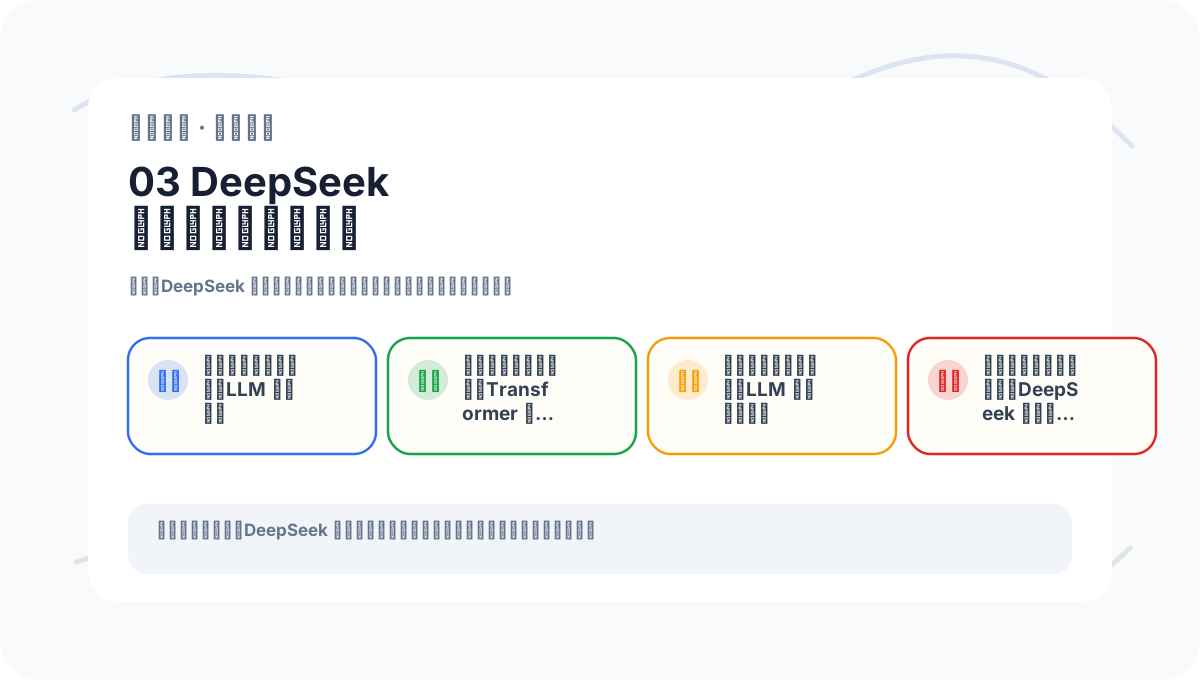
If DeepSeek: Essential Knowledge for Absolute Beginners hasn’t yet fully clicked, revisit this card’s four actions step-by-step.
LLM training typically begins with large-scale unsupervised learning:
- Gather massive volumes of raw text from the web—books, news articles, social media posts, etc.
- Train the model to predict the next token, implicitly learning grammar, facts, reasoning patterns, and stylistic conventions.
- Optimize for minimal prediction loss—i.e., maximize likelihood of generating correct continuations.
Supervised Fine-Tuning (SFT)
After pretraining, models usually undergo Supervised Fine-Tuning (SFT): using carefully curated, human-annotated datasets to adapt the model to specific downstream tasks—such as question answering or dialogue generation—and align its behavior more closely with human expectations.
Reinforcement Learning (RL)
Finally, many state-of-the-art LLMs apply Reinforcement Learning (RL)—specifically Reinforcement Learning from Human Feedback (RLHF)—to further refine outputs:
RLHF Optimization Process
- Step 1: Human annotators provide high-quality reference responses.
- Step 2: The model learns implicit human preferences (e.g., helpfulness, truthfulness, conciseness) by comparing its outputs against those references.
- Step 3: Policy optimization via reinforcement learning improves alignment—making generated text more consistent with human values and intent.
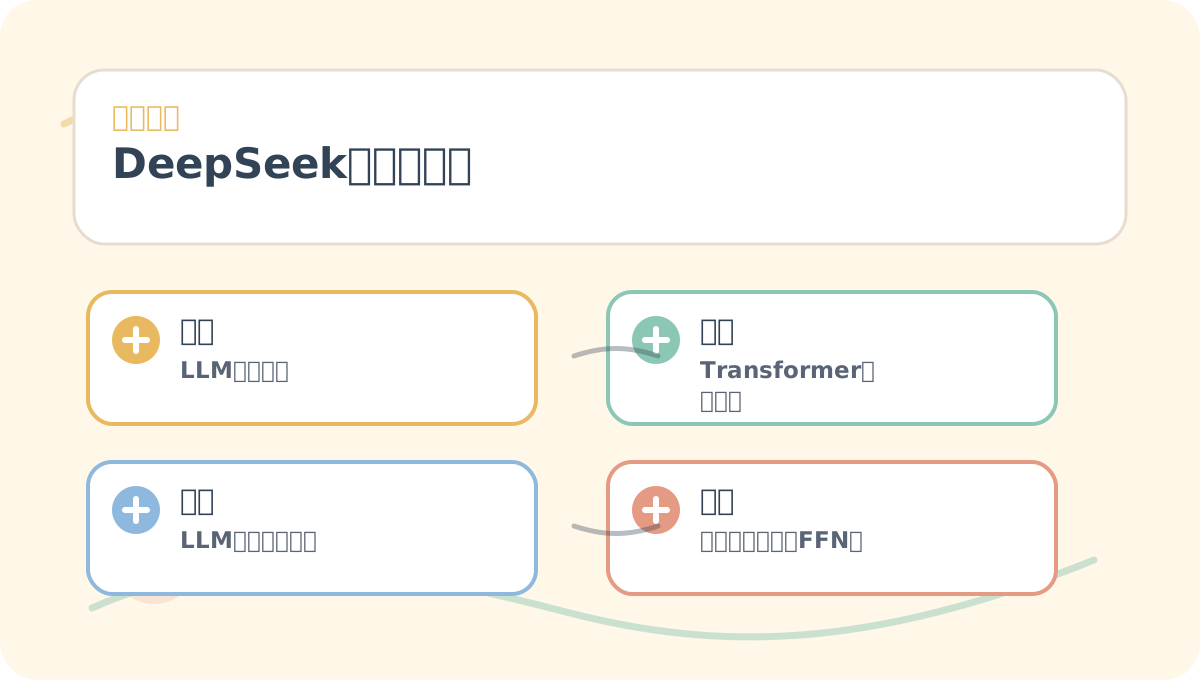
Don’t stop at “I understood” after reading DeepSeek: Essential Knowledge for Absolute Beginners. Pick one step—try implementing it hands-on. Then document exactly where you got stuck. That grounded practice makes future learning far more stable and effective.
Apply This Lesson
Turn this article into AI software, model, API, and security decisions.
English Article FAQ
Use this article as evidence before choosing AI tools
How should I use this AI Tutorials article?
Use it as the implementation or learning layer, then connect the idea to AI software buyer guides, tool comparisons, benchmarks, API choices, and security checks before making a production decision.
Is this English article different from the Chinese original?
The English edition is localized for global AI readers while preserving the original diagrams, screenshots, prompts, code examples, and source context from the Chinese article.
What should I read after DeepSeek for Beginners: 3 Essential Concepts to Know?
Continue with AI Software Buyer Guides, AI Tools Workbench, Best AI Coding Agents, AI Model Benchmarks, OpenAI vs Anthropic API, or LLM Security Tools depending on the decision you need to make.
Can this article alone choose an AI product or model?
No. Treat the article as evidence and context, then validate fit with pricing, privacy requirements, integration effort, benchmark results, workflow tests, and fallback planning.
Continue