English translation
DeepSeekMine Lite: Lightweight, Portable Version Launching Soon
AI Article Decision Snapshot
Turn the lesson into workflow, model, budget, and security checks before choosing tools.
Use this quick snapshot before leaving the article. It keeps the next search tied to practical AI software, model/API, cost, privacy, and implementation questions.
Workflow fit
Identify the real job behind the article: coding, research, document review, support, analytics, content, or internal automation.
Model or tool decision
Decide whether the next step is a software shortlist, an AI tool comparison, an API platform choice, or a model benchmark.
Budget and usage signal
Estimate seats, API calls, prompt volume, retries, review time, and fallback work before assuming the workflow is cheap.
Security and privacy review
Check whether source code, customer data, private documents, prompts, logs, or embeddings will enter the AI workflow.
When testing the portable version, you can run it from a fresh new directory, then switch to another directory and verify whether configurations and knowledge bases remain accessible. This test helps uncover hardcoded path issues early.
Recently, we’ve received many user messages about personal knowledge bases and DeepSeekMine usage.
After several days of investigation, we’re sharing our findings on the most common concerns and challenges users have reported. Feel free to read on if this interests you.
1. Software Fails to Launch
Some users encounter the following issue: DeepSeekMine fails to start.
Over the past two weeks, we’ve prioritized investigating this problem—common in private deployments—and identified four primary root causes:
- Firewall misconfiguration: The firewall is disabled or improperly configured, preventing DeepSeekMine from launching.
- Antivirus interference: Security software blocks DeepSeekMine execution.
- Incorrect installation scope: Selecting “Install for all users” during setup may prevent required dependencies from loading properly.
- Conflicts with locally installed Python environments: Existing Python installations interfere with DeepSeekMine’s bundled runtime.
Although we conduct thorough internal testing before each release, launch failures still occasionally occur post-release.
Hence, a definitive solution is essential.
Our research confirms that Docker-based private deployment is the optimal solution.
Why Docker is the best choice:
- Docker provides a fully isolated runtime environment, eliminating dependency on local Python setups, avoiding antivirus interference, and preventing conflicts with system libraries or ports. All dependencies are baked into the image—enabling true “build once, run anywhere.”
- Compared to traditional manual installation, Docker offers near-“zero-configuration” deployment—ideal for non-technical users.
- With Docker, upgrades reduce to a simple
docker pullcommand—no more repeated manual downloads of installers. Updates are atomic and guarantee zero impact on existing data, ensuring stable, predictable deployments. - Native support across all three major operating systems:
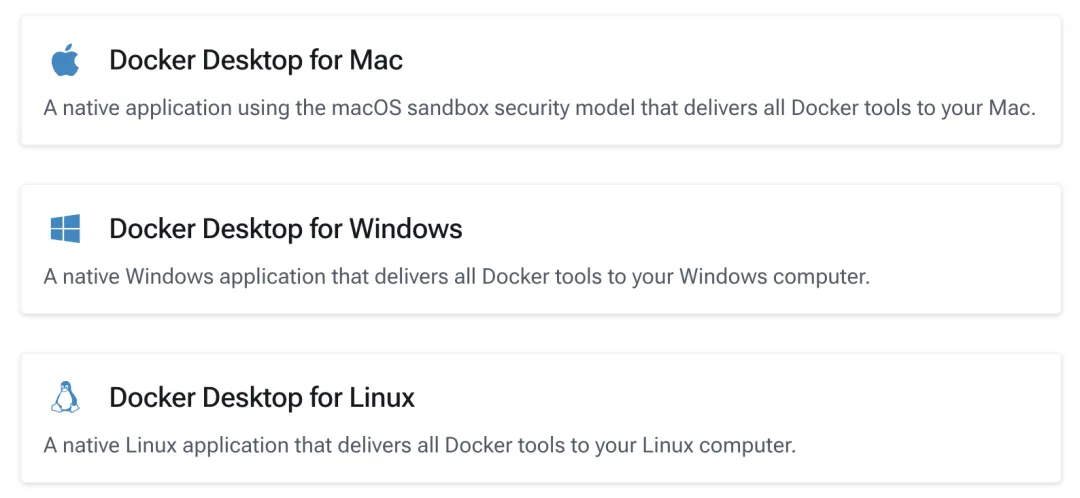
Given these four compelling advantages, we will soon release an official Docker deployment package—confidently resolving the DeepSeekMine launch failure issue once and for all.
2. Slow Installation Process
Users also report that installation takes ~2 minutes and hope for faster setup.
Starting with DeepSeekMine-V6, semantic vector computation is built-in—significantly increasing installation time.
3. Rapid Loading of 500 GB Files
Some users want to ingest 500 GB of documents quickly into their knowledge base:
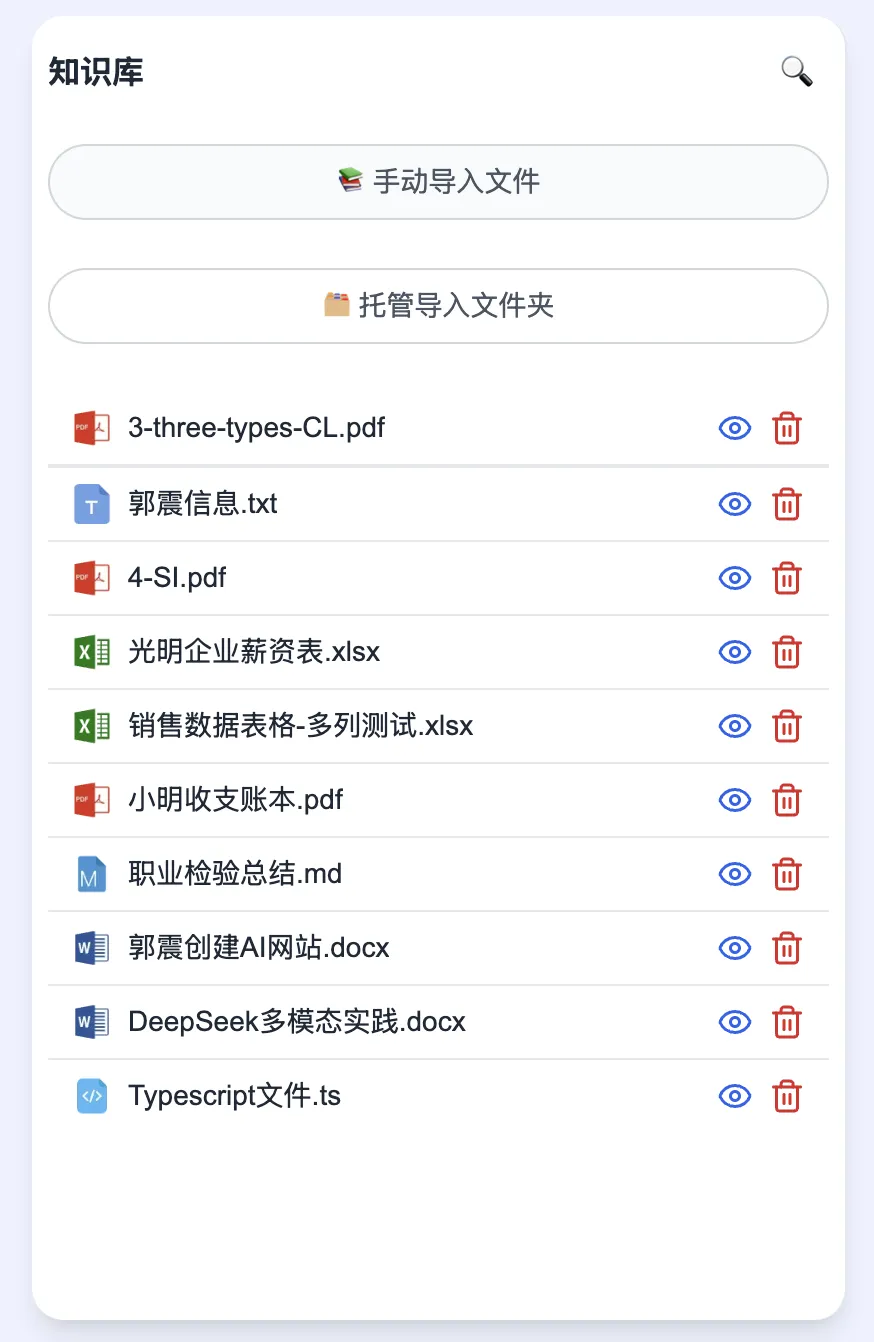
Currently, the most capable remote knowledge base—IMA—supports up to only 2 GB per ingestion. Feeding 500 GB into IMA is impossible; thus, users request native support for large-scale file ingestion (>500 GB).
4. RAG Accuracy Still Lags
Regarding RAG accuracy, some users report that DeepSeekMine-V6.1 appears less accurate than V6.
Here’s our unified explanation: In certain cases, accuracy did regress slightly—intentionally—to improve Excel-specific query precision. This optimization inadvertently impacted general document retrieval performance.
5. Lightweight Portable Edition Coming Soon
To address points #2–#4 above, we’ve designed a comprehensive solution over the past few days—and will soon release the DeepSeekMine Lightweight Portable Edition. The professional edition remains under active development: both versions will evolve in parallel.
The lightweight portable edition delivers four key “fast” capabilities: ✅ Fast installation ✅ Fast startup ✅ Fast file loading ✅ Fast query response …while maintaining sufficient accuracy for everyday use.
To achieve these four “fast” goals, the underlying technical architecture includes:
- Meilisearch — high-performance RAG engine
- Chunking module
- Question keyword extraction
- Keyword enhancement (e.g., multi-turn keyword fusion, synonym embedding)
- BM25-based ranking of matched text chunks
Technical architecture diagram:
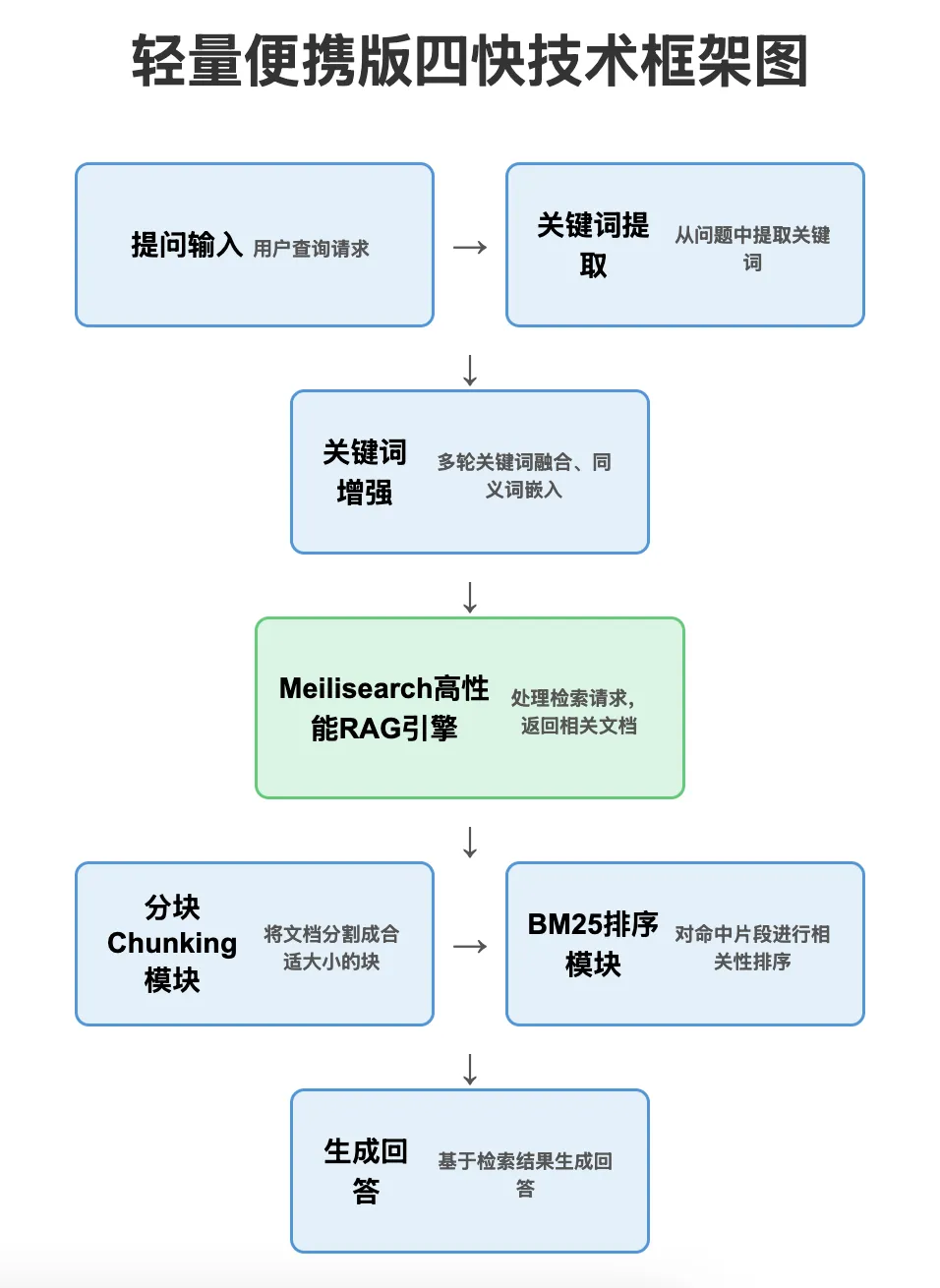
This “four-fast” framework intentionally omits semantic vector embedding—primarily because typical local PCs lack sufficient compute resources. Adding vector embeddings would increase computational overhead without delivering proportionate accuracy gains. Thus, the lightweight portable edition excludes embedding entirely.
So how do we compensate for the accuracy loss from omitting vectors?
Our research identified lightRAG, a RAG framework developed by Beijing University of Posts and Telecommunications and others, which leverages knowledge graph techniques to extract hierarchical entities and relationships. The integrated architecture looks like this:
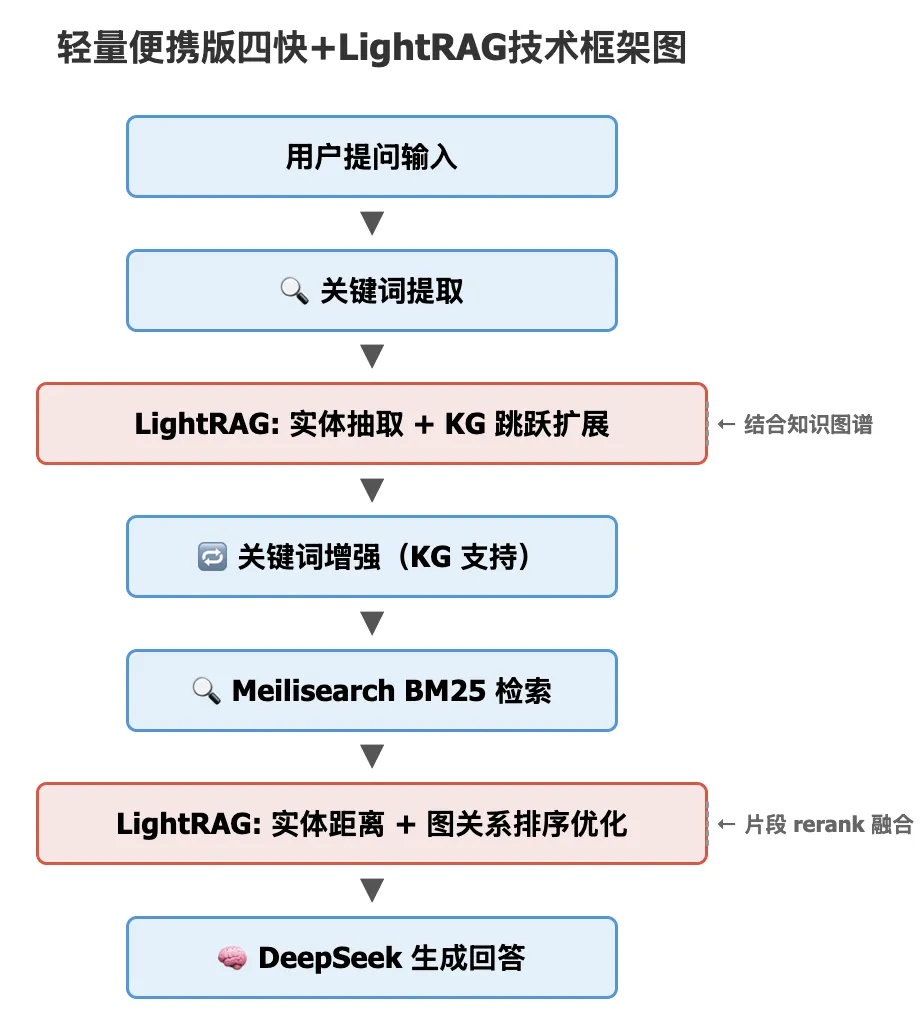
Why does lightRAG compensate for missing vector semantics?
lightRAG doesn’t rely on semantic vectors at all—it achieves “structured semantic enhancement” via knowledge graphs. As such, it integrates naturally with Meilisearch + chunking + BM25 pipelines.
The resulting hybrid architecture eliminates expensive vector computations entirely—making it ideal for lightweight, local, GPU-free deployments and perfectly suited for offline scenarios. During implementation, we’ll prioritize efficient, high-fidelity integration.
We’re committed to delivering this update promptly—without compromising quality—and will share it with you as soon as possible, aiming to meaningfully boost your productivity in both work and study.
Summary
This article highlights three core takeaways:
The portable edition’s mobility is convenient—but may cause users to overlook data location. While the application can be lightweight, data must never be lost. Before release, we’ll clearly document default data directories, backup procedures, and upgrade-overwrite rules.
1) Launch failures will be fully resolved via Docker private deployment
DeepSeekMine’s historical startup issues will be eliminated by the upcoming Docker installer—delivering true “build once, run anywhere,” greater stability, broader compatibility, and simplified maintenance.
2) A lightweight portable edition—focused on speed and practicality—is imminent
We’re developing a streamlined edition optimized for fast installation, fast startup, fast file loading, and fast querying, especially tailored for resource-constrained local devices.
3) lightRAG knowledge-graph enhancement replaces vector embeddings—preserving semantic capability without the cost
The new edition abandons vector embeddings entirely and instead integrates the lightRAG framework—using structured entity-relation modeling to restore semantic richness. This balances lightweight deployment with robust RAG accuracy.
If you’d like to apply “DeepSeekMine Lightweight Portable Edition — Coming Soon” to your own workflow, begin by narrowing the scope—focus first on validating just one critical decision point.
Apply This Lesson
Turn this article into AI software, model, API, and security decisions.
English Article FAQ
Use this article as evidence before choosing AI tools
How should I use this AI Tutorials article?
Use it as the implementation or learning layer, then connect the idea to AI software buyer guides, tool comparisons, benchmarks, API choices, and security checks before making a production decision.
Is this English article different from the Chinese original?
The English edition is localized for global AI readers while preserving the original diagrams, screenshots, prompts, code examples, and source context from the Chinese article.
What should I read after DeepSeekMine Lite: Lightweight, Portable Version Launching Soon?
Continue with AI Software Buyer Guides, AI Tools Workbench, Best AI Coding Agents, AI Model Benchmarks, OpenAI vs Anthropic API, or LLM Security Tools depending on the decision you need to make.
Can this article alone choose an AI product or model?
No. Treat the article as evidence and context, then validate fit with pricing, privacy requirements, integration effort, benchmark results, workflow tests, and fallback planning.
Continue